
Office park automatic doors for landlords and managing agents: who owns which entrance, the access states a working week needs, the morning peak that sizes the lobby, standardising across an estate, and why maintenance recovery changes the contract.
Automatic Doors for Business: Seven Demanding Settings
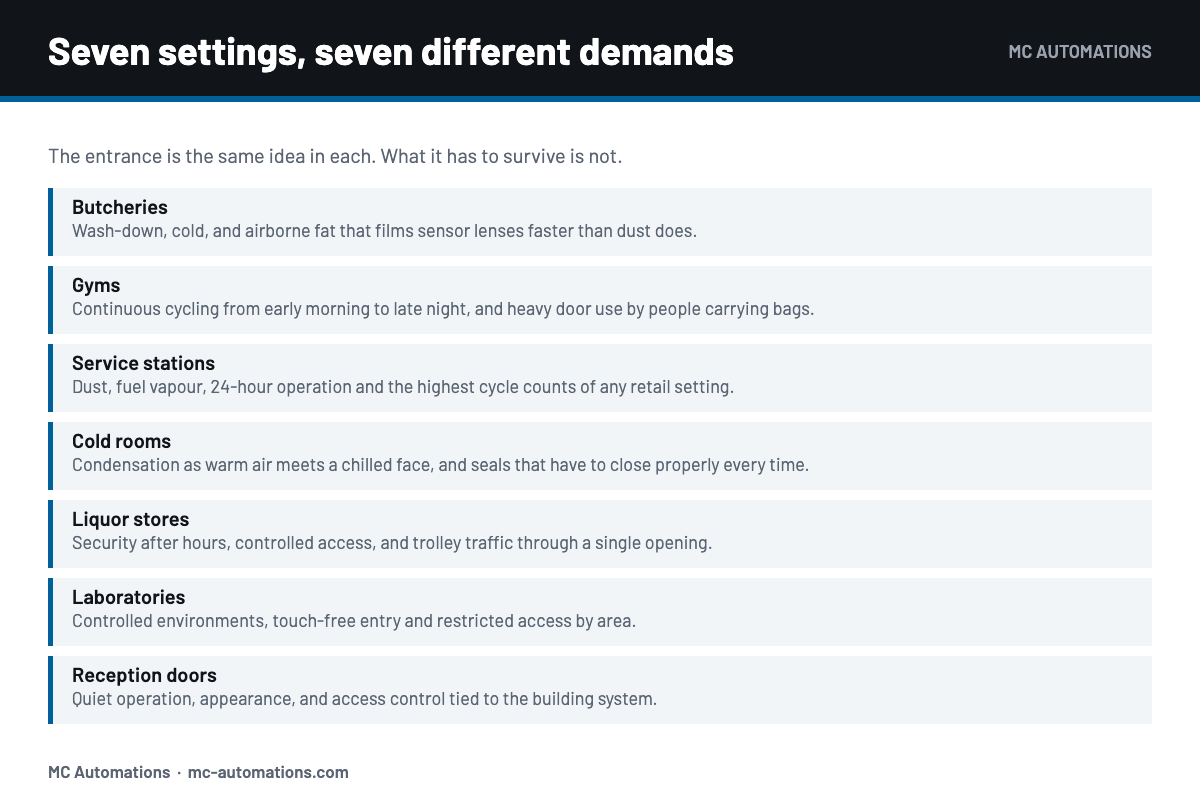
Automatic doors for business premises get specified as though every entrance is the same problem. They are not. A butchery, a gym, a service station, a cold room, a liquor store, a laboratory and a corporate reception can all take an opening of identical size and need genuinely different equipment behind it.
This guide covers those seven settings, because between them they account for most of the enquiries we get that do not fit the usual retail or hospital pattern.
Automatic doors for business: butcheries
The problem in a butchery is not traffic, it is what is in the air.
Airborne fat settles on sensor lenses and films them far faster than ordinary dust does, and to a sensor a filmed lens looks like a permanent target. That is why butchery entrances tend to develop doors that sit open rather than doors that will not open.
Wash-down is the second factor. Water into the header or onto an unsealed cable entry causes faults that look electrical and are actually plumbing.
Sliding is almost always right here, because nothing swings through a wet working area, and because seals close cleanly against a frame rather than relying on a hinge.
Automatic doors for business: gyms
Gyms are a duty rating problem disguised as a small entrance.
A 24-hour or early-till-late facility cycles its front door constantly, and members arrive carrying bags, bottles and mats. Hands-free entry is worth more here than in most retail.
Specify the operator for the cycle count rather than the opening width, and budget a service interval closer to retail than to office.
Multi-tenant buildings add a question single-occupier offices do not have: who owns the entrance. Our guide to office park automatic doors covers landlord and tenant scope, access states and standardising across an estate.
Automatic doors for business: service stations
Forecourt shops run the highest cycle counts we see in retail, often 24 hours a day, in the dustiest environment of the seven.
Dust and fuel vapour film sensor optics gradually rather than suddenly, so the entrance degrades over weeks and the staff stop noticing. Shorter service intervals are not an upsell here, they are the difference between a door that lasts and one that does not.
Automatic doors for business: cold rooms

Condensation is the whole story. Warm air meeting a chilled surface puts moisture on lenses and seals, and a chilled lens behaves exactly like a dirty one.
Seals matter more here than anywhere else, because a door that does not close fully is costing refrigeration continuously rather than occasionally.
Tell us the temperature range and the humidity when you enquire. Specifying a cold environment afterwards means re-siting sensors that are already installed.
Automatic doors for business: liquor stores
Two requirements pull in opposite directions: easy trolley access during trading, and a secure opening overnight.
That is a mode switching and locking question, and it needs a clear answer on what the entrance does during a power failure. An entrance that fails open is a security problem; one that fails locked on an escape route is a safety problem.
Automatic doors for business: laboratories
Touch-free entry and controlled access by area are the usual brief, often tied into the building access control system.
Where a genuine pressure differential has to be maintained between spaces, a standard slider will not do it and a hermetically sealed door is the correct answer.
Automatic doors for business: reception doors
Reception is the one setting in the seven where appearance genuinely competes with duty rating.
Quiet running matters, cycle counts are usually modest, and access control integration is normally part of the specification from the start. Where the opening is narrow, an automatic swing door is often better value than a slider.
Which door type suits which setting

Sliding dominates six of the seven, for the same reason it dominates commercial entrances generally: nothing sweeps through the path of people walking in.
Swing earns its place on narrow reception and service openings. Hermetic is a laboratory and clinical answer rather than a general one.
The sensor is the part that complains first
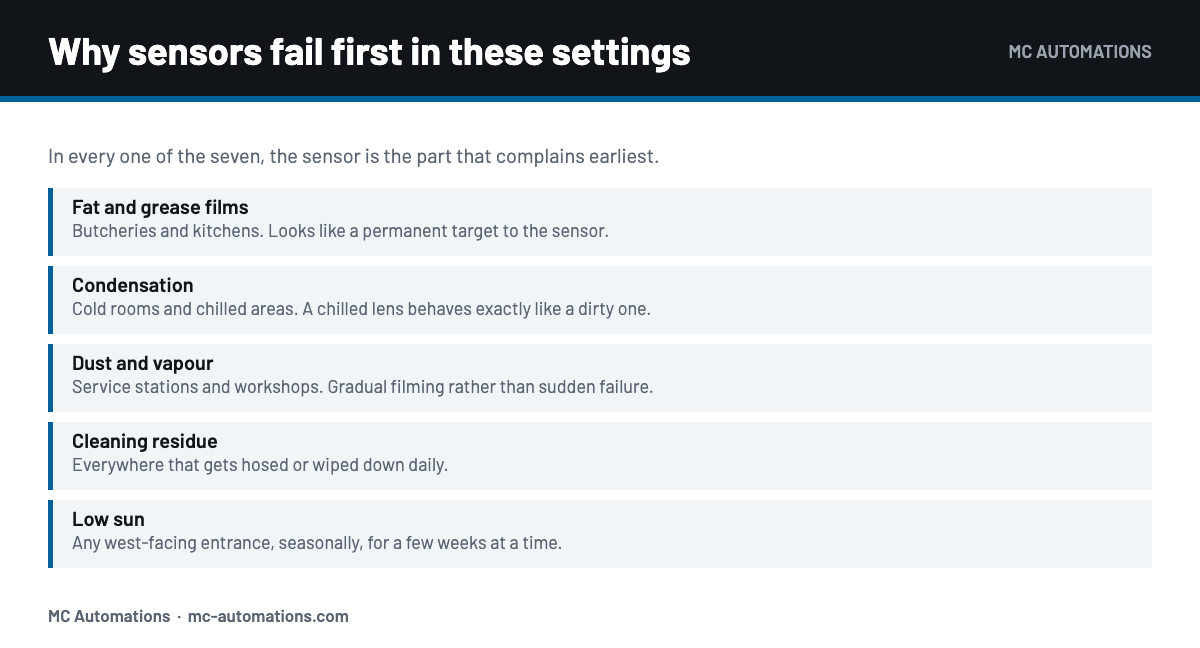
In all seven settings, the sensor is the earliest warning and the most common call-out.
Fat films, condensation, dust, fuel vapour and daily cleaning residue all do the same thing: they make the lens report a target that is not there, or stop it seeing one that is.
Cleaning lenses with a soft cloth and walk-testing the full opening width is the highest-value routine task in any of these buildings. See how automatic door sensors work and automatic door sensor not working.
Specifying for a demanding environment
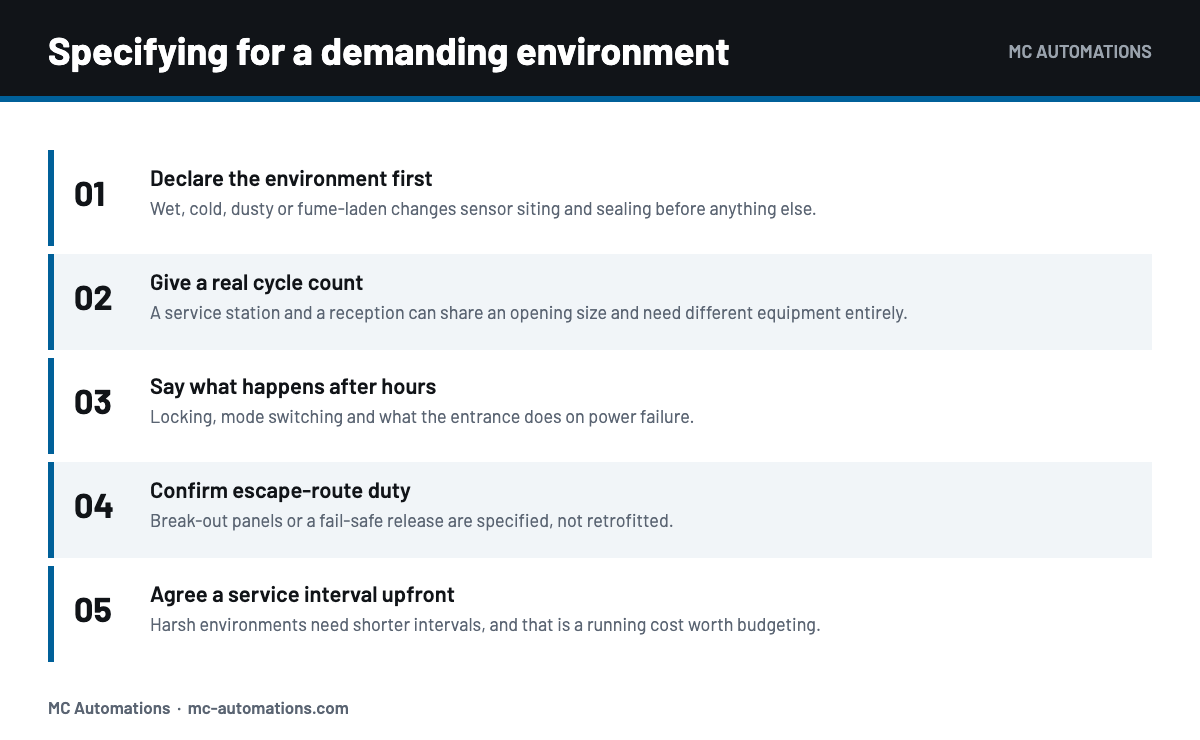
Declare the environment first. Wet, cold, dusty or fume-laden changes sensor siting and sealing before anything else is decided.
Then give a real cycle count. Then say what the entrance must do after hours, and whether it forms part of a fire escape route.
Then agree a service interval at the start rather than discovering it after the first failure. In harsh environments that interval is shorter, and it is a running cost worth budgeting honestly.
Sectors we already cover elsewhere
Retail shopfronts, shopping centres and healthcare have their own guides: automatic doors for shops, shopping centre automatic doors and hospital automatic doors.
What to send us
Structural opening size in millimetres, a photograph from inside and outside, rough daily cycles, the environment, whether the opening is on an escape route, and whether we can work in normal hours.
Request a quote or call 010 412 0062, Monday to Thursday 08:00 to 16:30 and Friday 08:00 to 14:00. We supply, install and service across South Africa, on our own operators and on other manufacturers equipment.
For published national standards, SABS, the South African Bureau of Standards is the reference body in South Africa.
Choosing automatic doors for business: the common thread
Across all seven settings the same four questions decide the specification, and they are worth asking in this order.
How many cycles a day? This sets duty rating, and it is the question most often skipped. Automatic doors for business premises fail early far more often from under-rating than from poor build.
What is in the air and on the floor? Fat, water, dust, vapour or condensation each change sensor siting and sealing.
What happens after hours? Locking, mode switching, and behaviour on power failure.
Is it an escape route? If yes, the opening must be passable without power, through break-out panels or a fail-safe release.
Answer those four and the equipment choice largely makes itself.
Running costs differ more than purchase price
Two identical entrances, one in a reception and one on a forecourt, will not cost the same to own even if they cost the same to buy.
The forecourt door cycles many times more often, in a dirtier environment, so it consumes rollers and belts faster and needs attention more often. That is not a fault, it is the job.
Where businesses get caught is budgeting the purchase and not the upkeep. When you are comparing automatic doors for business use, ask what the service interval should be in your environment, and put that number in the budget alongside the installation.
See automatic door installation cost for what moves the initial figure.
Standardising across multiple sites
If you run several premises, the cheapest estate is rarely the one where each site bought the cheapest door.
One operator family across the portfolio means one set of spares, one set of settings your staff recognise, and a technician who does not spend the first visit diagnosing which generation of equipment they are looking at.
Mixed estates multiply both the spares holding and the failure modes. That is worth deciding deliberately rather than letting it accumulate site by site.
Practical things staff can do
In every one of these seven settings, two routine tasks prevent most call-outs.
Vacuum the bottom track. Grit is abrasive and it is doing damage on every cycle, and in butcheries, forecourts and cold rooms the track fills far faster than in a dry shop.
Wipe the sensor lenses with a soft cloth, not a solvent, and then walk through the full width of the opening rather than just the middle. That single check catches most developing faults weeks before they become failures.
Servicing and support
We service what we install and we also take on other manufacturers equipment, including brands whose local support has closed.
See automatic door servicing, automatic door repairs and automatic door spare parts. Sites that cannot afford downtime should look at a service level agreement.
Automatic doors for business: sector quick reference
Butcheries. Automatic doors for business use in wet, cold, fat-laden air need sealed cable entries and sensors out of the spray line.
Gyms. Automatic doors for business premises cycling from dawn to late night are a duty rating decision, not a width decision.
Service stations. The hardest environment of the seven for automatic doors for business use: highest cycles, dust and fuel vapour.
Cold rooms. Condensation decides everything. Declare the temperature range before automatic doors for business use are specified.
Liquor stores. Automatic doors for business security need mode switching, locking and a clear power-failure plan.
Laboratories. Touch-free entry and zoned access. Where pressure must be held, hermetic rather than sliding.
Receptions. The one setting where appearance competes with duty rating, and where swing often beats sliding.
Across all seven, automatic doors for business premises are specified from cycles, environment, after-hours behaviour and escape-route duty. Everything else follows.
Not sure which applies? Send the opening size, a photograph and a description of the environment, and we will tell you what we would fit.
Why we wrote this as one guide
Most advice on automatic doors for business premises is written for a shopfront and then applied everywhere else by default.
That is how a forecourt shop ends up with a reception-grade operator, and how a cold room ends up with sensors sited as though the air were dry. Both are specification failures rather than product failures, and both are avoidable in a five-minute conversation.
The seven settings here share one thing: the environment, not the opening, is what makes them difficult. Automatic doors for business use in a butchery and in a boardroom reception are the same technology answering very different problems.
If your premises are not on this list, the four questions still apply. Cycles, environment, after-hours behaviour and escape-route duty will specify automatic doors for business use in almost any building.
What the building itself decides
Two features of a building change the specification of automatic doors for business more than the trade it houses: how the air moves, and how many openings there are.
A tall building with one entrance at ground level develops stack pressure, as warm air rising through the core draws replacement air in at the bottom. The leaves feel it as a constant push. A building with entrances on opposite elevations develops a through-draught whenever both are open. Exposed and coastal sites add wind on top. The symptoms are always the same and always misread: automatic doors for business that open slowly, stop part-way, or report an obstruction nobody can see, and which behave perfectly on a still day.
The structural answer is a lobby — two sets of doors with a space between them break the pressure path. Where that is not possible, automatic doors for business on that opening want a bi-parting configuration with conservative speeds and a drive specified above the static requirement, not a stiffer sensor setting.
The number of openings matters for a different reason. A business with one entrance has no fallback: any work on it has to happen out of hours or in halves. A business with two can take one out of service and keep trading, which changes both the programme and the price.
Budget, warranty and who attends
Entry pricing for the MCW-100 swing operator starts at R15 900 and for the MC-125 sliding operator at R27 590. On most commercial jobs the operator is not the largest line: sensors and safety devices, the header and structural work, the electrical supply, glass and out-of-hours labour all sit on top, and the ratio shifts with the setting rather than the size. We quote automatic doors for business against an opening we have measured rather than from a rate card.
The operator carries a 24-month warranty covering the operator itself. Wearing parts, glass and impact damage sit outside it, as does an entrance that has not been maintained on an interval appropriate to its duty.
Installation and service are carried out by our own technicians, or technicians working under our instruction, nationwide, with same-day call-outs available in Gauteng. Where a building already has automatic doors for business installed by somebody else — GEZE, dormakaba, ASSA ABLOY, record or TORMAX among them — we service them and can usually supply parts, and we report their condition before committing to a maintenance interval. We are independent of those manufacturers and are not an agent for any of them.
Automatic doors for business, answered
Which automatic doors for business suit a butchery?
A sliding entrance with sealed cable entries and sensors sited out of the spray line. Airborne fat films lenses faster than ordinary dust, so service intervals are shorter than in dry retail.
For how the specification changes between retail, office, healthcare and hospitality, see commercial automatic doors.
Do automatic doors work in cold rooms and chilled areas?
Yes, but condensation has to be handled at specification. A chilled lens behaves exactly like a dirty one, so sensor siting matters more than in a normal entrance.
What do gyms need from automatic doors for business use?
Duty rating above all. Gyms cycle from early morning to late at night, and members arrive with hands full, so a hands-free sliding entrance earns its cost quickly.
Why do service station doors fail more often?
The highest cycle counts in retail, plus dust and fuel vapour filming the sensors. They need a higher duty rating and a shorter service interval than a shop entrance.
Can an automatic door be locked overnight for a liquor store?
Yes. Mode switching and locking are specified with the entrance, along with a clear answer on what happens during a power failure.
What do laboratories need?
Touch-free entry and controlled access by area. Where a pressure differential must be held, that needs a hermetically sealed door rather than a standard slider.
Are reception doors different from retail entrances?
Mostly in emphasis. Quiet running and appearance matter more, cycle counts matter less, and access control integration is usually part of the brief.
How often should automatic doors in harsh environments be serviced?
More often than in dry retail. Declare the environment when you enquire and we will recommend an interval rather than defaulting to annual.
Do you supply automatic doors for business premises outside Gauteng?
Yes. We supply, install and service automatic entrance systems across South Africa.
What is the one detail businesses most often leave out?
The environment. Wet, cold, dusty or fume-laden changes sensor siting and sealing before anything else is decided.
In short
Automatic doors for business at a glance
- Automatic doors for business are quoted against the opening we measured, not a catalogue price.
- Ask about automatic doors for business and we confirm the opening, the head and the power position first.
