
Office park automatic doors for landlords and managing agents: who owns which entrance, the access states a working week needs, the morning peak that sizes the lobby, standardising across an estate, and why maintenance recovery changes the contract.
Automatic Sliding Door Operator: Why We Specify the MC-125
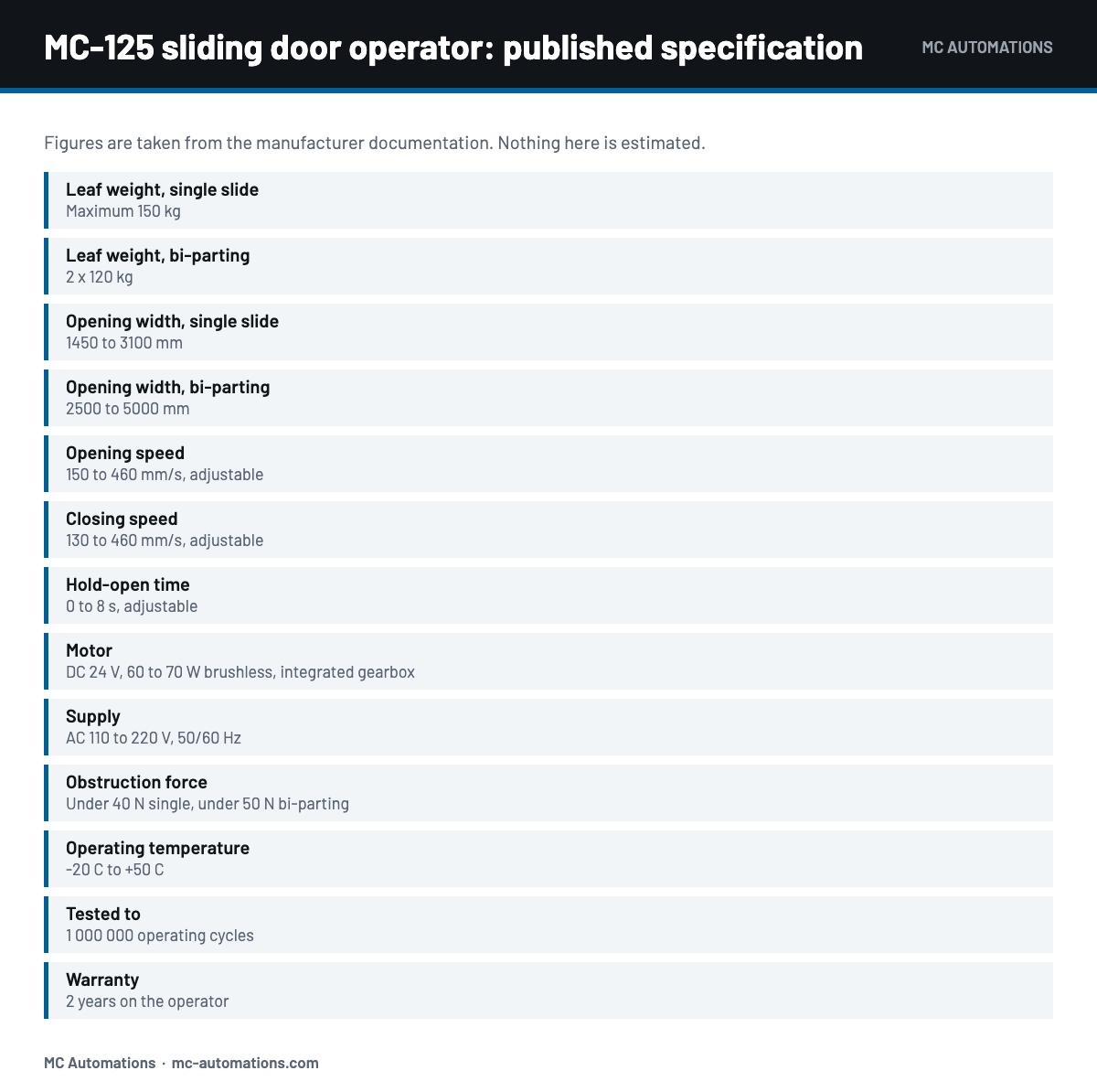
Automatic sliding door operator choices come down to a handful of checkable figures, and the MC-125 is the automatic sliding door operator we fit to most sliding entrances we supply. This page explains why we specify it, where an automatic sliding door operator of this size fits, and just as importantly where it does not. Every figure below is published on the MC-125 product page and comes from the manufacturer documentation. None of it is estimated.
The short answer
Three things decide it for most buyers: the parts are on a shelf in Johannesburg, the specification is published so you can check it against your own opening, and the adjustment range is wide enough that one unit covers a quiet reception and a centre entrance at its busiest.
None of those is a marketing claim. They are all checkable, and the third one is the reason a single operator family can standardise an entire estate.
Local assembly is about spares, not patriotism
The MC-125 sliding door operator is imported and assembled at our Laser Park facility in Johannesburg. We do not claim to manufacture the components, and we are deliberate about that wording because the industry is loose with it.
What local assembly actually buys you is inventory. Belts, rollers, guides, sensors and controllers sit on a shelf here rather than six weeks away on a vessel.
That is the difference between a same-visit repair and an entrance standing open across a trading weekend, and after the first failure it is the thing facilities managers care about more than any specification line.
The published specification
A single slide takes a leaf up to 150 kg, across openings from 1450 to 3100 mm. Bi-parting takes 2 x 120 kg, across 2500 to 5000 mm.
Leaf widths run 750 to 1600 mm on a single slide, and 650 to 1250 mm per leaf bi-parting.
The motor is a DC 24 V brushless unit of 60 to 70 W with an integrated gearbox, fed from an AC 110 to 220 V supply at 50/60 Hz. Operating temperature range is -20 C to +50 C.
It is tested to 1 000 000 operating cycles. That is a test result under test conditions. It is not a maintenance-free period and not a warranty term, and we will not present it as one.
The warranty is two years on the operator.

Single slide or bi-parting
Bi-parting moves two panels apart from the centre, so each panel travels half the distance for the same clear width. On a busy entrance that is the difference between a door that keeps up with arrivals and one that is always behind them.
A single slide is the right call on a quieter side entrance, where bi-parting is hardware you did not need.
Obstruction force differs between the two: under 40 N single, under 50 N bi-parting.
What the adjustability means in practice
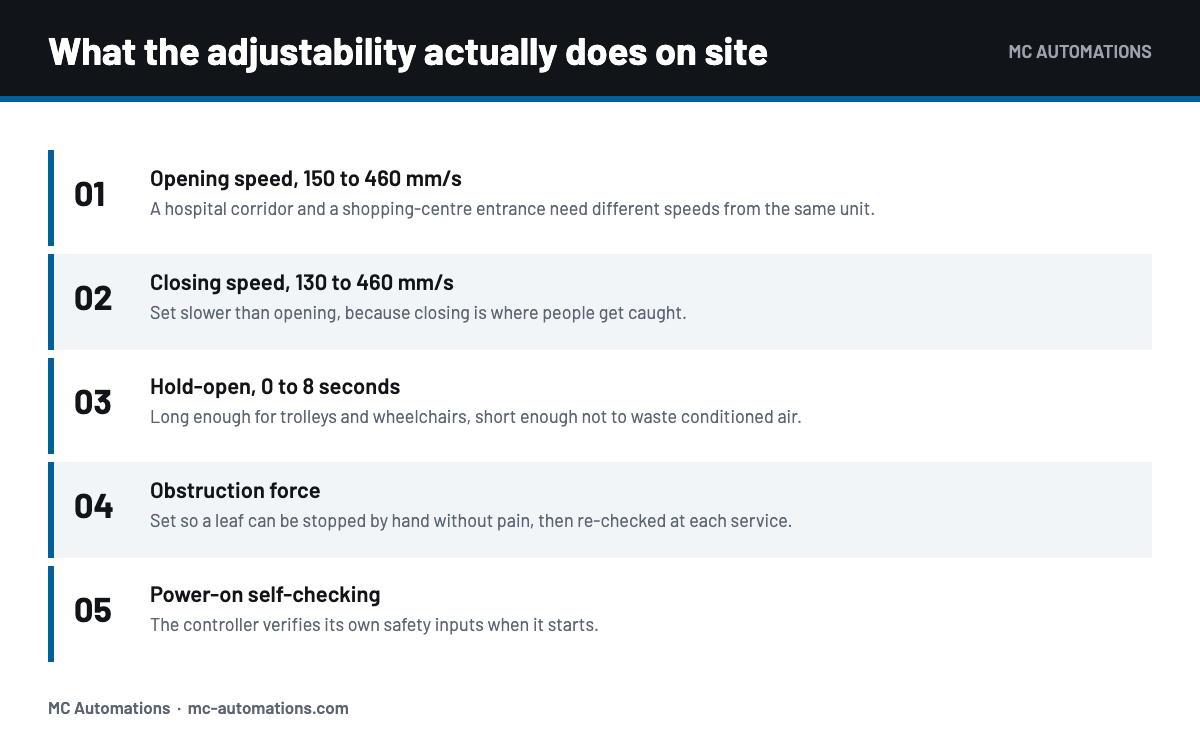
Opening speed is adjustable from 150 to 460 mm/s and closing from 130 to 460 mm/s, with hold-open from 0 to 8 seconds.
Those ranges are why one MC-125 sliding door operator suits a hospital corridor where beds pass through slowly and a retail entrance that has to clear a queue.
Closing is normally set slower than opening, because closing is where people get caught. Obstruction force is set so a leaf can be stopped by hand without pain, and it is re-checked at every service because the setting drifts.
The controller also performs power-on self-checking, verifying its safety inputs when it starts.
Where the MC-125 is the wrong choice
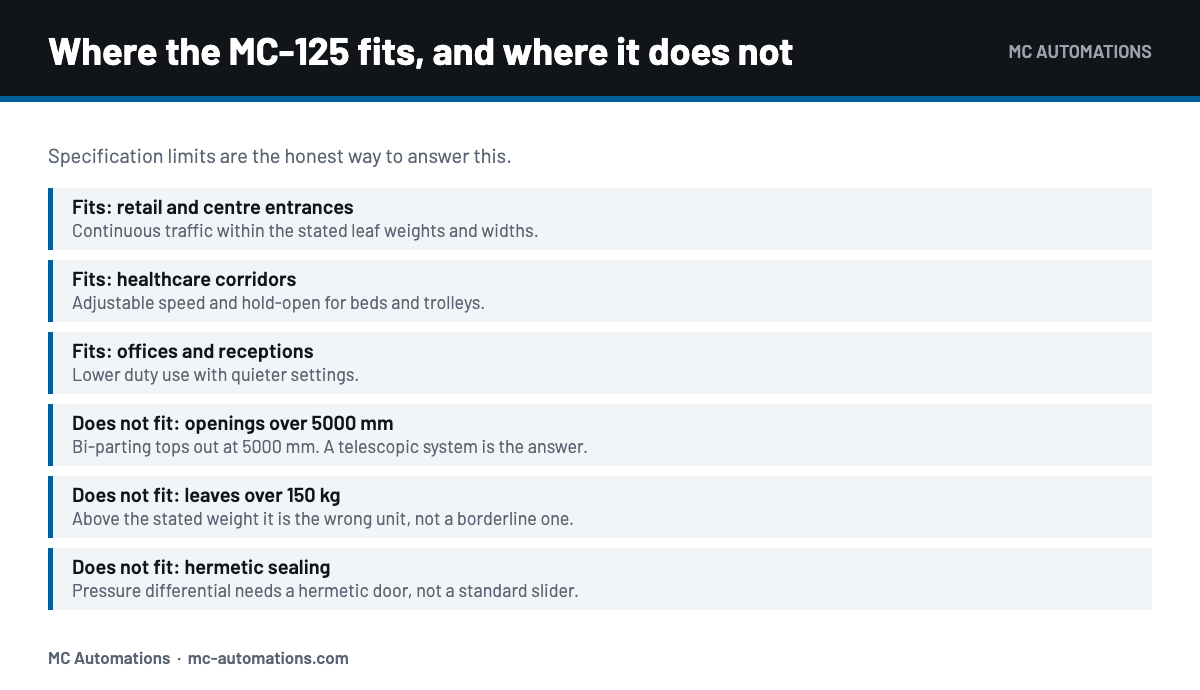
This matters more than the list of things it does well.
Above 5000 mm of opening, bi-parting has run out. A telescopic sliding door opens the widest clear width from a given structural opening and is the right answer.
Above 150 kg on a single leaf, it is simply the wrong unit. Specification limits are limits, not targets to push.
Where a pressure differential has to be held, in theatres or isolation areas, you need a hermetically sealed door rather than a standard slider.
And where the opening is narrow and traffic is light, a swing operator such as the MCW-100 is usually better value.
What we claim, and what we do not
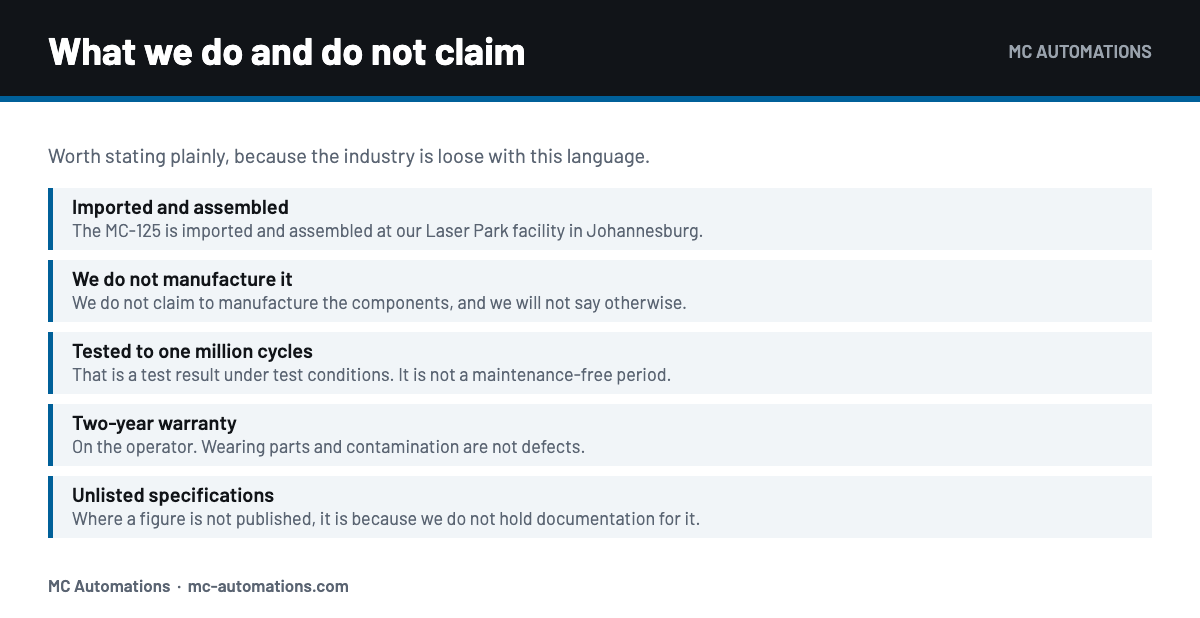
We publish the figures we hold documentation for, and we leave out the ones we do not.
Where a specification is not listed on the product page, that is because we do not have it rather than because it is unflattering. Ask and we will tell you which of the two applies.
For published national standards covering powered pedestrian doors, SABS, the South African Bureau of Standards is the reference body in South Africa.
Fitting it to an existing entrance
The MC-125 sliding door operator is frequently fitted to framing that is already in place. Where the header and track are straight and sound, that is usually cheaper and faster than replacing the whole entrance, and it puts the money into the parts that actually wear.
Condition decides this rather than age. See automatic door modernisation.
Getting a specification checked
Send the structural opening width and height in millimetres, the intended leaf configuration, a photograph, and rough daily footfall. We will tell you whether the MC-125 fits your opening or whether something else does.
Request a quote or call 010 412 0062, Monday to Thursday 08:00 to 16:30 and Friday 08:00 to 14:00. Full details and the downloadable brochure are on the MC-125 product page.
See also how to judge an automatic sliding door and automatic sliding doors in South Africa.
MC-125 sliding door operator against the MCW-100
These are the two operators we assemble, and they are not competing products. They answer different openings.
The MC-125 sliding door operator drives panels that slide sideways along a track, which is what suits a main entrance where nothing should swing into the path of people walking in.
The MCW-100 is a swing operator. It drives a hinged leaf, and it is usually the better value on a narrow side or service entrance where a sliding installation would be over-specified.
If you are unsure which your opening needs, send the structural opening width. Below about 1450 mm a sliding installation is often not viable, and that single number usually settles it.
Commissioning is where the specification becomes real
A correctly specified MC-125 sliding door operator that is badly commissioned behaves like a cheap door.
Opening and closing speeds have to be set for the traffic actually using the entrance, not left at factory defaults. Hold-open has to be long enough for trolleys and wheelchairs without wasting conditioned air all day.
Obstruction force has to be set and then verified by hand rather than assumed from a menu value.
Sensor coverage has to be walk-tested across the full opening width, not just through the middle where the technician happens to be standing.
Ask for a walk-through at handover. Ten minutes demonstrating what the entrance does when somebody stops in the opening is worth more than any certificate.
Servicing an MC-125
The wearing parts are the same as on any sliding entrance: rollers, belt, guides and seals.
A service should cover the track and rollers, belt tension, sensor cleaning and a full walk-test, obstruction force, the mode switch, and the battery backup where one is fitted.
Interval follows traffic rather than the calendar. Quarterly suits retail footfall. Twice a year suits a quiet office reception.
The single highest-value thing anyone on site can do between services is vacuum the bottom track. Grit is abrasive and it is doing damage on every cycle.
Spares, and why the list is short
Belts, roller carriages, floor guides, sensors and controllers cover the overwhelming majority of what an MC-125 sliding door operator ever needs.
Because the units are assembled here, those parts are held locally rather than ordered per job. See automatic door spare parts.
When something does fail, the useful information is what the door is doing, any noise, when it started, and a photograph of the header with the cover off. That is usually enough for the right part to travel with the technician.
Which buildings we fit it to
Retail entrances and shopping centres, where continuous traffic and queue clearance matter and bi-parting earns its cost.
Healthcare corridors and clinics, where bed and trolley clearance and adjustable speed matter more than anything cosmetic.
Offices and corporate receptions, where the settings are quieter and access control integration is usually part of the specification.
Gyms, service stations, liquor stores, laboratories and cold rooms, where the entrance runs constantly and the environment is harder on sensors than a showroom is.
In every one of those, the deciding question is the same: how many cycles a day, and what is the leaf weight.
A note on comparing it to other operators
We service plenty of other manufacturers equipment, so we see how it ages. We are still not going to publish a ranked comparison, because a supplier grading its competitors in public is marketing rather than information.
What we will do is publish our own figures and invite you to check them against whatever else you are quoted. Leaf weight, opening width, adjustable speed range, obstruction force, cycle testing, warranty and where the spares are held. Those seven lines compare any two operators honestly.
Reading a sliding door operator specification
A sliding door operator specification is only useful if you know which lines matter, so here is how we read one.
Leaf weight comes first. Every other figure in a sliding door operator specification is conditional on the unit actually being able to carry your panel.
Opening width second. Check both the single slide and bi-parting ranges, because a sliding door operator specification usually lists them separately and they are not interchangeable.
Speed ranges third. A wide adjustable range in a sliding door operator specification is what lets one unit serve a quiet reception and a busy entrance.
Obstruction force fourth. This is the safety line, and any sliding door operator specification that omits it deserves a question.
Cycle testing fifth. Read it as a test result. A sliding door operator specification quoting a million cycles is describing a test, not promising a maintenance-free life.
Warranty and spares last. A generous warranty in a sliding door operator specification means little if the part takes six weeks to arrive.
Compare any two units on those six lines and the differences become obvious quickly. That is the whole reason we publish our sliding door operator specification in full rather than summarising it.
Choosing an automatic sliding door operator
Match the automatic sliding door operator to leaf weight first. Everything else is conditional on the unit carrying your panel.
Check the opening width the automatic sliding door operator covers in both single slide and bi-parting form, because they are listed separately.
Look for a wide adjustable speed range. An automatic sliding door operator with a narrow range cannot serve both a quiet reception and a busy entrance.
Insist on a published obstruction force. Any automatic sliding door operator that omits this line deserves a question.
Read cycle testing as a test result. An automatic sliding door operator rated to a million cycles is describing a test, not promising a maintenance-free life.
Ask where the spares sit. A long warranty on an automatic sliding door operator means little if the belt takes six weeks to arrive.
Confirm what happens on power failure. On an escape route the automatic sliding door operator must leave the opening passable by hand.
Standardise where you can. One automatic sliding door operator family across an estate beats five, because it is one set of spares and one set of settings.
Those eight checks compare any automatic sliding door operator honestly, including ours.
Automatic sliding door operator: the short version
An automatic sliding door operator is the drive unit in the header. It carries the panel, controls how fast it moves, and decides what happens when something gets in the way.
The right automatic sliding door operator for your opening is the one rated for your leaf weight and your daily cycle count, with parts held in the country.
We specify the MC-125 as our standard automatic sliding door operator because it is assembled locally, its figures are published in full, and its adjustment range covers most commercial openings.
Where an opening falls outside that range, a different automatic sliding door operator or a different door type is the honest answer, and we will say so.
MC-125 sliding door operator, answered
Why choose the MC-125 sliding door operator?
Local assembly and local spares, a published specification you can check against your opening, and adjustability wide enough that one unit suits a quiet reception or a centre entrance.
Operator choice follows the sector the entrance serves, and our commercial automatic doors page sets out what each one needs.
Do you manufacture the MC-125?
No. The MC-125 is imported and assembled at our Laser Park facility in Johannesburg. We do not claim to manufacture the components.
What leaf weight does the MC-125 handle?
Up to 150 kg on a single slide, or 2 x 120 kg bi-parting. Above that it is the wrong unit rather than a borderline one.
What opening widths does the MC-125 cover?
1450 to 3100 mm single slide, and 2500 to 5000 mm bi-parting.
Is the MC-125 tested to a million cycles?
It is tested to 1 000 000 operating cycles. That is a test result under test conditions, not a maintenance-free period and not a warranty term.
What warranty comes with the MC-125?
Two years on the operator. Wearing parts and contamination damage are not defects.
How fast does the MC-125 open?
Opening speed is adjustable from 150 to 460 mm/s, and closing from 130 to 460 mm/s. Closing is normally set slower than opening.
What power supply does the MC-125 need?
AC 110 to 220 V, 50/60 Hz, driving a DC 24 V brushless motor of 60 to 70 W with an integrated gearbox.
Can the MC-125 be fitted to an existing entrance?
Often yes. Where the header and track are sound, fitting the operator to existing framing is usually cheaper and faster than a new entrance.
What if my opening is wider than 5000 mm?
Then the MC-125 is not the answer. A telescopic sliding system opens the widest clear width from a given structural opening.
In short
Automatic sliding door operator at a glance
- Automatic sliding door operator are quoted against the opening we measured, not a catalogue price.
- Ask about automatic sliding door operator and we confirm the opening, the head and the power position first.
- Automatic sliding door operator are installed and commissioned by our own technicians.
- Automatic sliding door operator carry a 24-month warranty on the operator.
- Spares for automatic sliding door operator are held in Johannesburg, so a repair does not wait on an import.
- Send the opening size and a photograph and a quotation for automatic sliding door operator usually follows within two working days.
- Service intervals for automatic sliding door operator are set against cycle count rather than the calendar.
- Commissioning of automatic sliding door operator ends with the speed, hold-open and force settings written down.
- We also service and repair automatic sliding door operator supplied by other companies.
- Prices for automatic sliding door operator exclude VAT unless the quotation states otherwise.
