
Office park automatic doors for landlords and managing agents: who owns which entrance, the access states a working week needs, the morning peak that sizes the lobby, standardising across an estate, and why maintenance recovery changes the contract.
Automatic Sliding Doors South Africa: A Complete Guide to Entrance Systems
Automatic sliding doors South Africa covers everything from a single shopfront slide to a bi-parting hospital entrance running ten thousand cycles a week. This guide explains how the systems work, what separates the door types, what actually drives the price, and what to send us for a firm quotation.
Key facts, up front
What they are: powered entrance doors whose panels slide apart automatically when a sensor detects approach.
Also called: auto doors, automatic entry doors, powered entrance systems, or simply automatic doors.
Who we are: MC Automations supplies, installs, commissions and services automatic entrance systems across South Africa.
Our operators: the MC-125 sliding operator and MCW-100 swing operator, imported and assembled at our Laser Park facility in Johannesburg.
Tested to: one million operating cycles. That is a test result, not a maintenance-free period.
Warranty: 24 months on the operator.
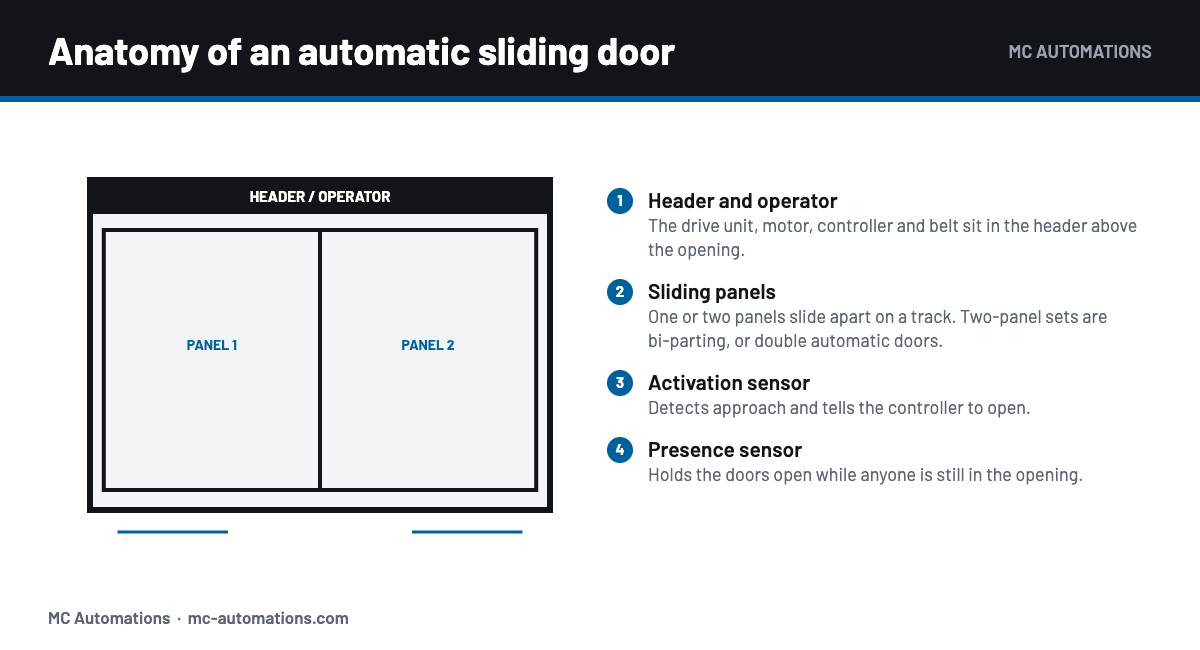
What automatic doors actually are
An automatic door is an entrance whose leaves are moved by a powered operator rather than by hand. Detection, movement and safety are handled by a controller in the header.
The term covers several mechanisms. Sliding panels are the most common in commercial buildings, but swing, telescopic, revolving and hermetic entrances are all automatic doors.
People also search for these as auto doors, powered entry doors or automated entrance systems. They describe the same category.
Why sliding dominates commercial entrances
A sliding leaf parks beside the opening instead of swinging into it. Nothing sweeps through the path of people walking in.
That is why retail, offices, clinics and hospitals default to sliding, and why the market for automatic sliding doors South Africa wide is larger than every other type combined.
How door automation works
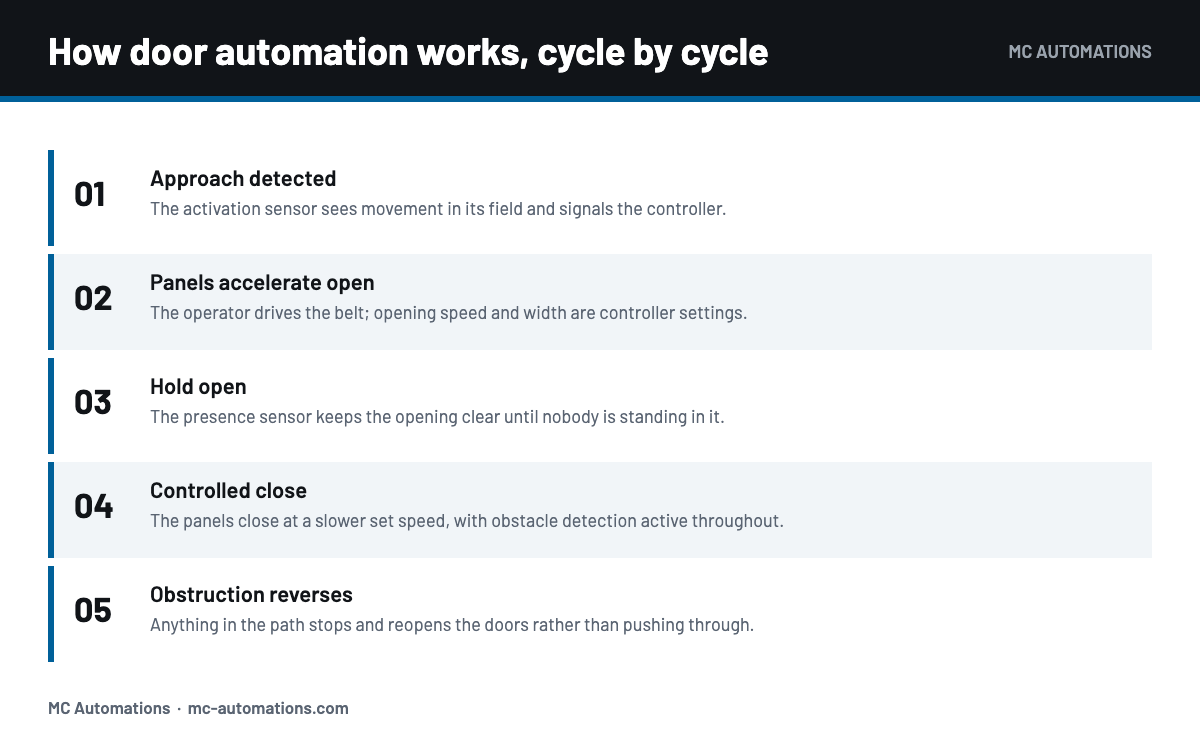
Door automation is a loop of detect, open, hold, close, with safety overriding all of it.
An activation sensor above the opening watches for approach and signals the controller. The operator drives a belt, and the panels accelerate open to a set width.
A presence sensor then holds the opening while anyone is still standing in it. This is the sensor that stops a door closing on a person who has paused.
The panels close at a slower speed, with obstacle detection live throughout. Anything in the path reverses the door rather than pushing through it.
Sliding door automation on an existing entrance
Sliding door automation does not always mean a new entrance. Where the track and header are sound, an existing manual or older powered opening can often be modernised.
That is usually cheaper and faster than replacement. See automatic door modernisation for what that involves.
The automatic door opener, or operator
The automatic door opener is the drive unit in the header: motor, gearbox, encoder, controller and belt in one housing.
It carries the panel weight through every cycle and holds the settings that decide how the entrance behaves. Opening speed, hold-open time, closing speed and obstacle force are all controller values, set on site.
Our MC-125 sliding door operator and MCW-100 swing door operator are imported and assembled at our own facility in Johannesburg. That is what keeps belts, rollers, guides, sensors and controllers on a shelf locally rather than six weeks away.
Both are tested to one million operating cycles and carry a 24-month warranty on the operator.
Entrance systems compared
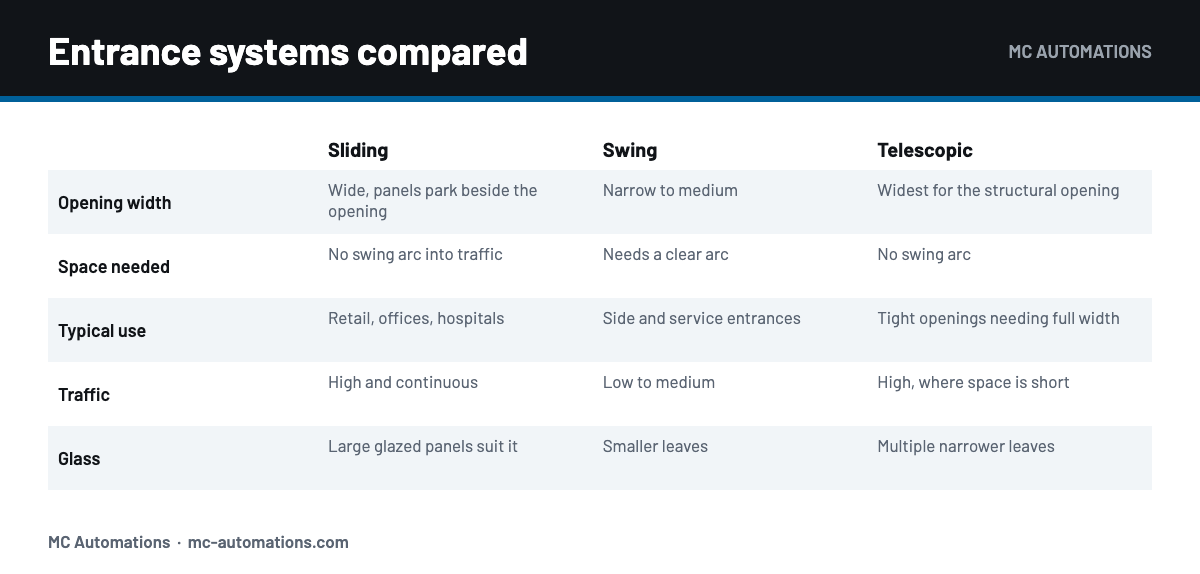
Choosing between entrance systems is mostly about opening width and the space around it.
Automatic sliding doors suit wide openings and continuous traffic, with no swing arc into the walkway.
Automatic swing doors suit narrower side and service entrances where a slide would be over-specified.
Telescopic sliding doors use multiple narrower leaves per side, opening the widest possible clear width from a tight structural opening.
Automatic revolving doors control air movement in tall or air-conditioned lobbies.
Hermetically sealed doors hold a pressure differential, which matters in theatres and isolation areas.
The full range sits under automatic entrance systems.
Glass sliding doors and aluminium automatic doors
Most commercial entrances are glass sliding doors in aluminium framing, and the two decisions are separate.
The framing decides structure. Aluminium automatic doors are specified by profile depth, finish and the panel weight the operator has to carry.
The glass decides safety and weight. Heavier glass needs a higher duty operator and a stronger track, so glass choice changes the mechanical specification, not just the look.
Frameless and narrow-stile options
Narrow-stile framing gives a lighter visual line while keeping a structural rail top and bottom. Fully frameless glass sliding doors are possible but change how the panel is carried.
Tell us the look you want at enquiry stage, because it affects the operator sizing.
Single or double automatic doors?
A single slide moves one panel to one side. Double automatic doors, properly called bi-parting, move two panels apart from the centre.
Bi-parting halves the travel distance for the same clear width, so the opening clears faster. On a busy entrance that is the difference between a door that keeps up and one that is always catching up.
It also costs more, because there are two panels, two carriages and more hardware. On a low-traffic side entrance a single slide is usually the right call.
Sizing a sliding entrance: opening, leaf weight and header
Most specification mistakes on automatic sliding doors South Africa wide come from sizing the opening before the leaf build is known. Three numbers decide whether an operator suits an entrance, and they are worth settling before anyone prices anything.
Clear opening. This is the usable gap when the leaves are fully parked, not the structural opening. The MC-125 covers 1450 mm to 5000 mm of clear opening, single or bi-parting. Size it from the widest thing that has to pass: a bed, a pallet truck, a loaded bell trolley with somebody walking beside it. A clear opening taken from a floor plan is almost always narrower than the one the building actually needs.
Leaf weight. The operator is chosen against the mass it has to move and stop, not against the opening width. The MC-125 handles leaves up to 150 kg. Toughened glass is heavier than people estimate, and a frameless leaf with patch fittings is heavier again, so the glass specification has to be settled before the operator is confirmed rather than after.
Header and the space above. The header casing is 125 mm, and the drawing allows the leaf height plus 25 mm from the underside of the casing down to finished floor. If there is a bulkhead, a ceiling line or a shopfront transom already in place, that is the dimension that decides whether the entrance can be automated as drawn or whether the opening has to change.
Get those three settled and the rest of the specification follows. Get them wrong and the operator is either working at its limit for the life of the entrance or it does not physically fit, which is the more expensive of the two discoveries.
What drives automatic doors prices
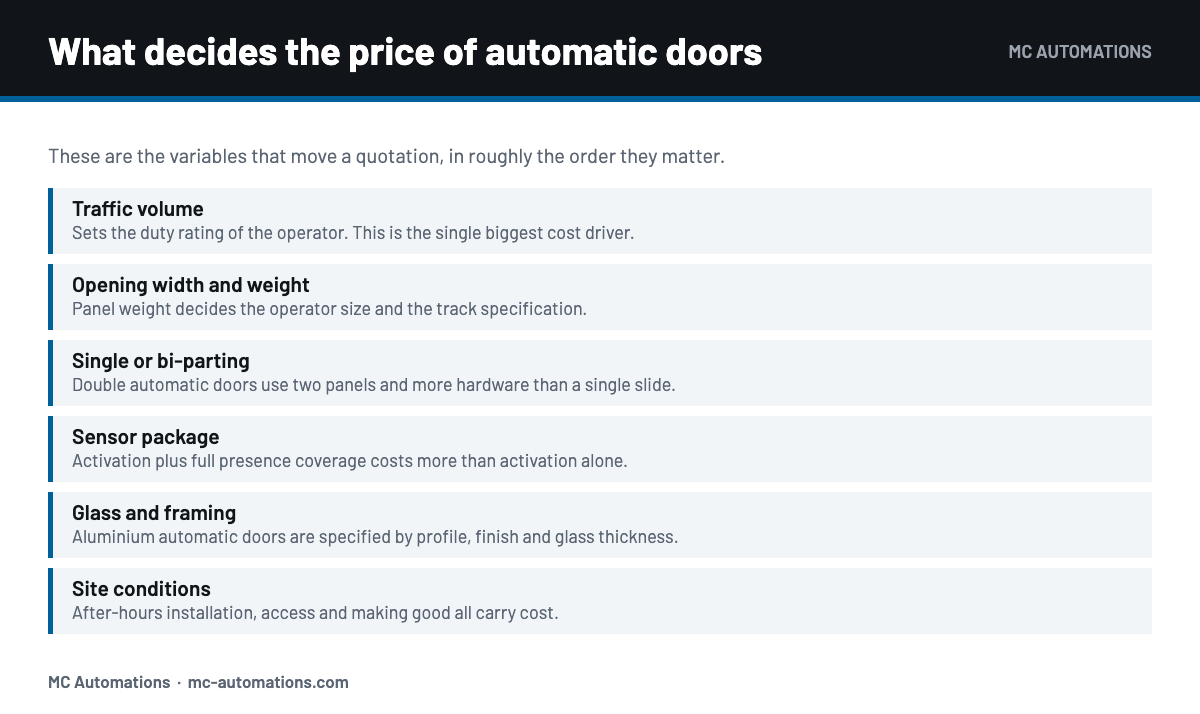
Traffic volume is the biggest driver, and the one most people leave out of an enquiry. It sets the duty rating, the sensor layout and the service interval.
Opening width and panel weight set the operator size and the track. Bi-parting adds hardware. A full presence-sensing package costs more than activation alone.
Site conditions matter too. After-hours installation in a mall, difficult access, or making good around the opening all carry cost, and we would rather quote them upfront than add them later.
For worked numbers, see our automatic door prices cost guide.
Choosing for your building
Retail wants speed and reliability, because a failed entrance at 08:00 on a Saturday is lost trade. Duty rating matters more than anything else here.
Offices want quiet operation and controlled access, often tied into the access control system.
Healthcare wants bed and trolley clearance, touch-free activation and equipment that can be serviced around clinical use.
Industrial and cold storage want sealing and robustness ahead of appearance.
Whatever the sector, if the opening is on a fire escape route it must be passable without power. That means break-out panels or a fail-safe release, and it is decided at specification, not afterwards.
Sector changes the brief more than most specifiers expect. A lobby entrance that has to hold its conditioned air is a different problem from a mall doorway at full trade, which is why we set the hospitality requirements out separately on our hotel automatic doors page. Completed installations across retail, legal and industrial sites are on our projects page.
What to send for a quotation
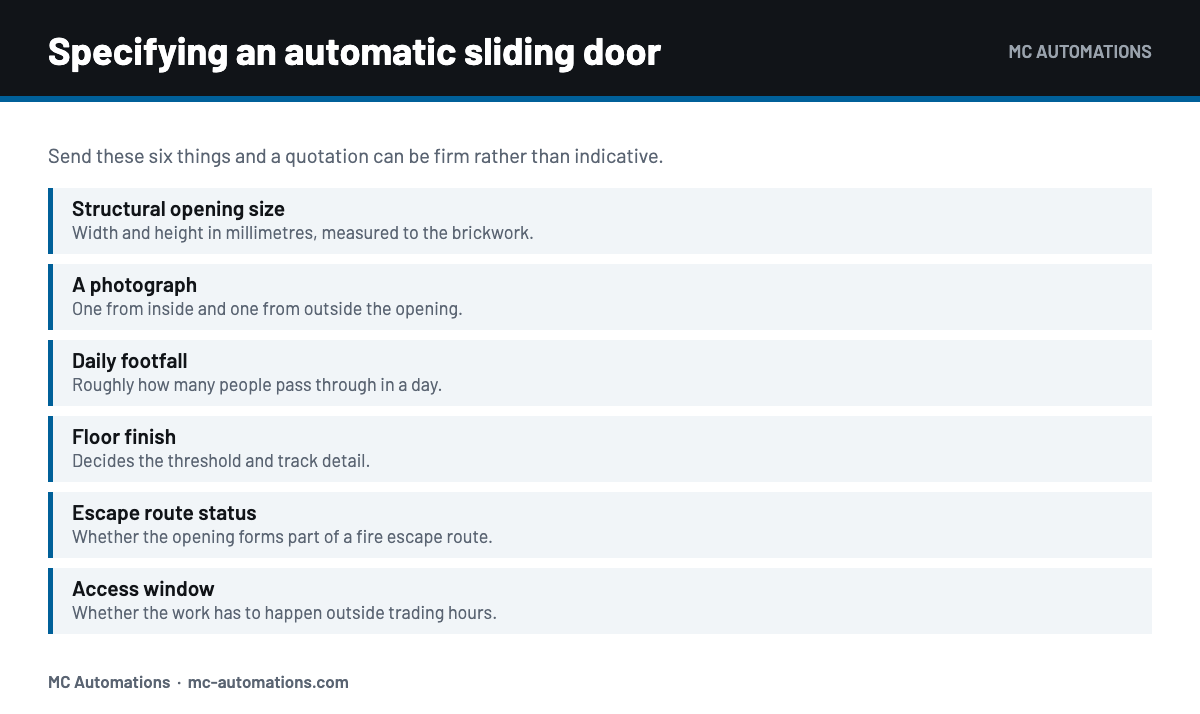
Six things turn a vague enquiry into a firm number: the structural opening size in millimetres, a photograph from inside and outside, rough daily footfall, the floor finish, whether the opening is an escape route, and whether we can work in normal hours.
Quotations go out within two working days of receiving the opening size and a photograph. Where a site survey is needed first, we say so rather than letting a date slip quietly.
You can request a quote or call us on 010 412 0062. We are open Monday to Thursday 08:00 to 16:30, and Friday 08:00 to 14:00.
Servicing, spares and the long run
An automatic entrance is a machine that runs every time somebody walks through it. Sensor coverage drifts as shopfitting changes, belts stretch, rollers wear.
We service what we install and we also take on other manufacturers equipment. If your doors came from a supplier who has since closed or stopped supporting the model, say so at first contact.
See automatic door servicing and automatic door spare parts, or an service level agreement for sites that cannot afford downtime.
For national standards and published guidance, SABS, the South African Bureau of Standards is the reference body in South Africa.
Sensors, and why most call-outs start there
Two sensor jobs sit on every powered entrance, and they are not the same thing.
Activation detects approach and asks the door to open. Presence detects someone standing in the opening and refuses to let it close.
Most nuisance faults we attend are contamination rather than failure. Dust film, insect nests and cleaning residue on a lens all read as a permanent target, so the door sits open.
Direct sun into the optics causes the opposite problem, and a few degrees of downward tilt or a hood usually fixes it.
Never tape over a sensor
Disabling a safety beam to keep an entrance running removes the protection the sensor exists to provide. If a sensor is misbehaving, isolate the operator and secure the opening instead.
When an entrance starts misbehaving, work from the symptom rather than from a guess about the part. Our automatic door troubleshooting guide matches what the door is doing to where the fault usually sits, and sets out what is safe to check yourself before anyone is called out.
Safety on a powered entrance
Presence sensing across the full opening is what stops a leaf closing on somebody who has stopped walking. Activation alone does not do this.
Obstacle detection is the second layer. A panel that meets resistance should stop and reopen rather than push through, and the force threshold is a controller setting rather than a fixed property of the door.
The practical test is simple: a leaf you can stop by hand without pain is in a sensible range.
Escape routes add a third requirement. The opening must be passable without power, through break-out panels or a fail-safe release.
Sensor coverage also drifts. Shopfitting moves, a display goes up beside the entrance, and a field that was correct at handover no longer is. That is one reason servicing is not optional.
Access control and automatic entry doors
Many entrances need to be selective rather than simply open. Card readers, intercoms, keypads and time schedules all tie into the same controller that drives the panels.
The useful question is what happens on power failure and on fire alarm, because those two cases decide whether the entrance fails secure or fails open. See automatic door access control.
Service intervals in practice
Our standard interval is every six months, and retail footfall justifies more frequent attention. A low-traffic office entrance is comfortable at twice a year.
A service should cover the track and rollers, belt tension, sensor cleaning and a walk-test of the full opening, obstacle detection force, and the battery backup where one is fitted. A dead backup is invisible until the power goes.
Keep the records. A dated service history is what lets you argue wear against defect if a warranty question ever arises.
Repair, modernise or replace?
Repair while the track is straight, the panels are square and parts are still available.
Modernise when the mechanism is tired but the header and track are sound. Replacing the operator on existing framing is usually the cheaper and faster route, and it is the most common recommendation we make on older entrances.
Replace when the track is damaged, the framing has moved, or the equipment is obsolete with nothing to match. If your supplier has closed or dropped support for the model, tell us at first contact and we will bring the right parts to the first visit.
Automatic sliding doors South Africa, answered
What are South African buildings typically fitted with?
Glass panels in aluminium framing, driven by a header-mounted operator, with an activation sensor and a presence sensor. Bi-parting on main entrances, single slide on quieter openings.
For a timber leaf rather than aluminium or glass, the weight and fixing limits are set out under wooden automatic sliding doors.
Sector-specific requirements for retail, office and healthcare entrances sit on our commercial automatic doors page.
How long do automatic doors last?
That depends on duty rating against actual traffic, and on servicing. Our operators are tested to one million operating cycles, which is a test result rather than a guaranteed life or a maintenance-free period.
Can an existing door be automated?
Often yes. Where the track and header are sound, sliding door automation can be retrofitted, or the entrance modernised rather than replaced.
What is the difference between an automatic door opener and the door itself?
The opener, or operator, is the drive unit in the header. The door is the panels and framing it moves. They are specified together because panel weight decides operator size.
Do automatic doors work during load shedding?
Only with a battery backup or generator supply. Without one, the entrance must still be openable by hand, which is a safety requirement on escape routes.
How much do automatic doors cost?
It depends mostly on traffic volume, opening width, whether the doors are bi-parting, and the sensor package. Send the opening size and a photograph and we will quote firmly.
What is the difference between single and double automatic doors?
A single slide moves one panel to one side. Double automatic doors, properly called bi-parting, move two panels apart from the centre and clear the opening faster.
Do you install outside Gauteng?
Yes. We supply, install and service automatic entrance systems across South Africa.
Do you service other brands?
Yes, including equipment we did not install.
Regional conditions change a sliding entrance
An automatic sliding door is specified on leaf weight, opening width and traffic wherever it goes. What changes across the country is everything around those three numbers, and buyers comparing automatic sliding doors South Africa wide should know which differences are real.
- Coastal humidity and salt. Corrosion happens at connectors, cable glands and fixings rather than at visible hardware, and it shows up as intermittent faults that test perfectly on a bench. Service intervals shorten and inspections look at connections, not just moving parts.
- Cape wind. Operator ratings are published without wind pressure. A slide fares better than a swing because the leaf moves across the wind, but running friction and track wear both rise on an exposed elevation.
- Inland dust. Fine dry grit in the track is the main wear driver on the Highveld and in the arid interior, and it arrives on boots and trolley wheels. A matwell that genuinely captures it extends carriage life more than anything inside the header.
- Temperature range. A large daily swing moves frames and hardens seals, so clearances are set for the range rather than for handover day.
- Subtropical humidity. Condensation runs into the track and turns dust into an abrasive paste, and insects get into housings and across optics.
None of that changes which operator you buy. It changes the detailing, the service interval and what an inspection actually looks at.
Getting a sliding entrance quoted properly
A quotation for automatic sliding doors South Africa wide should name the opening it was priced against, list the equipment it includes, and state what it excludes. Builders work, structural alteration, electrical supply to the entrance and making good are excluded unless the quotation says otherwise.
Compare scope rather than totals. Two figures that do not both state their exclusions are not comparable, and the cheaper one is frequently the one that will grow.
Operators start from R27 590 excluding VAT for the MC-125 sliding unit. Sensors are published separately, from R2 259,88 excluding VAT for the MC-DL8 motion sensor. Our warranty is 24 months on the operator, with sensors and wear parts quoted and warranted under their own terms.
In short
Automatic sliding doors in South Africa: at a glance
- Automatic sliding doors South Africa are quoted against the opening we measured, not a catalogue price.
- Ask about automatic sliding doors South Africa and we confirm the opening, the head and the power position first.
- Automatic sliding doors South Africa are installed and commissioned by our own technicians.
- Automatic sliding doors South Africa carry a 24-month warranty on the operator.
- Spares for automatic sliding doors South Africa are held in Johannesburg, so a repair does not wait on an import.
- Send the opening size and a photograph and a quotation for automatic sliding doors South Africa usually follows within two working days.
- Service intervals for automatic sliding doors South Africa are set against cycle count rather than the calendar.
- Commissioning of automatic sliding doors South Africa ends with the speed, hold-open and force settings written down.
- We also service and repair automatic sliding doors South Africa supplied by other companies.
- Prices for automatic sliding doors South Africa exclude VAT unless the quotation states otherwise.
