
Office park automatic doors for landlords and managing agents: who owns which entrance, the access states a working week needs, the morning peak that sizes the lobby, standardising across an estate, and why maintenance recovery changes the contract.
Automatic Door Not Opening: What to Check First
Automatic door not opening is the fault we are called out to most, and most of the time it is not a broken operator. It is power, a mode switch, a dirty sensor or something sitting in the track. This guide works through the causes in the order they actually occur, so you can clear the cheap ones before booking an automatic door repair.

Start here: the five checks that solve most cases
Work in this order. It costs nothing and it resolves a large share of faults before anyone is called.
Power and isolator. A completely dead entrance is usually a tripped breaker, a blown fuse or an isolator switched off during cleaning.
Mode switch. A programme switch left on Closed, Locked, Exit-only or Winter makes a perfectly healthy door look broken. Check this before anything else if the door was working yesterday.
Activation sensor. Clean the lens and walk-test the full approach. Dust film, insect nests and cleaning residue are the single most common cause of an automatic door not working.
Track and threshold. Grit, packaging or a bent floor guide will stop a panel before it starts moving.
Controller indicators. Most controllers show an LED pattern or fault code that names the failing part.
What the exact symptom tells you

The phrase people use matters, because each version points somewhere different.
Automatic door will not open at all points at supply or the mode switch.
Automatic door not opening all the way points at an obstruction or an opening-width setting that has drifted.
Automatic door keeps opening and will not stop is a presence-sensor problem, not an opening problem. Something is standing in its field permanently.
Sliding door will not open while the motor runs means the belt or rollers are no longer driving the panel.
Opens intermittently is the hardest one, and usually marginal sensor alignment or a loose connection. Log the times it happens; the pattern is what finds it.
The causes, in the order we find them
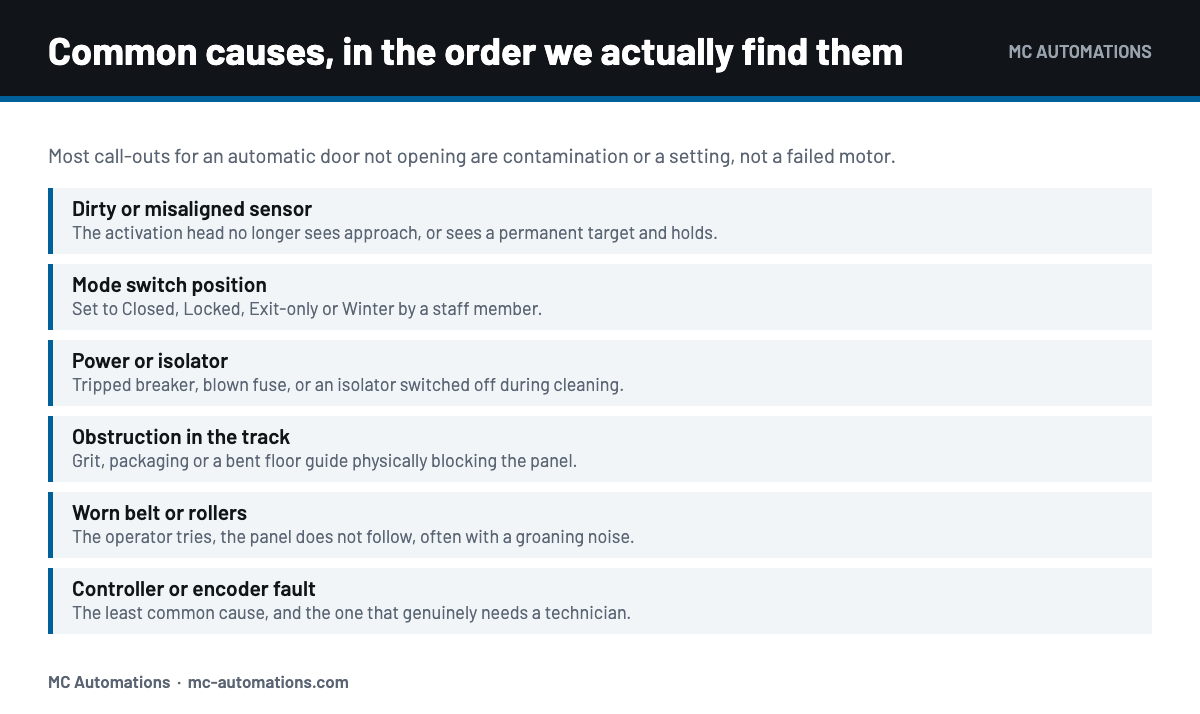
Contamination and settings dominate. Genuine component failure is well down the list.
Sensors drift out of alignment when they are knocked, and lose sight of the approach when the lens films over. Low winter sun straight into the optics causes the same thing seasonally.
Belts stretch gradually, so a door gets slower and noisier for weeks before it stops. That noise is the warning, and acting on it is far cheaper than a breakdown during trading hours.
Controllers and encoders do fail, but they are the least common cause and the one that genuinely needs a technician.
Where to look on the entrance
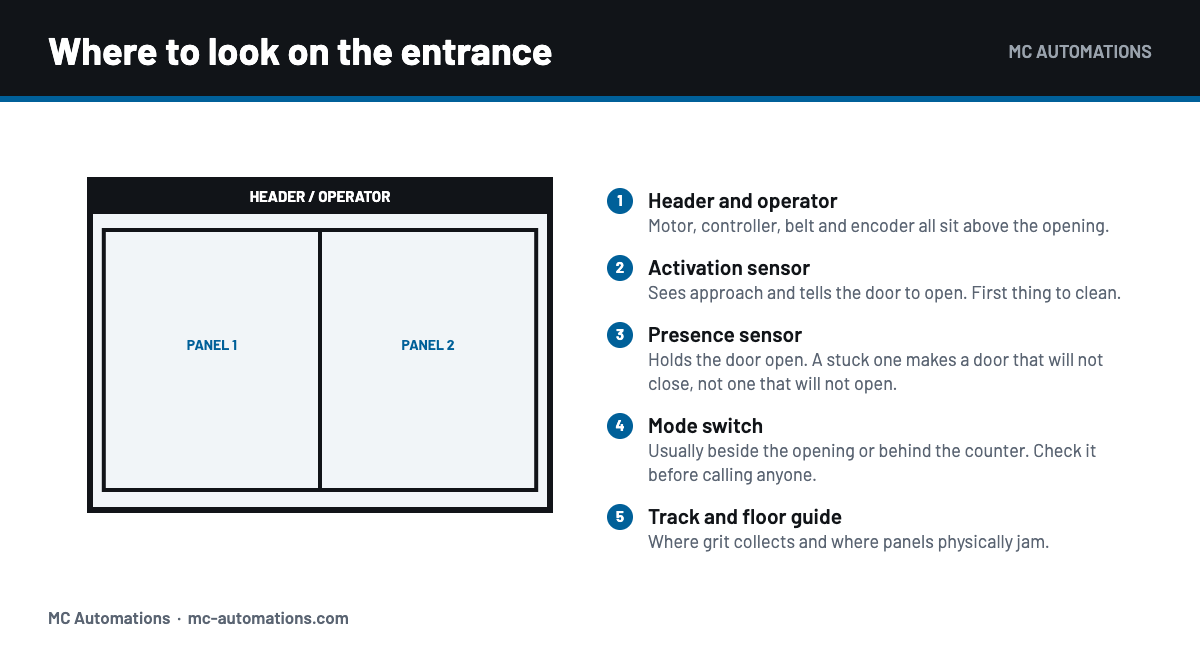
Everything that drives the door sits in the header above the opening: motor, gearbox, encoder, controller and belt.
The activation sensor looks outward for approach. The presence sensor looks down into the opening and holds the door while somebody is standing in it. They do different jobs, and confusing them sends people looking in the wrong place.
The mode switch is usually beside the opening or behind a counter. The track and floor guide are where grit collects.
What not to do
Do not tape over a sensor to keep an entrance running. Disabling a safety beam removes the protection it exists to provide.
Do not force a powered panel by hand. It damages the belt and the carriage, and turns a small repair into a large one.
Do not leave a failed door on a fire escape route. Isolate the operator and secure the opening manually until it is fixed.
Power failures and load shedding
A controller can lose its settings or trip on a dirty supply, so a door that stopped working straight after an outage often needs a reset rather than a repair.
Where a battery backup is fitted, a dead backup is invisible until the power goes. That is one of the things a service should be testing. See our guide to automatic doors and load shedding.
Repair, modernise or replace
Repair while the track is straight, the panels are square and parts are available.
Modernise when the mechanism is tired but the header and track are sound. Replacing the operator on existing framing is usually cheaper and faster than a new entrance, and it is the most common recommendation we make on older doors. See automatic door modernisation.
Replace when the track is damaged, the framing has moved, or the equipment is obsolete with nothing to match.
Booking an automatic door repair
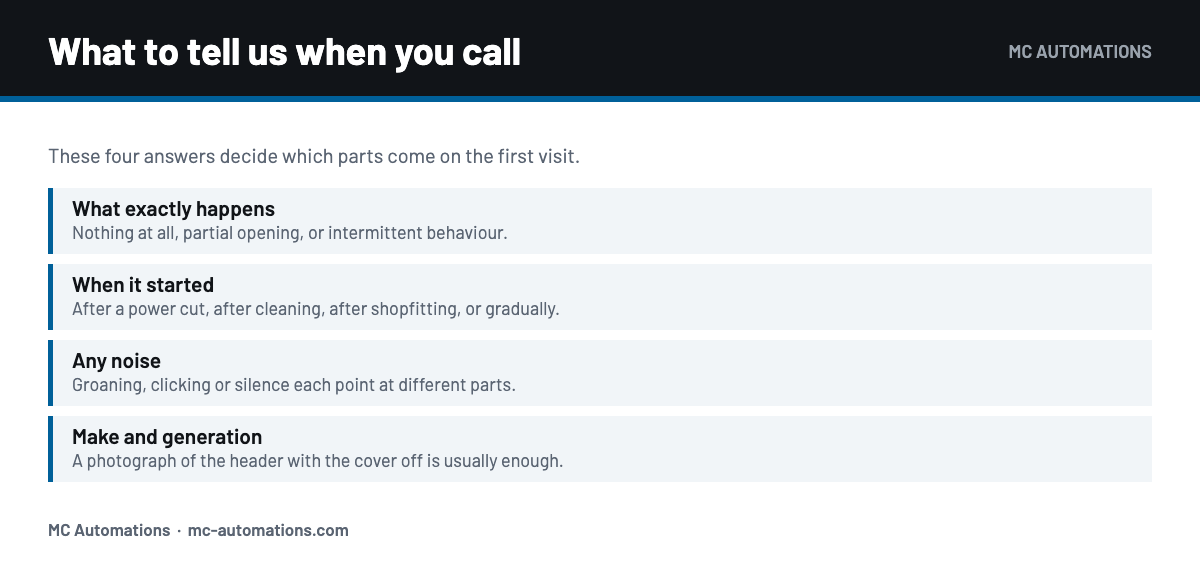
Four answers decide which parts arrive on the first visit: exactly what the door does, when it started, any noise it makes, and the make and generation. A photograph of the header with the cover off usually settles the last one.
We hold belts, rollers, guides, sensors and controllers locally because the MC-125 sliding operator and MCW-100 swing operator are imported and assembled at our own facility in Johannesburg. That is what turns a week-long wait into a same-visit repair.
Both operators are tested to one million operating cycles and carry a 24-month warranty on the operator. A cycle test is a test result, not a maintenance-free period.
See automatic door repairs, automatic door servicing and automatic door spare parts, or request a quote. Call 010 412 0062, Monday to Thursday 08:00 to 16:30 and Friday 08:00 to 14:00.
Related troubleshooting guides
If the opposite is happening, see automatic door not closing. For sensor-specific faults see automatic door sensor not working and how automatic door sensors work.
For published national standards, SABS, the South African Bureau of Standards is the reference body in South Africa.
Why sensors fail the way they do
Two sensors sit on a typical entrance and they fail differently, which is why identifying the right one saves a call-out.
The activation sensor is a motion or presence head aimed outward at the approach. When it films over with dust or gets knocked out of alignment, the door simply stops noticing people. That is the classic automatic door not opening complaint.
The presence sensor looks straight down into the opening and its job is to stop the door closing on somebody standing still. When it sees a permanent target it holds the door open instead, which reads as a door that will not close rather than one that will not open.
Cold storage and washdown areas add condensation to the list, because a chilled lens meeting warm air behaves exactly like a dirty one.
Direct sun is the seasonal version. Low winter sun into the optics swamps the receiver, so a door that misbehaves only in the late afternoon for a few weeks a year is usually telling you about the sun rather than the sensor.
Sector by sector
Retail. A failed entrance at opening time is lost trade, so duty rating and spares availability matter more here than anywhere else. A six-month service interval is our standard, shortened where shopping-centre footfall demands it.
Healthcare. Clearance for beds and trolleys, touch-free activation and work scheduled around clinical use. A door out of service on a ward corridor is a clinical problem, not just an inconvenience.
Offices. Quieter operation and access control integration, where the useful question is what the entrance does on power failure and on fire alarm.
Industrial and cold storage. Sealing and robustness ahead of appearance, and condensation handled at specification rather than discovered later.
Stopping it happening again
Most of what we attend is preventable, and the preventive work is unglamorous.
Vacuum the bottom track. Grit is abrasive and it is doing damage every single cycle.
Clean the sensor lenses with a soft cloth, not a solvent, and walk-test the full width of the opening afterwards rather than just the middle.
Re-check sensor coverage whenever the area around the entrance changes. A new display stand, a queue barrier or a seasonal promotion can put something permanent into a detection field that was correct at handover.
Keep a fault log. Two lines noting the date and what the door did will find an intermittent fault faster than any inspection, because intermittent faults are about patterns.
Test the battery backup where one is fitted. It is the one component whose failure is completely invisible until the moment you need it.
What a service should actually cover
Track and rollers, belt tension, sensor cleaning and a full walk-test, obstacle detection force, the mode switch, and the battery backup.
Ask for the obstacle force to be measured rather than assumed. A leaf you can stop by hand without pain is in a sensible range, and that setting drifts.
Keep the dated records. A service history is what lets you argue wear against defect if a warranty question ever comes up.
Working around your trading hours
Some repairs cannot be done with the public walking through the opening, particularly anything involving the track or the panels.
Tell us at booking whether the entrance has to stay open, whether it is on a fire escape route, and whether the building has a facilities contractor who needs to sign off. Those three answers decide whether we attend in normal hours or after hours, and after-hours work carries a different rate that we would rather agree upfront than add to an invoice afterwards.
Automatic door not opening: quick reference
Automatic door not opening at all. Power, isolator or mode switch. Check the supply and the programme switch before calling anyone.
Automatic door not opening all the way. An obstruction in the track, or an opening-width setting that has drifted on the controller.
Automatic door not opening reliably. Marginal sensor alignment or a loose connection. Log the times it fails, because the pattern is what finds it.
Automatic door not opening after a power cut. Usually a controller reset rather than a repair.
Automatic door not opening after cleaning. Either the isolator was switched off or residue is sitting on the sensor lens.
Automatic door not opening in the late afternoon only. Low sun into the sensor optics. A hood or a few degrees of downward tilt fixes it.
Automatic door not opening but the motor runs. The belt or the rollers are no longer driving the panel.
Automatic door not opening on one leaf. That narrows it to that leaf, its carriage or its loom, not the controller.
An automatic door not opening on a fire escape route is a safety issue. Isolate the operator and secure the opening manually until it is repaired.
Still stuck? Send us what the door is doing and a photograph of the header, and we will tell you which part to expect.
Automatic door not opening, answered
Why is my automatic door not opening at all?
Usually power or a mode switch rather than a failed motor. Check the isolator and breaker, then check the programme switch has not been left on Closed, Locked or Exit-only.
My automatic door is not opening all the way. What causes that?
Either an obstruction in the track or an opening-width setting that has drifted. Clear the track first; if the panel still stops short, the width needs re-setting on the controller.
The automatic door keeps opening and will not stop. Why?
That is the presence sensor seeing a permanent target, not an opening fault. A new display, sign or shopfitting inside its field is the usual reason.
My sliding door will not open but the motor is running. What is wrong?
The belt or the rollers. The operator is turning but the panel is not being driven, and it will fail completely if it is left.
Can I force an automatic door open in an emergency?
Escape-route doors have break-out panels or a fail-safe release designed for exactly that. Never force a powered panel by hand otherwise, as it damages the belt and the carriage.
Is an automatic door not opening a safety problem?
On a fire escape route, yes. Isolate the operator and secure the opening manually until it is repaired.
How quickly can you attend an automatic door repair?
Tell us what the door is doing and where it is, and we will give you a realistic time when you call rather than a promise we cannot keep.
Do you repair automatic doors you did not install?
Yes, including equipment from suppliers who have closed or dropped support for the model.
Why did my automatic door stop working after a power cut?
Controllers often lose their settings or trip on a dirty supply. Many post-outage faults are a reset rather than a repair.
How do I stop this happening again?
Clean the sensor lenses and vacuum the track regularly, and service at an interval matched to your traffic. Most faults we attend are contamination, not component failure.
In short
Automatic door not opening at a glance
- Automatic door not opening are quoted against the opening we measured, not a catalogue price.
- Ask about automatic door not opening and we confirm the opening, the head and the power position first.
- Automatic door not opening are installed and commissioned by our own technicians.
- Automatic door not opening carry a 24-month warranty on the operator.
- Spares for automatic door not opening are held in Johannesburg, so a repair does not wait on an import.
- Send the opening size and a photograph and a quotation for automatic door not opening usually follows within two working days.
- Service intervals for automatic door not opening are set against cycle count rather than the calendar.
- Commissioning of automatic door not opening ends with the speed, hold-open and force settings written down.
- We also service and repair automatic door not opening supplied by other companies.
- Prices for automatic door not opening exclude VAT unless the quotation states otherwise.
