
Wooden Automatic Sliding Doors
Timber leaves automated on the same operators we fit to glass and aluminium, within published weight and width limits, confirmed against your actual door.
Wooden automatic sliding doors are a normal job, not an exotic one. The operator does not care what the leaf is made of; it cares what the leaf weighs, how wide it is and how it is fixed. Timber simply brings a few considerations that aluminium and glass do not, and this page sets them out plainly so you know before you order rather than after.
We automate wooden doors. We do not make them. That distinction runs through everything below, and it is the first thing to be clear about.
What we do and what we do not supply
Our part of wooden automatic sliding doors is the automation: the operator in the header, the controller, the track arrangement where a new one is needed, the sensors, the commissioning and the ongoing service. That is the product we import, assemble at our Laser Park premises and warrant.
The timber leaf itself comes from whoever makes it. Usually that is your joiner, your shopfitting contractor or an existing door already hanging in the opening. We will tell you what the leaf has to satisfy for the operator to drive it safely, and we will assess a leaf you already have, but we do not manufacture timber doors and we do not hold them in stock.
Aluminium and glass leaves are different, because those come through our sister company, Coetz. So on an aluminium job the leaf and the automation can be quoted together; on a timber job the leaf sits on somebody else’s quotation and ours covers the automation. Saying that up front avoids the most common misunderstanding about wooden automatic sliding doors, which is an expectation that one quotation will cover the whole doorway.
One more scope note, because it comes up constantly: we work on pedestrian entrances only. We do not supply roller shutters, gates or garage doors, in timber or in anything else.
Can a wooden sliding door be automated?
Usually yes. Wooden automatic sliding doors work when three things hold true, and all three are measurable rather than matters of opinion.
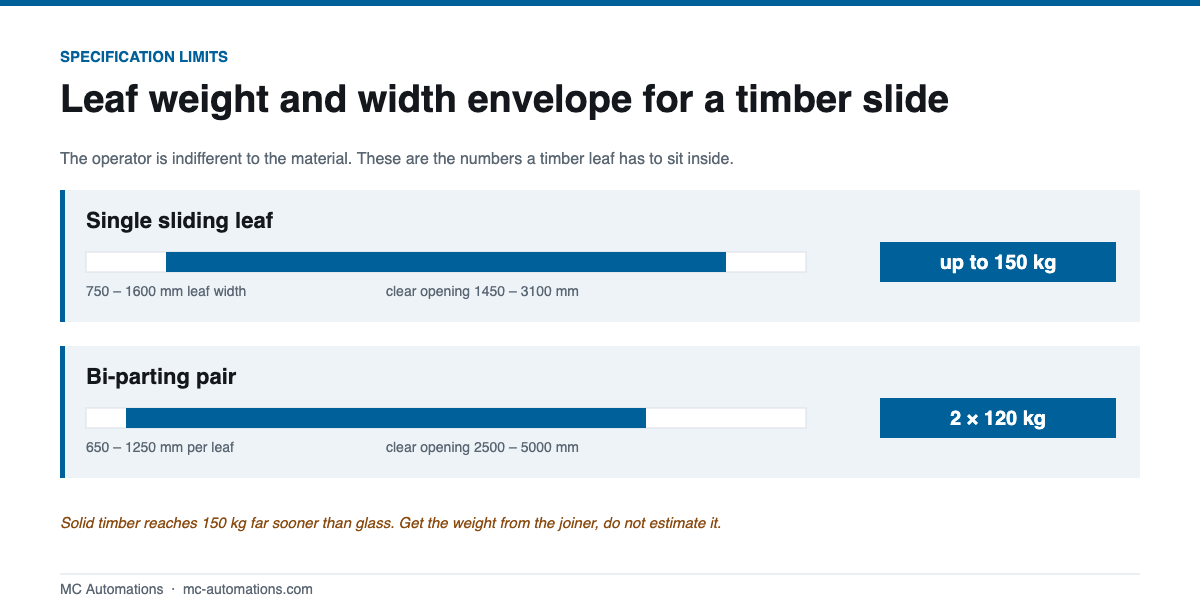
- The leaf is within the operator’s weight limit. Our MC-125 sliding operator drives up to 150 kg on a single sliding leaf, or 2 × 120 kg on a bi-parting pair. A solid timber leaf reaches those figures far sooner than a glass one, so the weight has to be known rather than estimated.
- The leaf is within the width range. Leaf widths run 750–1600 mm on a single slide and 650–1250 mm per leaf bi-parting, giving a clear opening of 1450–3100 mm single or 2500–5000 mm bi-parting.
- The leaf can carry the top-hung fixing. A sliding leaf hangs from carriages fixed into its top rail. Timber has to have enough sound material in the right place to take that fixing and hold it for years of cycling.
Where all three hold, wooden automatic sliding doors behave like any other automated slide. Where one does not, there is nearly always another route — a lighter door construction, a bi-parting pair instead of a single wide leaf, or a swing arrangement instead of a slide.
Weigh the leaf before you design the entrance
The single most useful thing you can do on a timber job is put a number on the leaf. Aluminium and glass leaves are predictable enough to estimate; timber is not, because construction varies enormously. A hollow-core or engineered leaf with a veneer face and a framed core is a completely different proposition from a solid hardwood slab of the same size, and the two can differ by a factor of three.
Get the figure from whoever is making the door. Your joiner can give a weight for the construction they are quoting, and that number is what decides whether wooden automatic sliding doors are available for the opening as drawn. If the leaf is already hanging, it can be weighed or estimated from the construction and the species, and we would rather assess it than guess.
The reason we are firm about this: an operator asked to drive a leaf beyond its rating does not fail dramatically on day one. It works, slightly slowly, and then wears out early. The belt, the carriages and the gearbox all take the punishment, and the entrance starts needing attention long before it should. Nobody connects that to a specification decision taken a year earlier, which is exactly why we take it now.
Where a leaf is too heavy for a single slide, the usual answer is a bi-parting pair. Splitting a 3 000 mm opening into two 1 500 mm leaves roughly halves the mass each carriage set has to move, and on wooden automatic sliding doors it is often cheaper than re-engineering the leaf to lose weight.
What timber does that aluminium does not
Four behaviours separate wooden automatic sliding doors from the aluminium and glass entrances we fit most often. None of them is a reason to avoid timber. All of them are reasons to detail it properly.
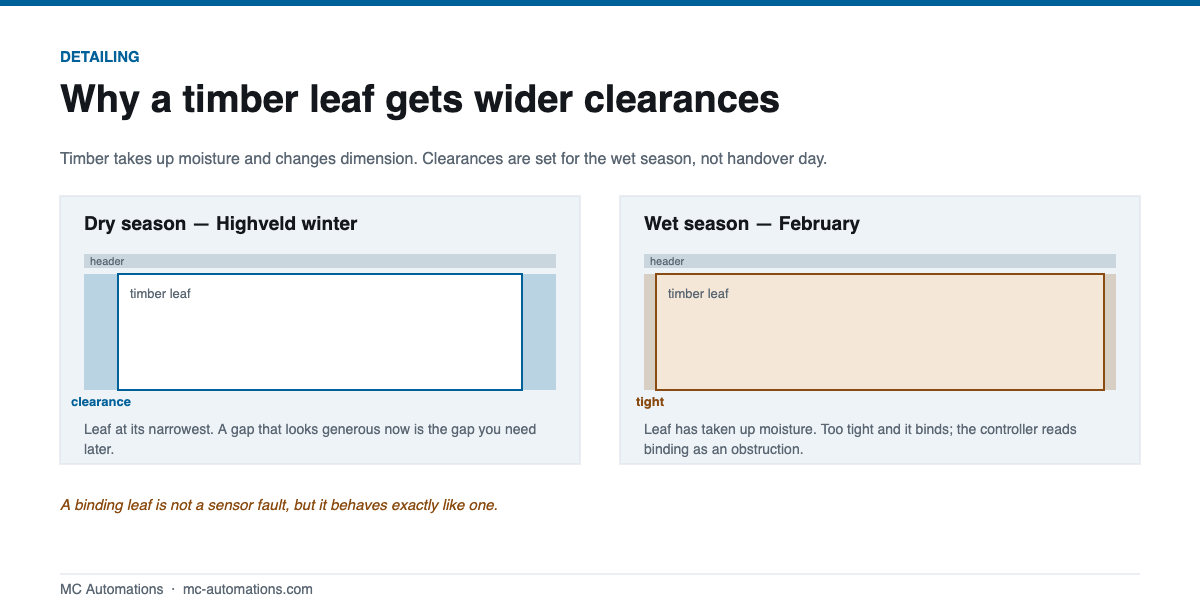
- Seasonal movement. Timber takes up and gives off moisture, and it changes dimension as it does. A leaf fitted tight in a dry Highveld winter can bind in a wet February. Clearances on wooden automatic sliding doors are set with that movement allowed for, not to the minimum that looks neat on handover day.
- Weight, and where it sits. Solid timber is heavy, and on a sliding leaf all of it hangs from the top rail. That concentrates load in a way a framed aluminium leaf does not, and it is the reason the fixing detail matters more here than anywhere else.
- Finish wear at hand height. An automated entrance is touched far less than a manual one, which is a genuine advantage for timber. But where people do push a leaf — on push-and-go, or during a power interruption — the finish takes it, and a timber finish shows that sooner than anodised aluminium.
- Exposure. Direct sun and driving rain are harder on a timber leaf than on aluminium. An external timber entrance needs its finish maintained on a schedule, and a leaf that has been allowed to go is a leaf that has probably also moved.
The practical consequence is that wooden automatic sliding doors reward a slightly more generous specification. Set clearances for movement, keep the leaf out of the worst of the weather where the building allows it, and put the finish on a maintenance schedule alongside the operator service.
The top-hung fixing is where timber jobs are won or lost
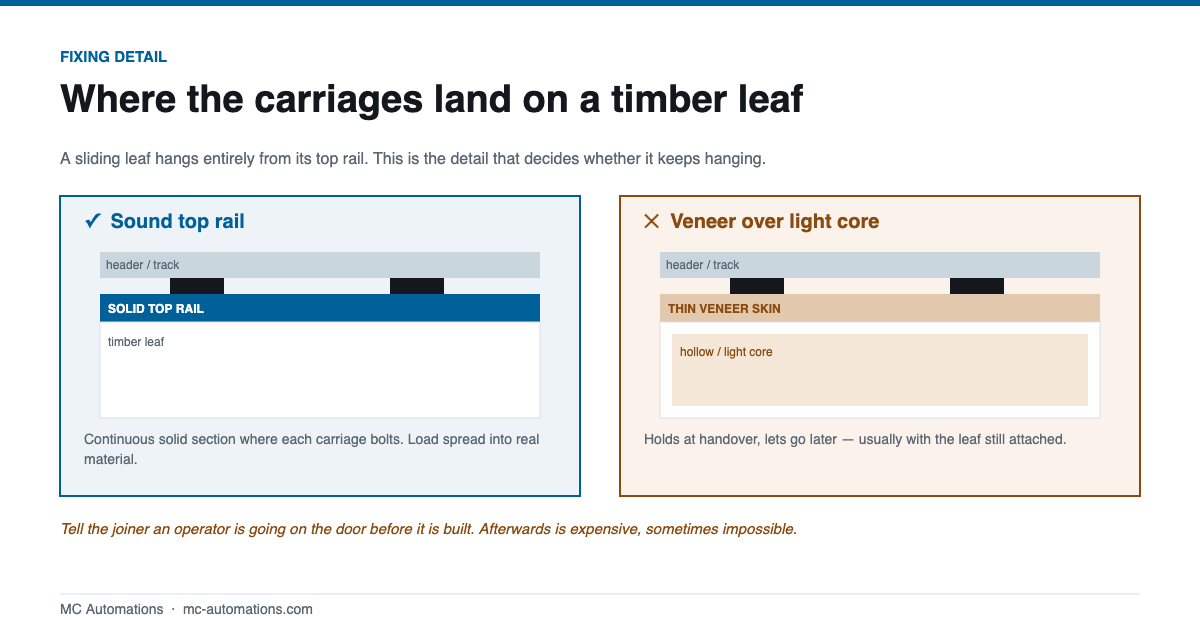
On a sliding entrance the leaf hangs from carriages that run in a track inside the header, and those carriages bolt into the top of the leaf. On aluminium that fixing goes into an extruded section designed for it. On timber it goes into whatever the joiner built.
So the top rail has to be sound, thick enough for the fixing, and continuous where the carriages land. A rail that is mostly veneer over a light core will hold for a while and then let go, usually with the leaf still attached. That is the single failure we most want to prevent on wooden automatic sliding doors, and it is entirely avoidable if the door is made knowing an operator is going on it.
Tell your joiner before the door is built. A leaf made with automation in mind costs the same as one that is not; a leaf that has to be modified afterwards costs considerably more, and sometimes cannot be fixed at all.
Where wooden automatic sliding doors earn their place
Timber is chosen for how the entrance looks and feels, and there are buildings where nothing else does the job. These are the positions where we are asked for wooden automatic sliding doors most often.
- Boutique hotels and lodges. An arrival that reads as warm rather than commercial, with hands-free entry for guests carrying luggage.
- Restaurants and wine estates. Where the entrance is part of the room and an aluminium shopfront would undercut it.
- Heritage and character buildings. Where the material is effectively fixed by the building, and the automation has to fit in behind it.
- Executive floors and boardroom suites. A quiet, unhurried door that matches the joinery already in the space.
- Showrooms and galleries. Where the entrance is part of the presentation and the detailing is scrutinised.
- Spa, wellness and consulting reception. Hands-free entry with a domestic rather than clinical feel.
In each of those the brief for wooden automatic sliding doors is the same: the entrance has to work like a commercial automated door and look like joinery. That is achievable, and it is mostly a question of deciding the automation early enough to influence how the leaf is made.
What wooden automatic sliding doors cost
We can give you a firm number for our half and a straight answer about the other half.
The automation is the part we price. The MC-125 sliding door operator is supplied from R27 590 excluding VAT. Where a swing arrangement suits the opening better, the MCW-100 swing door operator is supplied from R15 900 excluding VAT. Those are supply figures for the operator; installation, the track arrangement, sensors and any access control are quoted against the actual opening.
Sensors are priced separately and published. The MC-DL8 motion sensor for activation is R2 259,88 excluding VAT; safety sensors run from R2 777,90 for the Microcell One to R3 991,90 for the MC-507. Catalogue pricing was last updated 29 July 2026 and is confirmed in writing before an order.
The timber leaf is not ours to price. It comes from your joiner or shopfitter, and it is usually the larger and more variable half of the job, because species, construction, glazing and finish all move it. That is why you will not find a single figure for wooden automatic sliding doors anywhere honest — a solid meranti leaf and a veneered engineered leaf of the same size are not the same purchase.
What we can tell you is what the automation adds to a doorway you are already having made, which on wooden automatic sliding doors is usually the number you actually need in order to decide.
Retrofitting a timber door you already have
If a timber sliding door already hangs in the opening and runs properly by hand, automating it is frequently cheaper than replacing the entrance. Three questions decide whether that route is open.
- Will the header take an operator? There has to be sound structure above the opening to fix to, and depth for the unit.
- Is the leaf within weight and width? The same 150 kg and 750–1600 mm figures apply to an existing leaf as to a new one.
- Is the top rail sound enough for carriages? On an older door this is the question that most often ends the conversation, and it is worth checking before anything else.
Where the answers are yes, a retrofit keeps the door you chose and adds the automation behind it, which is the outcome most owners of character buildings are hoping for. Where the top rail will not take the load, we will say so rather than fit something that will fail.
Power is the other thing to settle early. There has to be a supply at the header, and on a retrofit in an older building there usually is not. That is an electrical job before it is a door job, and it is the most common cause of a wasted first visit on wooden automatic sliding doors.
When a swing arrangement beats a slide
Not every timber opening wants to slide. Our swing operator already drives aluminium, framed, timber, metal and glass swing doors, inward or outward opening, single or paired, using a pull-arm or push-arm arrangement, up to 150 kg and up to 1200 mm wide — though those two limits interact and we assess the leaf, hinges and head fixing before confirming.
A swing is worth considering instead of wooden automatic sliding doors in three situations, all of them about the opening rather than the timber. Where there is no wall space beside the opening for a leaf to slide into, a slide simply does not fit. Where a timber door is already hung on hinges and works, automating the swing avoids rebuilding the opening entirely. And where the leaf is heavy and narrow, a swing carries the weight on hinges in the wall rather than hanging all of it from a header.
Push-and-go is worth knowing about on a timber swing: a light push on the leaf tells the operator to take over and complete the opening under power, which suits a boardroom or a restaurant door where a fully automatic entrance would feel wrong.

Sensors and safety do not change with the material
The safety requirement on wooden automatic sliding doors is identical to any other powered entrance, and it is not a comfort feature. Activation sensing opens the door for an approaching person; presence sensing holds it while somebody is standing in the opening. The door must detect a person in the opening and hold rather than close on them, and that principle is not negotiable on a timber leaf any more than a glass one.
One timber-specific point does arise. A solid leaf is heavier than a glass one, so it carries more momentum, which makes the closing force setting and the presence field more important rather than less. Opening and closing speed, hold-open time, force and the detection zones are set on site for the way the doorway is actually used, then demonstrated at handover and written down. Sensor arrangement is worth getting right the first time.
Where the doorway sits on an escape route, what it must do on alarm and on power loss is set by the building’s fire strategy and confirmed with the fire consultant or the local authority, not chosen by us. Published guidance from the South African Bureau of Standards is a reasonable starting point for the vocabulary, though the requirement for a particular entrance is always confirmed for that building. We make no fire-performance claim for a timber leaf we did not supply.
Servicing a timber entrance
The operator on wooden automatic sliding doors is serviced exactly as it would be on any other door: sensors checked and realigned, belt, rollers and guides inspected, opening and closing force re-checked, wear parts replaced before they strand the entrance. Our warranty is 24 months on the operator, and wear parts and sensors are quoted and warranted separately.
What changes on wooden automatic sliding doors is that the leaf goes on the visit list too. We look at clearances, because a leaf that has moved seasonally will bind before it fails, and a binding leaf reads to the controller as an obstruction. We look at the top-rail fixing, because that is the one that matters. And we flag finish deterioration, because on an external timber entrance the finish is what holds the movement in check.
Our service visits record the condition each time so the interval can be set from evidence, and we attend repairs on any major brand, not only operators we supplied.
What to send us for a quotation
Five things get you a real answer on wooden automatic sliding doors without a site visit.
- The clear opening you need, and the structural opening you have.
- The leaf weight from your joiner, or the construction and species if the door already exists.
- A photograph of the opening taken far enough back to show the wall either side and the header above.
- How much wall space there is beside the opening for a leaf to slide into.
- Whether there is an electrical supply at the header, and whether the entrance is on an escape route.
From that we will tell you which operator suits the leaf, whether a slide or a swing is the better arrangement, and what the automation costs. If the door as drawn will not work, we will say what to change while it is still a drawing.
A short glossary
- Leaf. The moving part of the door. On wooden automatic sliding doors, the timber panel itself.
- Top-hung. A sliding leaf suspended from carriages in the header rather than running on a floor rail.
- Carriage. The wheeled assembly that bolts to the top of the leaf and runs in the track.
- Clear opening. The usable width once the door is fully open, always less than the structural opening.
- Bi-parting. Two leaves opening away from each other from the centre of the opening.
- Push-and-go. A light manual push that signals the operator to complete the opening under power.
- Operator. The drive unit and controller in the header. What we supply, warrant and service.
Quick answers on wooden automatic sliding doors
- Wooden automatic sliding doors are automated by us; the timber leaf is made by your joiner, not by us.
- Wooden automatic sliding doors run on the MC-125, supplied from R27 590 excluding VAT.
- Wooden automatic sliding doors are limited to 150 kg on a single leaf, or 2 × 120 kg bi-parting.
- Wooden automatic sliding doors take leaf widths of 750–1600 mm single and 650–1250 mm per leaf bi-parting.
- Wooden automatic sliding doors need a sound, continuous top rail to carry the carriages.
- Wooden automatic sliding doors get wider clearances than aluminium, because timber moves with the seasons.
- Wooden automatic sliding doors can be retrofitted to an existing timber door that still runs by hand.
- Wooden automatic sliding doors carry a 24-month warranty on the operator; the leaf is warranted by whoever made it.
- Wooden automatic sliding doors have no single price, because timber construction varies more than the automation does.
- Wooden automatic sliding doors need the same activation and presence sensing as any powered entrance.
- Wooden automatic sliding doors are a swing job instead where there is no wall space to slide into.
- Wooden automatic sliding doors are pedestrian entrances; we supply no roller shutters, gates or garage doors.
Frequently asked questions
Can you automate a wooden sliding door?
Yes. The operator is indifferent to the material within its limits, so wooden automatic sliding doors work where the leaf is under 150 kg on a single slide, within the 750–1600 mm width range, and has a top rail sound enough to carry the carriages. We confirm all three against your actual door before quoting.
What does a wooden automatic sliding door system cost in South Africa?
We price the automation, not the leaf. The MC-125 sliding operator is supplied from R27 590 excluding VAT and the MCW-100 swing operator from R15 900 excluding VAT, with installation, track, sensors and access control quoted against the opening. The timber leaf comes from your joiner and is usually the larger and more variable half of the job, which is why no honest single figure exists for a complete system.
Do you make the wooden doors as well?
No. We automate them. We import and assemble our operators at our Laser Park premises and we fit, commission and service the automation. Aluminium and glass leaves come through our sister company Coetz; a timber leaf comes from your joiner or shopfitter, or it is the door already in the opening.
How heavy can the timber leaf be?
Up to 150 kg on a single sliding leaf, or 2 × 120 kg on a bi-parting pair. Solid timber reaches that far sooner than glass, so get the weight from whoever is building the door rather than estimating it. Where a single leaf is too heavy, splitting the opening into a bi-parting pair usually solves it.
Will a timber leaf bind in wet weather?
It can if the clearances were set too tight. Timber takes up moisture and changes dimension, so we set clearances on wooden automatic sliding doors with seasonal movement allowed for. A binding leaf reads to the controller as an obstruction, so the door starts behaving oddly for a reason nobody connects to the weather.
Can an existing wooden door be automated rather than replaced?
Often yes, and it is usually cheaper. The header must take an operator, there must be a power supply at the opening, and the top rail must be sound enough for the carriages. On older doors that last point is the one that most often rules it out, so it is worth checking first.
Talk to us about a timber opening
Send the opening size, the leaf weight and a photograph of the doorway, and we will tell you whether wooden automatic sliding doors suit the position and what the automation costs. Request a quote, see the wider range on our automatic door systems page, or call 010 412 0062. We install nationwide, with same-day call-outs in Gauteng.
In short
Wooden automatic sliding doors at a glance
- We automate the timber leaf; your joiner makes it. Aluminium and glass come through Coetz.
- Limits that decide it: 150 kg single leaf, 750–1600 mm leaf width, and a top rail that will hold carriages.
- Operators from R27 590 sliding and R15 900 swing, excluding VAT. The leaf is priced separately.
- Timber moves seasonally, so wooden automatic sliding doors get wider clearances by design.
- Tell the joiner an operator is going on it before the door is built, not afterwards.