
Office park automatic doors for landlords and managing agents: who owns which entrance, the access states a working week needs, the morning peak that sizes the lobby, standardising across an estate, and why maintenance recovery changes the contract.
Benefits of Automatic Doors: Five That Hold Up
Benefits of automatic doors get listed in every brochure, usually with percentages nobody can substantiate. This guide sets out the five that genuinely hold up, explains what each one depends on, and is honest about where an automatic entrance is not worth it.
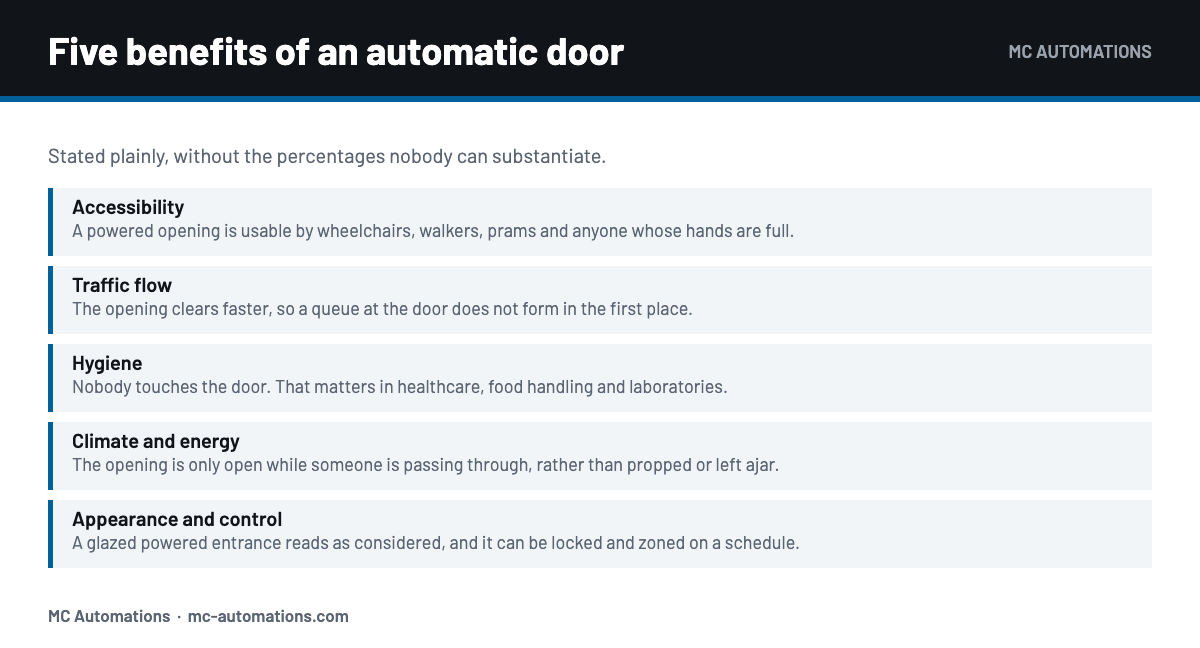
Benefits of automatic doors 1: accessibility
This is the benefit that changes whether somebody can use your building at all, rather than merely making it nicer.
A heavy manual door with a strong closer is a real barrier for a wheelchair user, and for many older visitors. Add a pram, a trolley or an armful of stock and the same door becomes awkward for almost anyone.
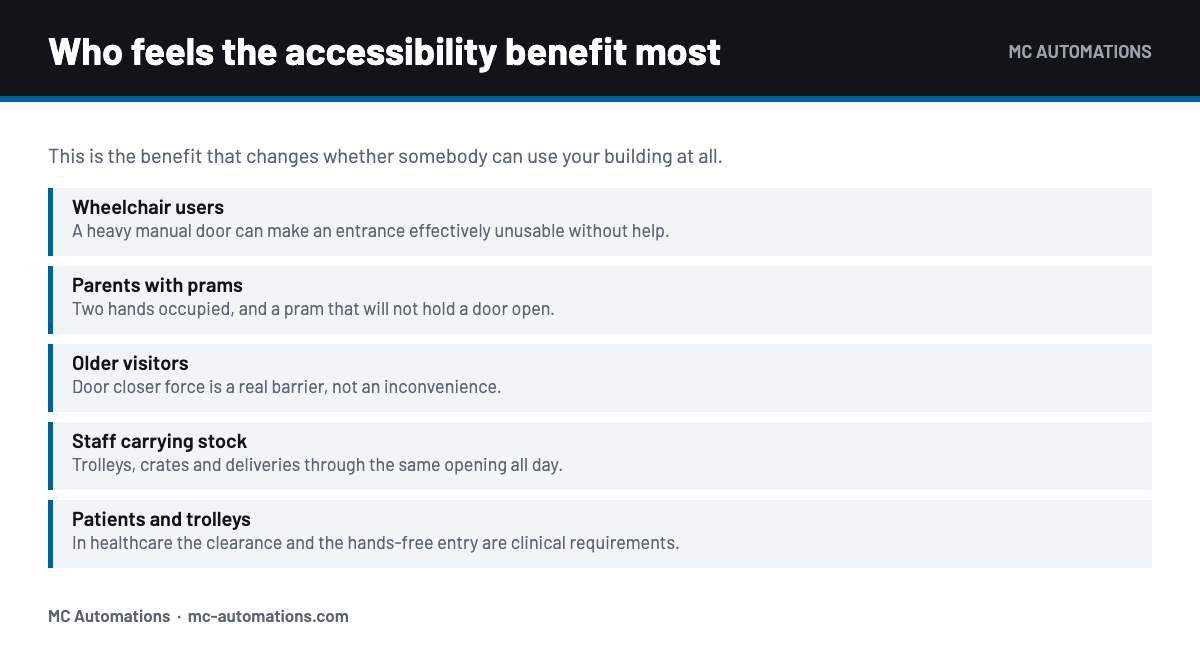
A powered opening removes that entirely. Nobody has to ask for help, and nobody has to put anything down.
Of all the benefits of automatic doors, this is the one that is hardest to argue with and easiest to observe on any busy entrance.
Benefits of automatic doors 2: traffic flow
A manual door creates a bottleneck at exactly the moment you least want one.
Every person arriving has to slow, pull or push, and hold. During a busy period that compounds into a queue at the threshold, which on a retail entrance is a queue of people deciding whether to come in.
An automatic entrance clears continuously. On a wide opening, a bi-parting configuration halves the travel distance again, which is why busy centre entrances use it.
Benefits of automatic doors 3: hygiene
Nobody touches the door. That is the whole argument, and it is a strong one in the right building.
In healthcare, food handling and laboratory settings, a shared door handle is a contact point that has to be managed. Removing it is simpler than managing it.
This is also why touch-free activation is specified so often in clinical corridors, and why the benefits of automatic doors are taken more seriously in those sectors than almost anywhere else.
Benefits of automatic doors 4: climate and running costs
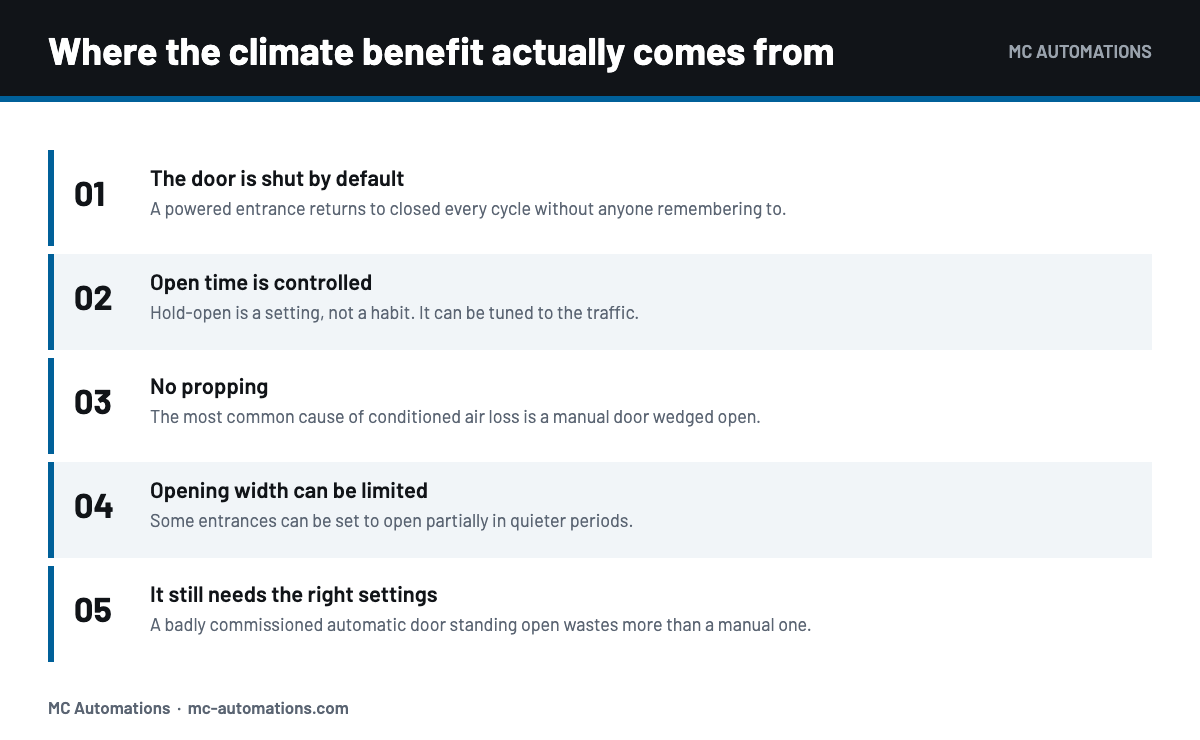
The honest version of this benefit is narrower than the brochures suggest, and it is still real.
A powered entrance is closed by default. It returns to closed after every single cycle without anyone remembering to close it.
The largest single source of conditioned air loss in most buildings is a manual door propped open, usually for convenience during a delivery or a busy spell. An automatic door removes the reason to prop it.
Hold-open time is a setting rather than a habit, so the opening is open for as long as it needs to be and no longer.
We are not going to quote you a percentage saving. It depends on your building, your climate control and your traffic, and anyone offering a precise figure without seeing those things is guessing.
Benefits of automatic doors 5: appearance and control
A glazed powered entrance reads as considered. That matters on a reception, a showroom or a shopfront where the entrance is the first thing anyone sees.
More practically, it is controllable. Mode switching, locking, time schedules and access control integration all become possible once the entrance is powered.
A liquor store that needs easy trolley access during trading and a secure opening overnight is solving that with settings rather than with staff.
Manual against automatic, honestly
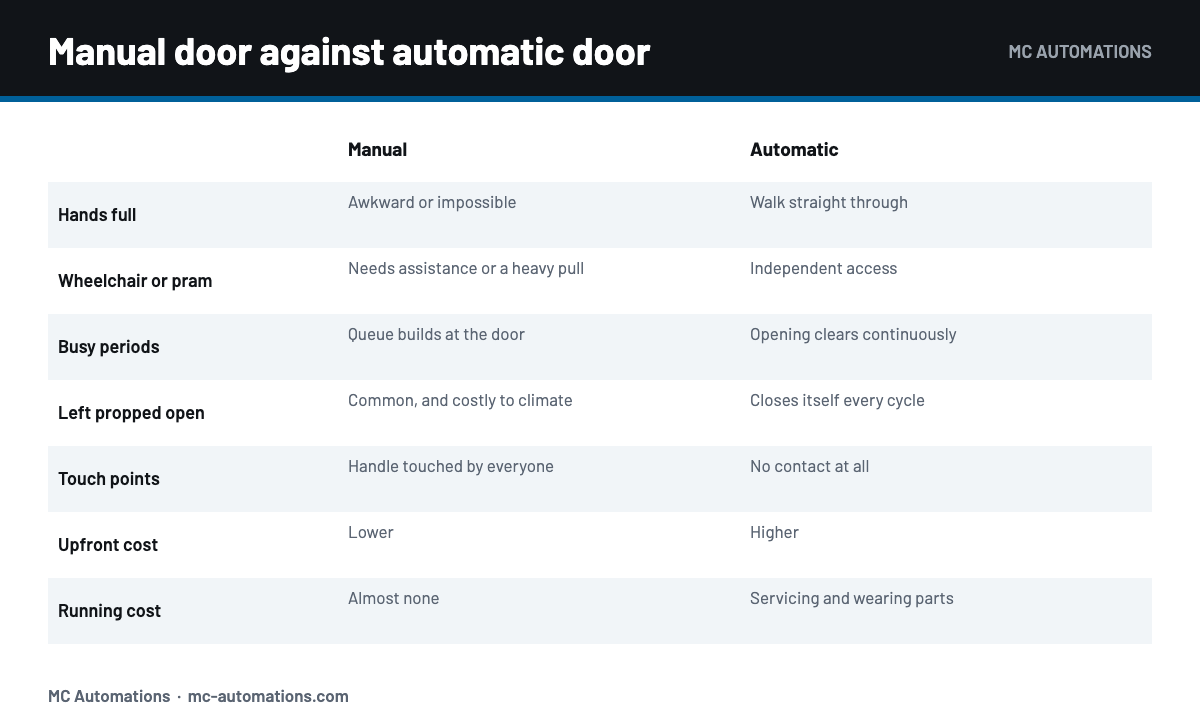
A manual door is cheaper to buy and has almost no running cost. That is a genuine advantage and it is why not every opening should be automated.
An automatic door costs more upfront and has real running costs, because it is a machine with wearing parts.
The trade is worth making where traffic is continuous, where accessibility matters, or where hands are routinely full. It is usually not worth making on a quiet back-office or store-room door.
What the benefits depend on

Every benefit above is conditional, and it is worth being blunt about that.
Correct duty rating. An operator under-specified for your traffic fails often, and an entrance out of service delivers none of these benefits.
Proper commissioning. Speeds, hold-open and obstacle force set for your building rather than left at factory defaults.
Full presence sensing. Without detection across the whole opening, the entrance is a convenience rather than a safe one.
Regular servicing. Benefits degrade quietly. Sensors film over, belts stretch, and the entrance is noticeably worse months before anyone reports a fault.
A plan for power failure. On a fire escape route the opening must be passable without power, through break-out panels or a fail-safe release.
Where an automatic door is not the answer
Low-traffic openings where the cost will never be justified by use.
Buildings unwilling to budget servicing, because an unmaintained automatic door is genuinely worse than a manual one.
Openings where a pressure differential must be held, which needs a hermetically sealed door rather than a standard entrance.
We would rather tell you an opening does not warrant automation than sell you one that will sit unserviced.
Getting it specified properly
Send the structural opening size in millimetres, a photograph from inside and outside, rough daily footfall, and whether the opening is on an escape route.
Request a quote or call 010 412 0062, Monday to Thursday 08:00 to 16:30 and Friday 08:00 to 14:00.
See also automatic door installation cost, how to judge an automatic sliding door and automatic doors for business.
For published national standards, SABS, the South African Bureau of Standards is the reference body in South Africa.
Benefits of automatic doors by building type
The five benefits are the same everywhere. Which one justifies the spend is not.
Retail. Traffic flow dominates. The benefits of automatic doors here are measured in whether a queue forms at the threshold during your busiest hour.
Healthcare. Accessibility and hygiene, in that order. Bed and trolley clearance is a clinical requirement rather than a convenience.
Offices and reception. Appearance and control, with access integration usually part of the brief from the start.
Food handling and laboratories. Hygiene first. Removing a shared contact point is simpler than managing one.
Cold rooms and chilled areas. The climate benefit is at its largest here, because the cost of an opening left ajar is continuous rather than occasional.
Gyms and service stations. Hands-free entry and continuous flow, at the highest cycle counts of any setting.
See automatic doors for business for what each of those environments demands technically.
How to tell whether the benefits apply to you
Three questions settle it faster than any brochure.
How many people pass through in a day? Below a certain volume the benefits of automatic doors never repay the running cost, and we will say so.
What are they carrying? Trolleys, prams, stock and equipment change the answer dramatically.
Who are you excluding? If a heavy manual door is a barrier to any of your visitors, that is an accessibility question rather than a commercial one.
The benefits that only appear later
Two of the benefits of automatic doors are invisible on day one and obvious after a year.
The first is consistency. A powered entrance behaves identically at 08:00 and at 17:00, regardless of who is on shift and whether anybody remembered to prop or unprop anything.
The second is control. Once an entrance is powered, changing how it behaves is a settings conversation rather than a building one. Opening width, hold-open, locking schedules and access zones are all adjustable without touching the fabric.
A fair summary
The benefits of automatic doors are real, well understood and entirely conditional on specification and servicing.
Specified correctly and maintained on a sensible interval, a powered entrance is better than a manual one on every measure except purchase price and running cost.
Specified badly or left unserviced, it is worse than the manual door it replaced. That is the part most articles leave out, and it is the part worth knowing before you spend.
Benefits of automatic doors: the short list
Accessibility. Of all the benefits of automatic doors this is the one that decides whether some visitors can use the building unaided.
Traffic flow. The benefits of automatic doors show up fastest on a busy entrance, where a manual door builds a queue.
Hygiene. No shared handle. The benefits of automatic doors are taken most seriously in healthcare and food handling for this reason.
Climate control. Closed by default, with hold-open as a setting rather than a habit.
Control and appearance. Locking, schedules and access zones become settings once the entrance is powered.
The honest caveat. All five benefits of automatic doors depend on correct duty rating, proper commissioning, full presence sensing and regular servicing.
Where they do not apply. On a low-traffic opening, the benefits of automatic doors will not repay the running cost, and we will tell you that rather than quote you.
Not sure? Send daily footfall and a photograph of the opening and we will give you a straight answer.
Weighing the benefits of automatic doors against the costs
A fair assessment puts the benefits of automatic doors next to two real costs rather than pretending they do not exist.
The first is purchase. A powered entrance costs meaningfully more than a manual one, and that gap widens with duty rating and sensor coverage.
The second is upkeep. Rollers, belts and seals wear, sensors need cleaning, and the service interval follows your traffic rather than the calendar.
Set against that, the benefits of automatic doors accrue every single day the entrance is used, and they accrue most on exactly the entrances that are hardest to staff and busiest to manage.
Our view, having serviced a great many of both: automate the openings where traffic, accessibility or hygiene genuinely demand it, and leave the rest manual. The benefits of automatic doors are real, but they are not universal, and spreading the budget across every opening in a building is usually the wrong call.
Questions worth asking before you commit
Whoever you buy from, these five questions surface the difference between an entrance that delivers and one that disappoints.
How many cycles a day is this rated for, and how did you work that out from my traffic? If footfall was never discussed, duty rating was guessed.
Does presence detection cover the full opening width? Activation-only specifications are still quoted, and they are a convenience rather than a safety system.
What happens on power failure, and on fire alarm? Those two answers determine whether the entrance is suitable for an escape route.
Where are the spare parts held, and what is a realistic lead time? A warranty is only as useful as the part behind it.
What service interval do you recommend for my environment? A supplier who says annual regardless of setting has not thought about your building.
None of those require technical knowledge to ask, and the answers tell you a great deal about what you are actually buying.
Benefits of automatic doors, answered
What are the main benefits of automatic doors?
Accessibility, faster traffic flow, hygiene through hands-free entry, better control of conditioned air, and a controllable entrance that can be locked and zoned.
The benefits land differently in each sector, which is where our commercial automatic doors page goes into detail.
Do automatic doors save energy?
They help, mainly by being closed by default and by removing the habit of propping a door open. The size of the saving depends on your building, and anyone quoting you a precise percentage is guessing.
Are automatic doors worth it for a small business?
It depends on traffic and on who uses the entrance. Where customers arrive with trolleys, prams or full hands, the benefit is immediate. On a quiet back office door it usually is not.
Do automatic doors improve accessibility?
Substantially. A heavy manual door can make an entrance effectively unusable for a wheelchair user without assistance, and a powered opening removes that barrier entirely.
Are automatic doors more hygienic?
Nobody touches the door, which removes a shared contact point. That matters most in healthcare, food handling and laboratories.
What are the disadvantages of automatic doors?
Higher upfront cost, and genuine running costs. They are machines with wearing parts that need servicing, and an unserviced automatic door is worse than a manual one.
Do automatic doors need a lot of maintenance?
They need regular, small maintenance rather than a lot of it. Track cleaning, sensor cleaning and a periodic service matched to your traffic.
Do automatic doors work during load shedding?
Only with a battery backup or generator supply. Without one the opening must still be openable by hand, which is a requirement on escape routes.
Will an automatic door make my entrance safer?
Only if it is specified with full presence sensing and commissioned properly. Activation sensing alone is a convenience, not a safety system.
How long do the benefits last?
As long as the entrance is serviced. Benefits degrade quietly as sensors film over and belts stretch, which is why interval matters more than brand.
In short
Benefits of automatic doors at a glance
- Benefits of automatic doors are quoted against the opening we measured, not a catalogue price.
- Ask about benefits of automatic doors and we confirm the opening, the head and the power position first.
- Benefits of automatic doors are installed and commissioned by our own technicians.
