
Office park automatic doors for landlords and managing agents: who owns which entrance, the access states a working week needs, the morning peak that sizes the lobby, standardising across an estate, and why maintenance recovery changes the contract.
How an Automatic Door Installation Works, Step by Step
An automatic door installation is mostly decided before anybody arrives with tools. The survey sets the specification, the specification sets the operator, and the operator decides how the entrance behaves for the next decade. This guide walks through the work the way we actually run it, so you can tell a thorough job from a fast one.
What an automatic door installation involves
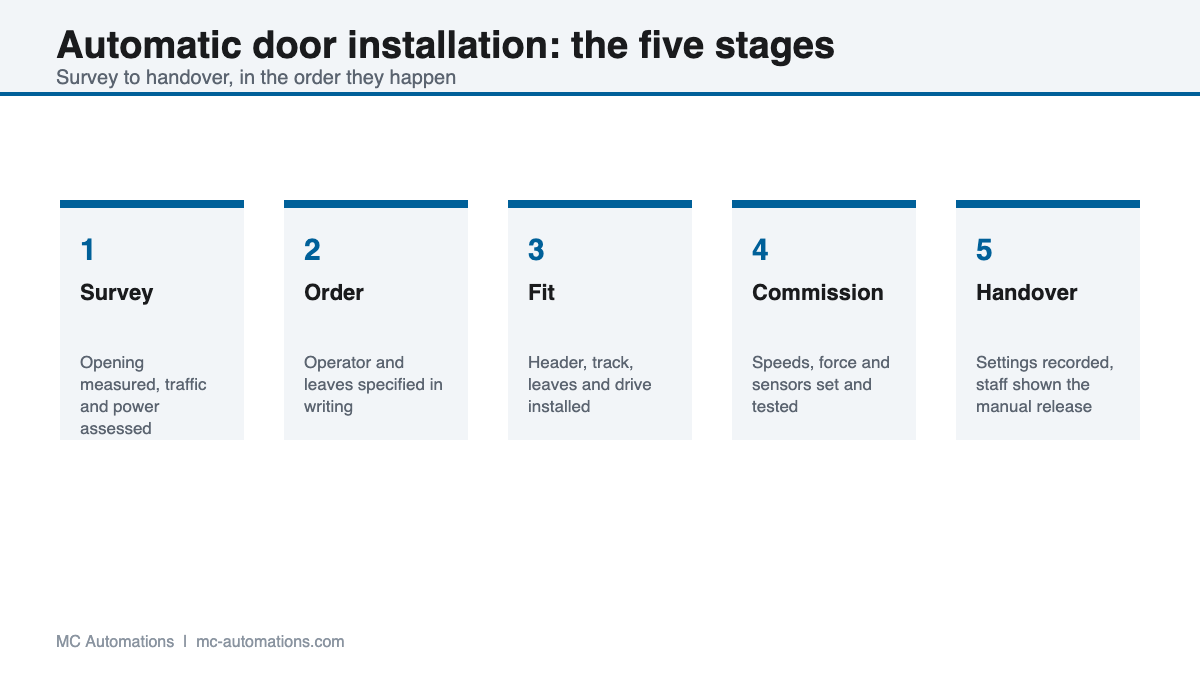
A complete automatic door installation covers five stages: survey, specification, fitting, commissioning and handover. Skipping any of them is what produces an entrance that runs badly from the first week. The physical work is the shortest part. Most of the outcome is decided on paper, which is also why a quotation built without a site visit is usually the one that changes later.
It helps to be clear about what is being bought. You are not buying a door; you are buying a door, a drive unit, a sensor arrangement and the setting-up that makes the three behave as one. Take away the last of those and you have components rather than an entrance.
Stage 1: the survey
Every automatic door installation starts with measurements taken on site, not from a photograph. We record the structural opening, the clear passage width the building needs, the floor condition, the power supply and the traffic the entrance carries.
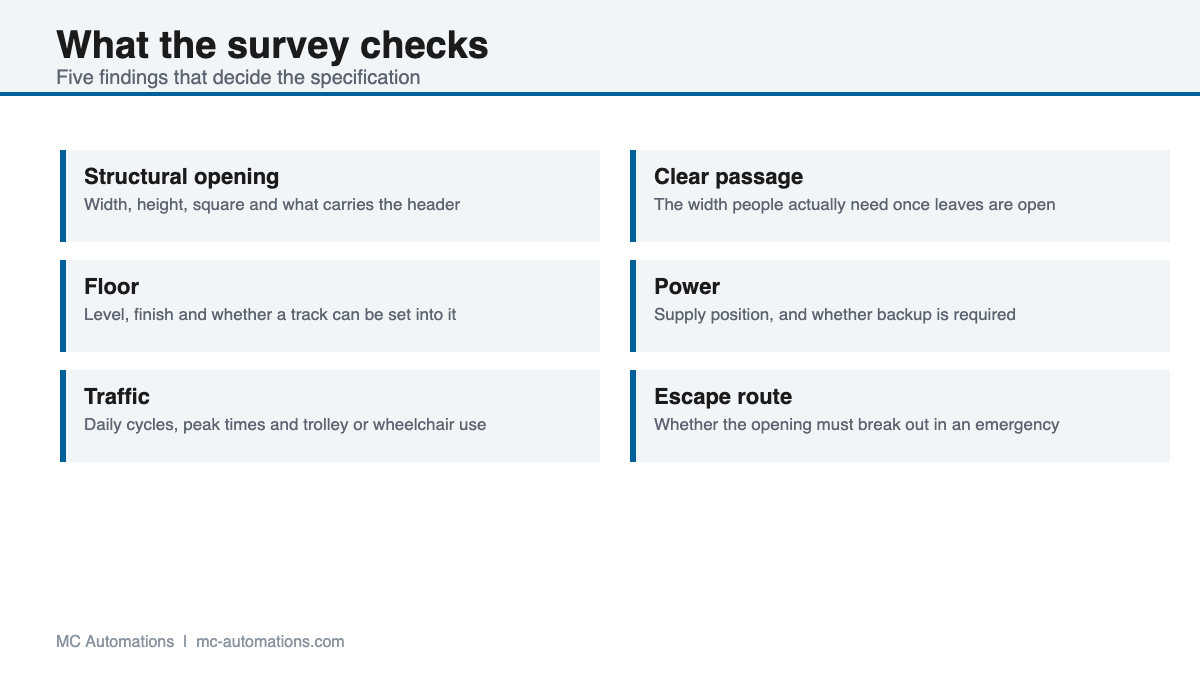
Two findings matter more than the rest. The first is leaf weight, because mass decides which operator can start and stop the door safely on every cycle. The second is whether the opening sits on an escape route, because that dictates break-out and fail-safe behaviour rather than leaving it to preference.
The survey also establishes what is above the opening. A header has to be fixed to something that can carry it: a lintel, a steel beam or a properly designed sub-frame. Shopfronts that have been altered over the years often have less structure there than the drawing suggests, and finding that out on fitting day is expensive.
Stage 2: specification and order
The specification turns the survey into a written scope naming the operator, the leaf arrangement, the glass, every sensor and what the building must provide. Ours separates equipment, installation and commissioning so each is visible. If you are comparing prices, read what drives automatic door installation cost before choosing on the total alone.
System choice is settled here too. A sliding entrance, a swing operator on an existing leaf, a telescopic arrangement for a wide opening in a narrow shopfront, or a revolving or hermetic door all lead to different work on site. Our automatic door systems page sets out where each one fits, and the MC-125 sliding operator covers most retail and office entrances we are asked about.
Stage 3: the fitting
On the day, the automatic door installation follows a fixed order: header and fixings, track, carriages, leaves, drive unit, then sensors and any access control. The header carries everything, so its fixings are checked against the structure rather than assumed. Leaves are hung and moved by hand before power is applied, because a door that binds when pushed by hand will bind under an operator too.
Where an existing entrance is being replaced, the old equipment comes out first and the opening is re-measured before the new track goes in. Buildings move, and a structural opening is rarely exactly what it was when the previous entrance went in.
Who does what on the day
Our technicians bring the equipment, the fixings and the tools, and they are responsible for everything from the header up. The building provides access, a working power supply at the header position, and a clear area to work in. Where glazing is being replaced at the same time, sequencing matters: glass arrives after the track is aligned, not before, so a heavy panel is not standing on site waiting for adjustment work.
On trading sites we agree the sequence in advance so the opening is secured at the end of each day. A shopfront that cannot be locked overnight is not an acceptable outcome, and planning for it costs nothing if it is discussed before the booking.
Stage 4: commissioning
Commissioning is where an automatic door installation becomes safe rather than merely functional. Opening and closing speeds, hold-open time and obstruction force are set for the traffic the entrance actually carries. Activation and presence sensors are aimed and walked through the full sweep, including the threshold, and obstruction detection is tested with an object rather than trusted from a controller display.
Force, speed and sensor coverage are set against the relevant South African standards, published by the SABS. Where a client asks for a faster door than the setting allows, we explain the trade-off rather than simply turning it up. Speed is the first thing people ask for and the first thing that causes an incident.
Stage 5: handover
An automatic door installation ends with a record, not a handshake.
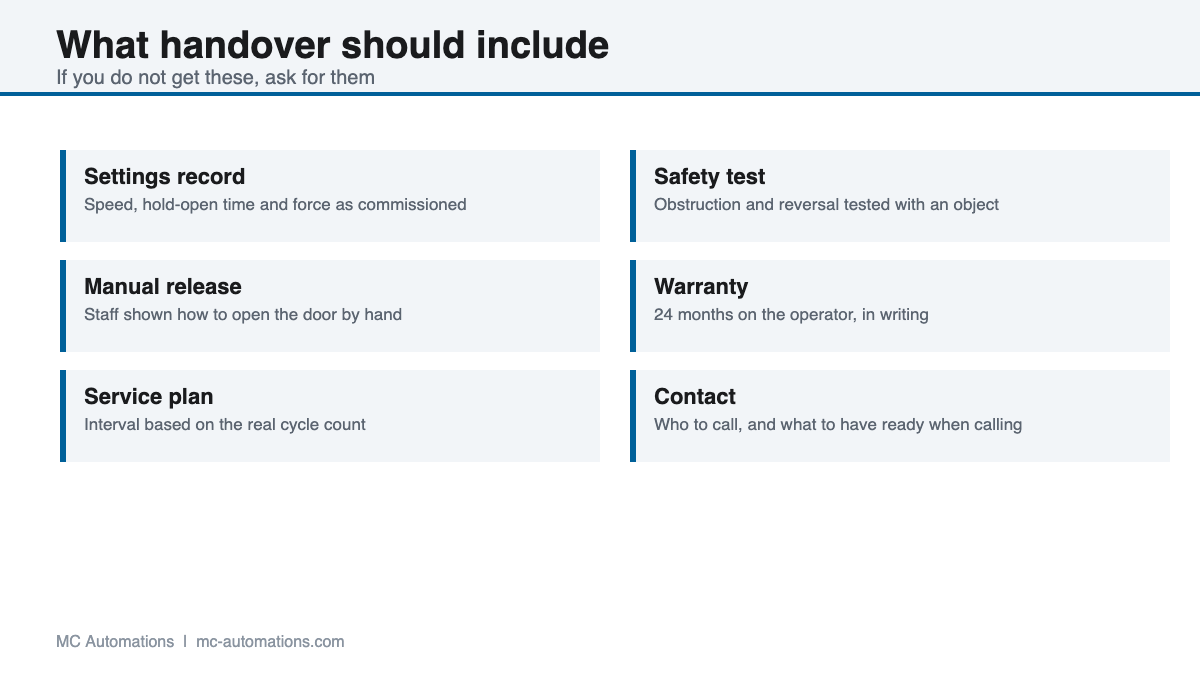
You should receive the commissioned settings in writing, a demonstration of the manual release, the warranty terms and a recommended service interval. Our operators carry a 24-month warranty, and the settings record is what lets the next service visit start from a known state instead of guesswork. Staff turnover is high on most sites, so we show more than one person how to release the door by hand.
How long an automatic door installation takes
Site time depends on the system and on what is already there. A swing operator fitted to a sound existing door is the quickest job we do. A telescopic entrance with four leaves takes the longest, because there is more to align and more to set.
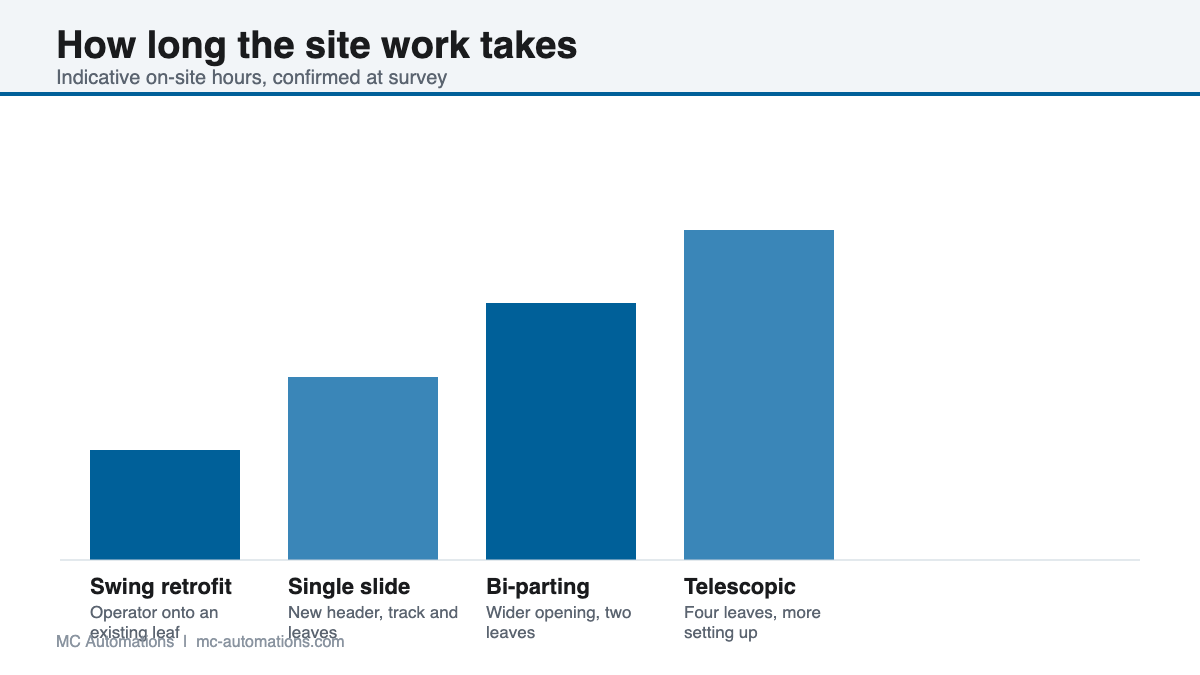
Those hours cover fitting and commissioning only. Lead time beforehand depends on supply of the operator and the glass, and it is quoted separately so a trading shopfront can plan around it.
What goes wrong in an automatic door installation
Most failures trace back to one of five things, and all of them are avoidable:
- An operator sized below the leaf. The cheapest quotation is often the one that has undersized the drive for the glass.
- No presence sensing. Activation alone does not see somebody standing still in the opening.
- A header fixed to something that cannot carry it. This shows up as sagging and misalignment months later.
- Floor not checked. An uneven threshold makes leaves drag no matter how well the drive is set.
- No commissioning record. Without settings written down, every future adjustment is guesswork.
If an existing entrance already shows these symptoms, a repair visit can usually correct setting and sensor problems, but an undersized operator has to be replaced.
Retrofit or new opening
A retrofit reuses the structural opening and sometimes the frame, which keeps cost and downtime down. A new opening gives free choice of clear width and system, but adds structural work and usually a longer programme. The survey tells you which one you are actually facing: where the header cannot carry the load or the opening is out of square, a retrofit stops being the cheaper option.
There is a middle case worth knowing about. An entrance whose structure is sound but whose drive and controller are obsolete does not need replacing at all: the header stays and the working parts are renewed. That is modernisation rather than a new automatic door installation, and it is usually the better spend on a building that is otherwise in good order.
How to prepare your site
Four things make an automatic door installation go quickly, and none of them cost money:
- Clear the opening on both sides, far enough back to stand a leaf safely.
- Confirm the power at the header position, and tell us if the circuit is shared with anything that trips.
- Agree access times in writing, especially in centres with loading restrictions.
- Name one contact who can make a decision if something on site differs from the drawing.
The last one matters more than it sounds. Nearly every delay we see on an otherwise straightforward automatic door installation comes down to waiting for somebody to approve a small change.
Where an automatic door installation meets the other trades
On a new opening, the automatic door installation is rarely the first or the last thing to happen, and most programme problems come from the joins rather than from the door.
The electrician needs to have brought a switched supply to the head of the opening before we arrive. It is a small item that holds up an entire day when it is missing, because an operator cannot be commissioned without power and a temporary lead is not an acceptable substitute. The builder needs the structural opening finished to the dimensions on the order — not close to them. An opening 20 mm out of square is workable; one 40 mm narrower than ordered means the leaves do not fit and the automatic door installation stops.
Flooring is the join most often missed. If screed, tiling or a levelling compound is going down after us, the bottom track and the door clearances have to be set for the finished floor level rather than the level on the day. Get that wrong and the leaves either scrape the new floor or run with a gap large enough to admit dust and draughts. We ask for the finished floor level in writing, and where it is not yet decided we would rather return to set the clearances than guess.
Ceilings and bulkheads come last and cause the most surprises. A header needs its depth above the opening, and a bulkhead designed without reference to the automatic door installation can leave nowhere for the drive to sit. It is worth the ten minutes at design stage.
Snagging, and what a completed installation should look like
An automatic door installation is finished when the entrance has been commissioned, demonstrated and documented — not when the leaves move.
Walk it yourself before you sign. Approach at normal walking pace from both sides and check the door opens in time rather than making you wait. Stand still in the opening and confirm the leaves hold rather than closing on you. Watch the closing cycle end: the last few degrees should be controlled, not hurried. Check the leaves meet evenly on a bi-parting pair and that the gap at the jamb is consistent top to bottom.
Then ask for the handover items: the fail state the entrance is set to, where the manual release is and a demonstration of it, the sensor layout, and the maintenance interval recommended for your traffic. Any automatic door installation we complete includes those, and an entrance handed over without them has been fitted rather than commissioned.
Quick answers
- Start with a survey — opening, floor, power and traffic, measured on site rather than estimated.
- Cost follows the leaf — weight and width decide the operator, and the operator drives the price.
- Escape routes need break-out or fail-safe behaviour agreed before the order is placed.
- Sensors are itemised — activation and presence listed separately, never bundled as a package.
- Power-up is not the end — commissioning sets speed, hold-open time and force.
- Trading sites are sequenced so the opening is never left unsecured overnight.
- Swing retrofits are the quickest route to an accessible entrance.
- Wide openings often mean telescopic leaves rather than a single slide.
- Warranty is 24 months on the operator, with wear parts quoted separately.
- Handover includes the settings record and a manual release demonstration.
- Doors fitted by others can still be serviced by us, starting with a condition survey.
- Outside Gauteng work is scheduled in runs to keep travel costs honest.
Frequently asked questions
How long does an automatic door installation take?
The site work runs from roughly six hours for a swing retrofit to about two days for a telescopic entrance. Equipment lead time is separate and is quoted before the booking is made.
Can the work be done while we trade?
Usually yes. The sequence is agreed beforehand so the opening is secured at the end of each day, which matters most on shopfronts and hospital entrances.
Does an automatic door installation need a site visit first?
For a replacement entrance, yes. For a new opening on a drawing we can quote from the drawing, but the details are still confirmed on site before fitting begins.
What power supply is needed?
A dedicated supply at the header position. Where power interruptions matter, battery backup is specified up front rather than added afterwards.
Who is responsible for the structural opening?
The building. We assume a sound, square opening with a floor that can take the track; where it is not, we report it and quote the remedial work instead of fitting over the problem.
What happens after the entrance is commissioned?
Servicing. The interval is set against the real cycle count, and planned servicing keeps the settings from drifting as components bed in.
What to ask before you book an automatic door installation
Five questions separate a quotation you can rely on from one that will move. Ask them of every supplier, including us.
- What operator have you specified, and for what leaf weight? A quotation for an automatic door installation that names neither is not comparable with one that names both.
- Which sensors are included? Activation and presence do different jobs, and only one of them protects somebody standing still in the opening.
- What does the building have to provide? Power position, access times and a clear opening are the usual three, and they belong in writing.
- What happens if the opening differs from the drawing? The answer tells you whether the automatic door installation was priced on assumptions or on measurements.
- What do I get at handover? Settings record, safety test result, manual release demonstration and warranty terms.
A supplier who answers those five plainly will usually deliver an automatic door installation that still behaves correctly two years later, because each answer forces a decision to be made before the order rather than improvised on site. A supplier who cannot answer them is quoting a price for equipment, not for a working entrance, and the difference between those two things becomes visible the first time somebody stops in the opening with a trolley.
It is also worth asking who carries out the work. Some quotations cover supply only, leaving the automatic door installation to a subcontractor the supplier has never worked with. Ours is carried out by our own technicians, which is the only reason we can commit to the commissioning record and the 24-month operator warranty in the same document.
Getting a quotation
Send the structural opening size, a photograph of the existing entrance and an idea of daily traffic. That is enough for us to say which system fits and what an automatic door installation involves on your site. If the answer is that your opening does not need a new entrance at all, we will tell you that too. Request a quote or call 010 412 0062.
In short
Automatic door installation at a glance
- Automatic door installation are quoted against the opening we measured, not a catalogue price.
- Ask about automatic door installation and we confirm the opening, the head and the power position first.
