
Office park automatic doors for landlords and managing agents: who owns which entrance, the access states a working week needs, the morning peak that sizes the lobby, standardising across an estate, and why maintenance recovery changes the contract.
Automatic Door Safety Requirements in South Africa
Automatic door safety requirements are about what the door does when something goes wrong, not when everything works. A powered entrance moves a heavy leaf through a space people walk in. The devices that matter are the ones that stop it, hold it, or release it — and they are the ones most often adjusted away when a door becomes a nuisance.
What the devices actually do
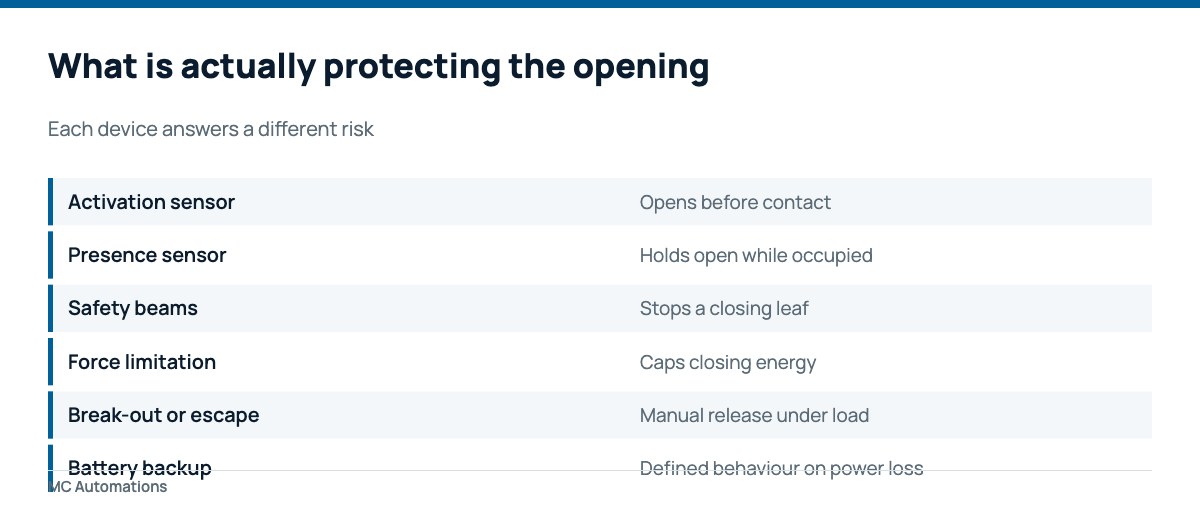
A powered door has layers. The activation sensor opens it before anyone reaches it. A presence sensor holds it open while somebody is still in the opening. Safety beams stop a closing leaf. Force limitation caps how hard it can push. On an escape route there is usually a release requirement as well.
Automatic door safety requirements are the reason those layers exist together rather than as options.
Escape routes change the answer
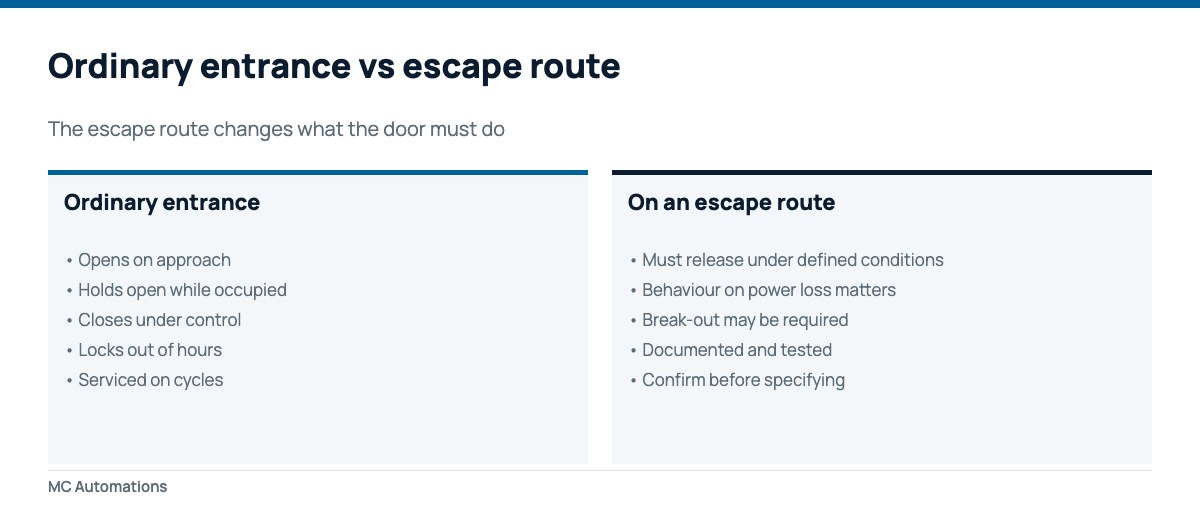
An entrance on an escape route is a different specification from a convenience entrance. What the door does on power loss, whether it can be pushed open under load, and how it is released are all part of the building strategy rather than a preference.
Requirements for powered pedestrian doors in South Africa are published through SABS. We will tell you which apply to your opening, and we do not publish a certification claim we cannot evidence.
Where compliance quietly slips
Three patterns recur. A safety sensor is desensitised because the door kept reopening. A door is propped because staff find it slow. A battery backup is removed at replacement time because it added cost and nobody asked what it was for.
Each converts a designed behaviour into an assumption, and none of them shows up until an incident or an inspection.
What testing looks like
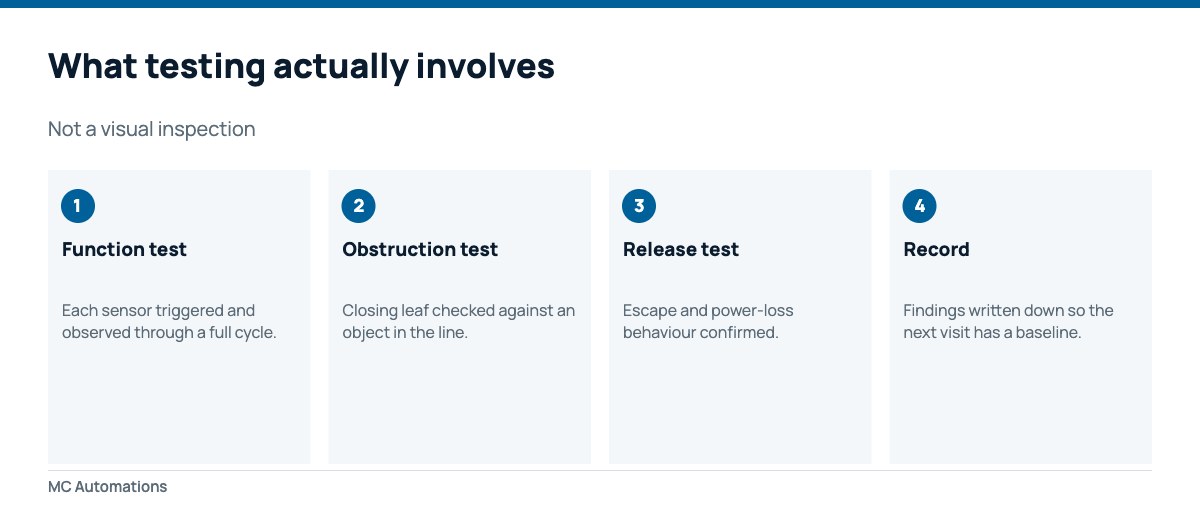
Testing is not a glance. Each sensor is triggered and watched through a full cycle, the closing leaf is checked against an object in the line, and escape or power-loss behaviour is confirmed. The findings are written down, so the next visit has something to compare against.
That record is also what a facilities team needs when asked to demonstrate that automatic door safety requirements are being maintained rather than assumed.
What to ask your contractor for
Ask what devices are fitted, what each is for, when they were last tested and what the result was. If nobody can answer, the entrance is being maintained on hope. Our service level agreement page explains what an agreement should define, and servicing covers what a visit includes.
Who carries the responsibility
Automatic door safety requirements do not sit with the installer alone. The building owner or occupier is responsible for an entrance being safe in use, the installer for it being correctly specified and commissioned, and the maintainer for it staying that way between visits.
In practice that means a facilities team cannot delegate the question entirely. Knowing what devices are fitted, when they were last tested and what the result was is part of running the building, not an optional record.
Where a door is shared between a landlord and a tenant, the boundary is worth agreeing in writing before a fault occurs rather than during one.
Force, speed and why they are measured
A powered leaf carries energy, and the amount it can transfer on contact is limited by design. Closing force and speed are therefore set at commissioning and verified at service rather than tuned to preference.
The reason is simple. A door adjusted to close faster because staff found it slow is a door with more energy in the leaf, and the person it eventually meets may be a child or someone using a walking frame. Automatic door safety requirements exist to keep that decision out of the hands of whoever is annoyed on the day.
Speed also interacts with hold-open time. A door that closes gently but too soon is as much a problem as one that closes hard, because it catches the second person in a group.
Signage, floor markings and the human layer
Devices are not the whole answer. Clear glass leaves need manifestation so people see them, floor markings keep queues out of the swept area on swing doors, and a bollard or guard keeps trolleys away from a jamb.
These are cheap, and they address the failures that sensors cannot: somebody walking into a clean glass leaf, or a pallet jack clipping a sensor bracket and quietly changing its alignment.
Records, and what an auditor asks for
The question is rarely whether a door is safe on the day. It is whether you can show it has been kept safe. That means a record per door of what is fitted, what was tested, the result, what was adjusted and when the next visit is due.
Automatic door safety requirements become manageable once that record exists, because the estate stops being a set of doors and becomes a schedule. Without it, every question is answered by sending somebody to look.
Requirements for powered pedestrian doors in South Africa are published through SABS. We tell you which apply to your opening and what documentation we can provide, and we do not publish a certification claim we cannot evidence.
Common shortfalls we find on takeover
When we take over doors from another contractor, four gaps recur. Safety sensors desensitised to stop nuisance reopening. Battery backups removed at replacement and never reinstated. Hold-open timers extended until the door barely closes. And no record of any of it.
None of those is dramatic on its own. Together they describe an entrance that looks maintained and is not, which is why a condition report comes before an interval is agreed.
Getting from unknown to documented
Start with an inventory: every powered door, what it serves, whether it sits on an escape route. Then a condition visit that tests each device and writes down the result. Then an interval set on traffic rather than the calendar.
That sequence turns automatic door safety requirements from an anxiety into a schedule, and it usually costs less than people expect because most doors turn out to be serviceable.
Glass, manifestation and visibility
A clear glass leaf is invisible at speed. Manifestation, a contrast band or applied graphic at the right height, is part of making an entrance safe and is frequently omitted or removed during a rebrand.
Automatic door safety requirements cover more than the drive. If somebody can walk into a leaf because they could not see it, the entrance is unsafe regardless of how well the sensors are set.
Training the people who use the door
Staff defeat more safety devices than faults do. Wedging a door, overriding a mode, hanging signage in a detection field and stacking stock against a jamb are all done with good intentions and all undermine the design.
A short briefing at handover, and again when a store changes manager, prevents most of it. Automatic door safety requirements are easier to maintain when the people using the entrance know why it behaves as it does.
What changes when the building changes
A door commissioned for one layout is not automatically correct for the next one. New flooring, a moved queue, a different opening hour pattern or a change of use all alter the assumptions behind the settings.
Re-check the entrance after any of those, because automatic door safety requirements are about the door in its current context rather than the one it was installed into.
Contractors, subcontractors and who tested what
On larger sites the door is often installed by one party, commissioned by another and maintained by a third. Automatic door safety requirements are where that fragmentation shows, because each assumes another did the testing.
Ask for the commissioning record at handover and the test record at each service. If nobody can produce either, the entrance has never been demonstrated to be safe, only assumed to be.
Budgeting for compliance
Meeting automatic door safety requirements is rarely expensive on a serviceable door. It is testing, occasional realignment and replacing a device that has failed. It becomes expensive only when years of deferral are addressed at once.
A condition survey across the estate turns that from an unknown liability into a costed list, and most doors on most surveys turn out to need very little.
Where to start tomorrow
If automatic door safety requirements are currently an unknown in your building, start with a list of powered doors and a note of which sit on escape routes. That single page changes the conversation from general anxiety to a specific, finite task.
Then book a condition visit for the doors on that list. Most will be serviceable, a few will need a device tested or replaced, and you will have a written baseline for everything that follows.
Automatic door safety requirements are not onerous on a maintained estate. They become onerous only when the first honest look happens after an incident rather than before one.
A note on how we quote and attend
Everything on this page is written from work we actually do: supplying, installing, commissioning and servicing automatic entrance systems across South Africa, on our own operators and on other manufacturers’ equipment. We do not publish specifications we cannot evidence, and where a figure is a test result rather than a guarantee we say so.
Quotations go out within two working days of receiving the opening size and a photograph. Where a site survey is needed first we say so rather than letting a date slip quietly, and we sometimes charge for a visit depending on what it involves — told beforehand, never afterwards.
The MC-125 sliding operator and MCW-100 swing operator are imported and assembled at our own facility in Johannesburg. That is what keeps belts, rollers, floor guides, sensors and controllers on a shelf locally rather than six weeks away, and it is usually the difference between a same-visit repair and an entrance standing open for a week.
Both operators are tested to one million cycles and carry a 24-month warranty. A cycle test is a measure of what the mechanism withstood under test conditions; it is not a maintenance-free period and not a warranty term, and we are careful never to present it as one.
If you want a second opinion on a quotation, a condition report on doors somebody else installed, or simply a straight answer about whether an opening needs replacing or servicing, send the details through and we will tell you what we would do.
Automatic door safety requirements, answered
Are automatic door safety requirements the same for every door?
No. An escape route, a hospital corridor and an office entrance have different obligations, which is why the opening is assessed rather than assumed.
Can I turn a safety sensor down?
You should not. It is the device that stops a closing leaf meeting a person. If it nuisance-trips, the cause is found rather than the sensitivity reduced.
What happens during a power failure?
That is a design decision. Some doors fail open, some fail secure, some run on battery. It should be recorded, not discovered.
How often should safety devices be tested?
At every service visit, and the interval is driven by cycles rather than the calendar.
Do you certify doors?
We test and report on what we service. We do not publish a certification claim we cannot evidence.
Does this apply to doors you did not install?
Yes. We take over other manufacturers’ equipment and report its condition before committing to an interval.
Automatic door safety requirements checklist
Use this when reviewing automatic door safety requirements across a building or an estate.
- List the devices on each door. Automatic door safety requirements start with knowing what is actually fitted.
- Identify the escape routes. These carry obligations an ordinary entrance does not.
- Ask for the last test record. No record means the automatic door safety requirements are assumed, not verified.
- Check nothing has been desensitised. A quieter door is sometimes a less safe one.
- Confirm power-loss behaviour. It should be a decision, not a surprise.
- Set the interval on cycles. Traffic, not the calendar, drives wear.
If you cannot answer those six for your building, that is the place to start. Send us the doors and we will report what is fitted and what it does — request a quote or see compliance and downloads.
Automatic door safety requirements: quick answers
- Automatic door safety requirements start with detection. Presence sensing across the full opening, not just activation, is what stops a leaf on a person standing still.
- Automatic door safety requirements on escape routes mean the opening must be passable without power. Break-out leaves or a fail-safe release are the two usual answers.
- Automatic door safety requirements include force limits. A leaf that can be stopped by hand without pain is the practical test; the controller setting behind it is obstacle detection sensitivity.
- Automatic door safety requirements cover the side screens too — finger-trap gaps at the jamb and at the pocket are a common oversight on older installations.
- Automatic door safety requirements are not a one-off. Sensor coverage drifts as shopfitting changes around the entrance, which is why they are re-checked at every service.
- Automatic door safety requirements apply to inherited doors. If you took over a building with automatic entrances, the obligation came with it.
- Ask for the automatic door safety requirements to be demonstrated at handover, not just certified on paper. A walk-through with the installer takes ten minutes.
- Where automatic door safety requirements reference a standard, ask which standard and which clause. We will not publish a compliance claim we cannot evidence, and neither should a supplier.
Still stuck? Send the opening size and a photograph to MC Automations and we will tell you what we would do.
In short
Automatic door safety requirements at a glance
- Automatic door safety requirements are quoted against the opening we measured, not a catalogue price.
