
Limpopo
automatic doors Polokwane: supply, installation and service
MC Automations supplies, installs, commissions and services automatic doors in Polokwane, with spares held in South Africa rather than ordered from overseas. Sliding, telescopic, swing, revolving and hermetically sealing entrances for retail, healthcare and industrial buildings.
Polokwane is a provincial hub, and that single fact explains most of what is distinctive about entrances here. Retail and healthcare buildings serve a catchment far larger than the city itself, so cycle counts run well above what the local population would suggest. Add sustained heat and open-country dust, and the maintenance interval matters more than the hardware choice. Specifying automatic doors Polokwane well starts with the real catchment rather than the address.
Why automatic doors Polokwane wear the way they do
Cycle count sets the interval, and regional-hub entrances carry counts that surprise people. Two climate factors sit alongside that.
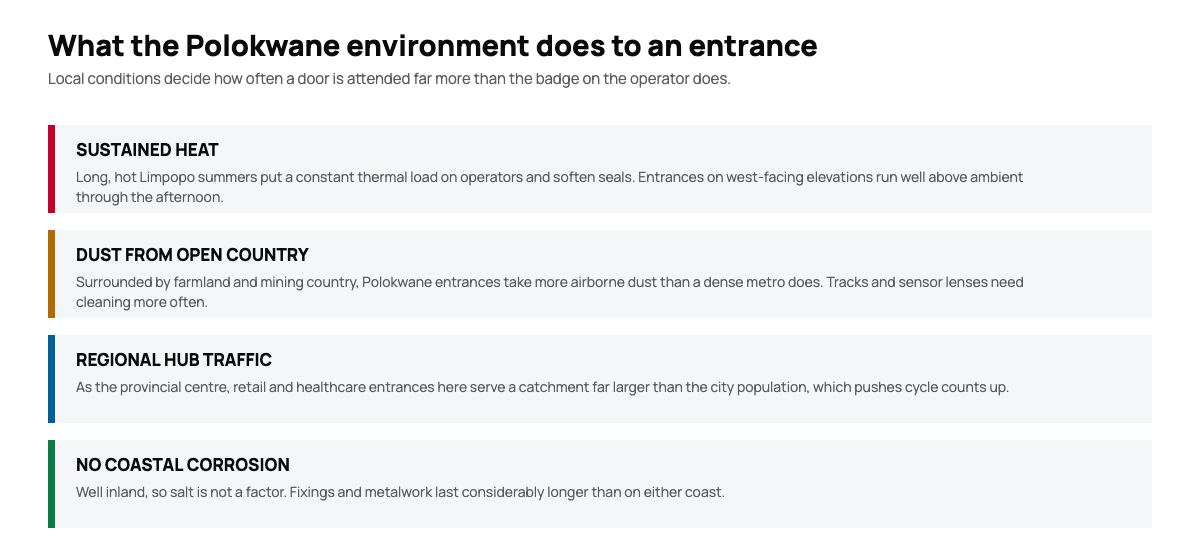
Heat is the first. Long Limpopo summers put a constant thermal load on the operator and soften seals, and a west-facing glazed entrance can run well above ambient through the afternoon. On automatic doors Polokwane we set speeds and hold-open time against the worst case rather than a comfortable morning, because a door tuned in July will feel wrong in January.
Dust is the second, and it is worse here than in a dense metro because the surrounding country is open farmland and mining ground. Tracks and sensor lenses collect it faster, and the symptom is a door opening late or hesitating rather than failing. On automatic doors Polokwane cleaning and realignment are routine rather than remedial.
Where automatic doors Polokwane are specified
The building stock decides the door type, the traffic assumption and the maintenance interval. These are the sectors we work in across Polokwane.
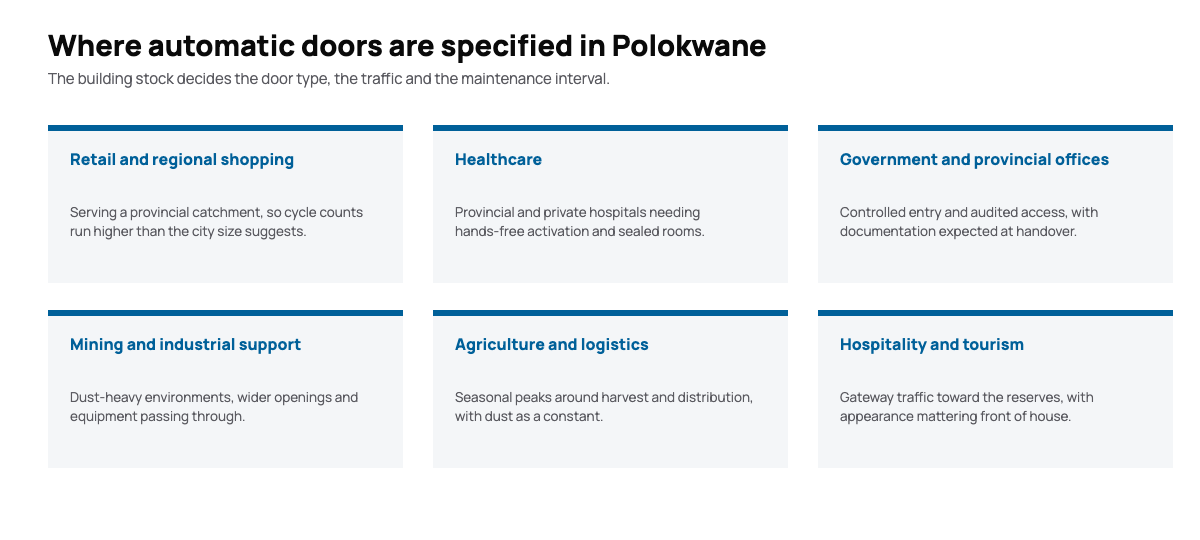
Regional retail is the defining sector. A shopping centre serving a provincial catchment sees traffic that a similarly sized city elsewhere would not generate, and specification has to assume sustained duty rather than occasional use. Healthcare works the same way — provincial hospitals draw from a wide area, which puts their entrances under continuous load.
The mining and agricultural support estate brings the dust problem in concentrated form, along with wider openings and equipment passing through rather than only people. Those entrances are specified conservatively and cleaned more often.
How we support automatic doors Polokwane
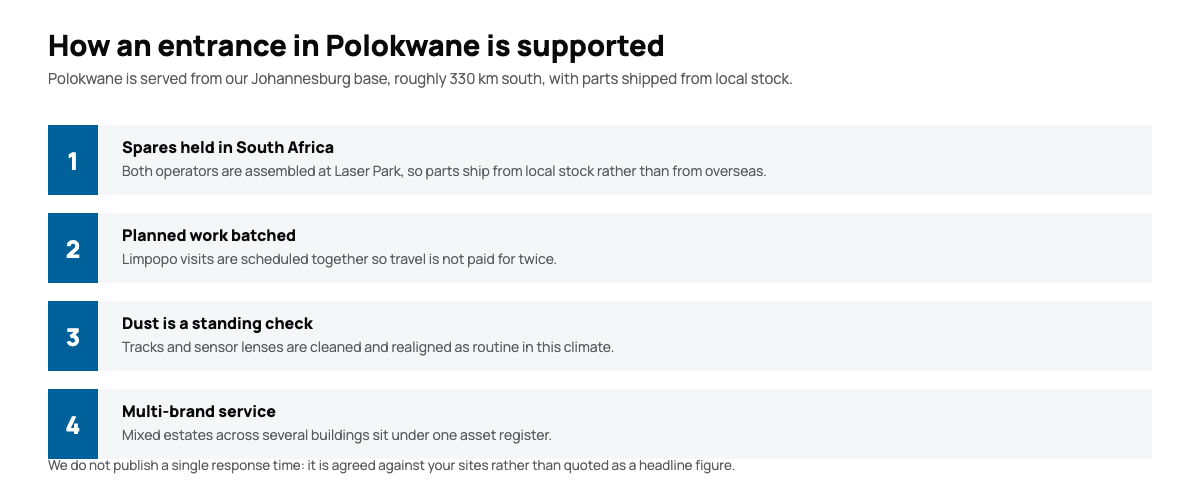
Polokwane sits roughly 330 km from our Laser Park base. Because the MC-125 and MCW-100 are imported and assembled there, parts for automatic doors Polokwane ship from South African stock rather than being ordered from overseas, and Limpopo work is batched so travel is not paid for twice.
We do not publish a single response time, here or anywhere. Response is agreed against your sites and the consequence of a failure. Our service level agreement page sets out the seven terms an agreement should define.
The systems we install in Polokwane
- Automatic sliding doors — the default for most commercial entrances. Figures in the MC-125 brochure.
- Telescopic sliding doors — a wide opening in a short facade. See the telescopic brochure.
- Automatic swing doors — hinged openings and accessibility retrofits, driven by the MCW-100.
- Automatic revolving doors — lobbies that need to hold conditioned air.
- Hermetically sealing doors — theatres, imaging and controlled rooms.
Working around a building that stays open
Regional retail entrances cannot be closed during trading, and in a hub centre the trading day is long. automatic doors Polokwane in those buildings are worked outside hours, which needs planning rather than improvisation given the travel involved.
Hospital work is coordinated with the department rather than the facilities office, because closing a door affects clinical movement in ways a maintenance schedule cannot capture. Tell us the constraints at enquiry stage and the visit goes in once.
Maintaining automatic doors Polokwane properly
Set the interval against measured cycles, then shorten it for dust. The standing items are the carriage rollers, drive belt and tension, the track, activation and safety sensors, and the operator fixings. In this climate tracks and sensor lenses need cleaning noticeably more often than the national average, and that alone prevents a large share of the callouts we would otherwise attend.
Without salt, fixings and metalwork are far less of a concern than on either coast, so the effort goes into cleanliness, alignment and thermal settings instead.
Areas we cover
We cover the city and the surrounding Limpopo corridor from Johannesburg, with visits planned together. That includes the CBD and Bendor, the retail corridors at Mall of the North and Savannah, the hospital and government precinct, the industrial areas at Superbia and Ladine, and out toward Seshego, Mokopane and Tzaneen.
Duty varies more than climate across that list. automatic doors Polokwane in a regional mall and in a government office face the same heat and dust but very different traffic, and the interval follows the cycles.
Modernising rather than replacing
Where the leaves, track and header are sound and only the drive has reached the end of its life, replacing the operator and sensors and keeping the rest is considerably cheaper than a full replacement. Our automatic door modernisation page covers what can usually be retained.
Inland, retained components on automatic doors Polokwane tend to be in good condition because corrosion has not been working on them, which makes modernisation a stronger proposition here than on the coast.
What we need to price a Polokwane entrance
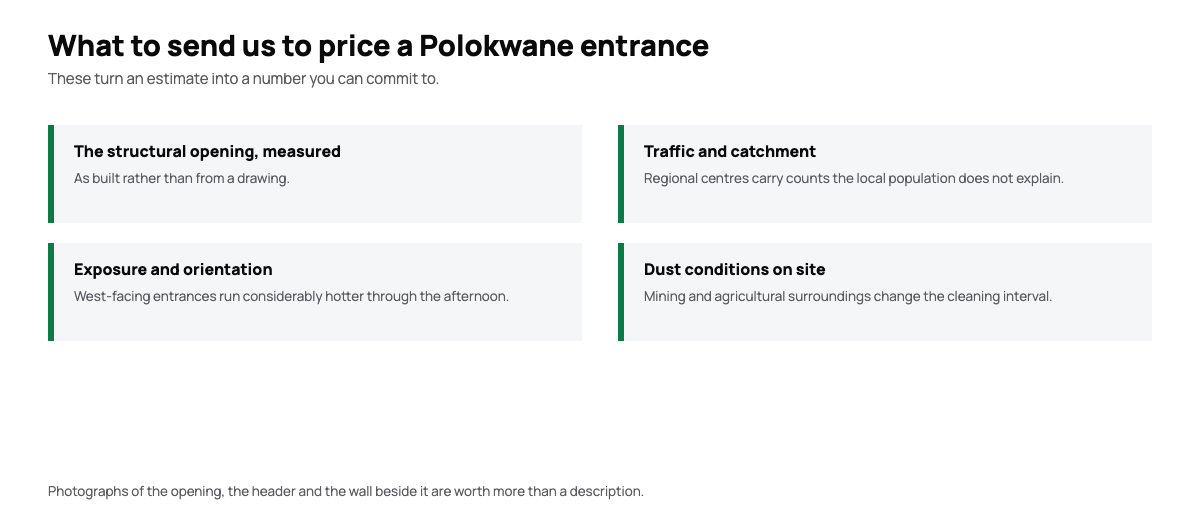
Send the structural opening measured as built, the clear opening you need, the header construction, the traffic, and photographs. Tell us the real catchment too — a regional centre’s entrance carries counts the local population does not explain, and that sets both specification and interval.
Automatic entrances in South African buildings are designed against the SANS 10400 series supporting the National Building Regulations; copies are published by the South African Bureau of Standards. We will tell you which requirements apply to your opening, and we do not publish a certification claim we cannot evidence.
Costs, and comparing quotations
There is no single figure for automatic doors Polokwane, and any supplier quoting one without seeing the opening is guessing. Published starting points and the four items that move the number are in our automatic door price guide. The item most often missing from a cheap quotation is builders work to make the opening ready.
Compare on identical clear openings, equivalent safety devices, builders work included or excluded consistently, and commissioning priced rather than assumed.
automatic doors Polokwane: the short version
- Catchment, not population. Regional-hub automatic doors Polokwane carry counts the city size does not explain.
- Heat is constant. Set speeds and hold-open against summer, not a mild morning.
- Dust is the main maintenance driver. Cleaning prevents most of the callouts.
- No salt. Fixings and metalwork last far longer than on either coast.
- Parts ship from local stock. Assembled at Laser Park rather than ordered from overseas.
We supply, install, commission and service automatic doors Polokwane and will tell you plainly what we hold in writing and what we do not.
automatic doors Polokwane: frequently asked
Do you install automatic doors in Polokwane from Johannesburg?
Yes. We are roughly 330 km south at Laser Park, and parts ship from South African stock because both operators are assembled there.
Why does dust matter so much here?
The surrounding country is open farmland and mining ground, so entrances collect airborne dust faster than in a dense metro. It causes late opening and hesitation rather than outright failure.
Is corrosion a concern in Polokwane?
No. Well inland, salt is not a factor, so fixings and metalwork last considerably longer than on either coast.
Do regional shopping centres need heavier specification?
Usually yes. They serve a provincial catchment, so cycle counts run well above what the local population would suggest.
Do you work on doors you did not supply?
Yes. We service and repair automatic doors from other manufacturers, so a Limpopo estate can sit under one asset register.
How quickly can you attend a breakdown?
We agree that against your sites rather than publishing a figure. Tell us whether the entrance is secure and whether anybody is at risk.
Other areas we cover
Polokwane is one of the cities in our automatic door service areas. We supply, install and service nationwide across all nine provinces from Laser Park, Johannesburg.
Automatic doors Mbombela · Automatic doors Johannesburg · Automatic doors Cape Town · Automatic doors Gqeberha
Need automatic doors Polokwane?
Send the opening, the traffic and a photograph, and we will confirm the configuration in writing before anything is ordered.
Heat without humidity, and what that changes
Polokwane is hot and dry, and automatic doors Polokwane face a different problem from the coastal cities: not corrosion, but thermal load and dust.
Heat concentrates in the header. A controller above an entrance taking afternoon sun runs considerably warmer than the lobby below it, and electronics age with temperature rather than with time. Where a header is exposed, shading it is worth more than anything specified inside the housing.
Dry heat also works on seals and brushes. Rubber hardens, brush seals lose their set, and a leaf that sealed well on handover is passing air a couple of summers later. On automatic doors Polokwane those are inspected as wear items rather than assumed to be permanent.
Dust behaves differently here from coastal grit. It is fine and dry, so it travels further into housings and sits on optics rather than washing off. A sensor reading as insensitive in Polokwane is frequently a sensor that needs its lens cleaned, and that is worth checking before anybody quotes a replacement.
A regional hub, and what that means for the entrances
Polokwane serves a large catchment, and its retail and healthcare buildings carry traffic out of proportion to the city’s own population. Automatic doors Polokwane in those buildings are specified for that wider draw rather than for local footfall.
Regional shopping centres see weekend and month-end peaks that dwarf the weekday average, and an entrance sized on an average will struggle exactly when the building is busiest. Cycle counts taken at the busiest hour, not the typical one, are what should drive the specification.
Healthcare entrances carry trolley and wheelchair traffic, which needs presence sensing set for people who stop in the opening and hold-open times set for people who move slowly. Those are commissioning decisions made against the real doorway rather than left on factory defaults.
Government and municipal buildings bring access control into the conversation, and the behaviour on power loss has to satisfy both the fire strategy and the security policy — a decision made by the people who own those risks, in writing, before installation.
The distance conversation
Automatic doors Polokwane are attended on a scheduled basis from Laser Park in Johannesburg. Same-day call-outs are a Gauteng commitment.
Planning around that is straightforward if it is done deliberately. Group entrances into one attendance rather than reacting to each. Send the operator model and the actual behaviour in advance so the right part travels. Put genuinely critical doorways on a different tier from back-office ones, and agree what that means before a breakdown rather than during one.
Where load shedding is part of the picture, decide in advance what the entrance should do on power loss. Battery backup buys normal operation for a period; without it, the fail state is what you get, and it should be a decision rather than a discovery.
Quick answers on automatic doors Polokwane
- Automatic doors Polokwane face dry heat and fine dust, not coastal corrosion.
- Automatic doors Polokwane age controllers through header temperature; shading helps.
- Automatic doors Polokwane often need a lens cleaned rather than a sensor replaced.
- Automatic doors Polokwane serve a regional catchment, so specify for peak, not average.
- Automatic doors Polokwane in healthcare need trolley-appropriate sensing and hold-open times.
- Automatic doors Polokwane should have their power-loss behaviour decided in advance.
- Automatic doors Polokwane are attended on a scheduled basis; same-day is Gauteng only.
- Automatic doors Polokwane are serviced on any major brand, nationwide.
Repair or modernise, when the technician is a day away
Distance changes the arithmetic on automatic doors Polokwane. In Johannesburg, running an ageing operator for another year is a manageable risk because a technician can be there the same day. Four hundred kilometres away it is a different calculation.
The signals that a unit is near the end are the same everywhere: parts lead times stretching, repeat attendances for different faults, settings that will not hold, and a controller that has become hard to source. What changes here is what those signals should trigger. A unit showing two of them on a critical doorway in Polokwane is a modernisation candidate sooner than the same unit in Gauteng, because the cost of the next failure includes waiting for it to be attended.
The same logic applies to spares. On a critical entrance we will name the one part most likely to strand it, and holding that part on site converts a scheduled visit into a same-day fix by your own maintenance team under guidance.
A modernisation keeps the shopfront, the framing and usually the leaves, replacing the operator, controller and sensing. On a trading building it normally completes inside a day, which at this distance is a single planned trip rather than several reactive ones.
Getting a technician there efficiently
The single biggest saving available on automatic doors Polokwane is planning attendances rather than reacting to them.
Grouping every doorway on a site — and where a business has several sites in the province, grouping those too — turns a series of long individual trips into one planned visit. A condition survey on that visit tells you what will need attention in the next six months, which is what makes the following trip plannable as well.
Sending the operator model and a clear description of the behaviour in advance is the other half. Spares are held in Johannesburg; a part that travels with the technician is a fault cleared on the day, and a part identified on arrival is a second trip.
Warranty and wear in a hot, dry climate
Our warranty is 24 months on the operator, with sensors and wear parts quoted and warranted separately under their own terms, confirmed in writing before an order.
On automatic doors Polokwane the practical consequence is that seals and brushes are the items to budget for rather than the drive. Dry heat hardens rubber and takes the set out of brush seals, so an entrance that sealed well on handover is passing air two summers later. That is wear rather than failure, and planning for it is cheaper than being surprised by it.
Controllers are the other item worth watching, because header temperature ages electronics faster than cycle count alone suggests. Where a header takes direct afternoon sun, shading it is the cheapest life-extension available.
In short
Automatic doors Polokwane at a glance
- Automatic doors Polokwane are quoted against the opening we measured, not a catalogue price.