
Product brochure
MCW-100 brochure: automatic swing door operator
This MCW-100 brochure puts every published figure for the MCW-100 automatic swing door operator on one page — door weight and width, opening angle and time, power, protection class and warranty. Written to be printed, saved as a PDF or attached to a tender.
The MCW-100 is the swing door operator MC Automations supplies, installs and services across South Africa. Like the MC-125, it is imported and assembled locally at our Laser Park premises. This MCW-100 brochure carries the specification exactly as it appears in the operator documentation we hold. Where a figure is not listed, it is because we do not hold it in writing — ask, and we will confirm it in writing before you specify it.
How to use this MCW-100 brochure
The specification block below is the part most people need, but it comes with a caveat that matters more here than on a sliding operator: door width and weight are interdependent, and the stated limits were tested without wind pressure. A 1200 mm leaf at 150 kg is not a combination you can simply read off the table and order. If you are writing a tender, quote the figures with that caveat attached.
Use the print button at the top of this MCW-100 brochure to produce a clean PDF. The print layout strips navigation, buttons and pop-ups, leaving the specification and diagrams on their own.
What the MCW-100 is built to do
A swing door operator automates a door that is hinged rather than sliding. That sounds like a smaller job than a sliding entrance, and mechanically it is, but it introduces a problem a sliding door does not have: the leaf sweeps through space that people occupy. Everything about how a swing operator is specified and set up follows from that.
The MCW-100 drives a single or double hinged door using either a pull-arm or a push-arm, depending on which face of the door the operator sits on. It runs a 55 W brushless DC motor from an AC 100–240 V input, and provides a 24 V DC control supply for the sensors and any access control tied into it. The operator itself is compact — 475 × 81 × 98 mm and 5.5 kg — which is why it suits existing doorways where there is no room for a sliding installation.
Where the MCW-100 is specified
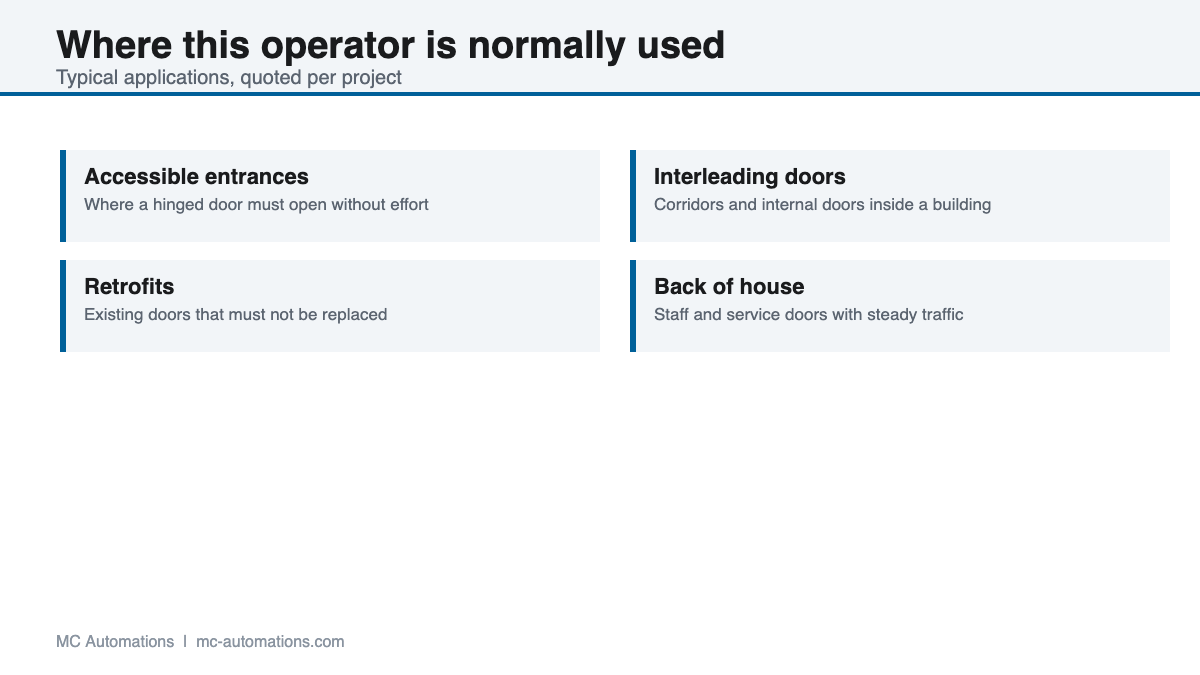
The MCW-100 is used on office and reception doors, clinic and healthcare doors, retail store entrances, apartment building entrances, controlled and staff doors, and accessible entrances. The common thread is an opening that has to swing rather than slide — either because there is no wall space for a sliding leaf to stack into, or because the door has to hold a rating a sliding leaf cannot.
MCW-100 or MC-125: which operator suits the opening
The two operators are not interchangeable and the choice is made by the door. Sliding suits a wide opening with wall space beside it and steady two-way traffic; it moves more people faster and sweeps no arc. Swinging suits an opening with no stacking space, a door that must carry a fire or acoustic rating, or a single-leaf doorway where a sliding installation would be disproportionate.
Where an opening could take either, traffic usually decides. A swing leaf has to sweep clear before the next person can pass, so on a busy entrance it becomes the bottleneck. Full figures for the sliding operator sit in the MC-125 brochure, and both operators are imported and assembled locally on the same basis, carry the same two-year warranty and share the same spares position in Johannesburg.
Installation and site readiness
The operator is 5.5 kg and mounts above the door, so the frame or header has to be able to carry it and the reaction loads the arm applies each cycle. On a masonry frame this is rarely an issue. On a light partition head, or a frame that was never designed to take a powered device, it needs checking before anything is ordered.
Protection class is IP21, which is a meaningful constraint: the MCW-100 is protected against fingers and dripping water, not against wind-driven rain or wash-down. It is an internal or sheltered-external device. An unsheltered external doorway on a weather face is not a suitable location, and specifying one there is a warranty problem waiting to happen.
Power should be terminated where the operator will sit, within the AC 100–240 V input range. Because the operator provides its own 24 V DC control supply, the sensors and any access control interface can usually be fed from it rather than needing a separate supply — but those cables still need to be pulled before the head is closed up and finished.
Automatic entrances in South African buildings are designed against the SANS 10400 series supporting the National Building Regulations; copies are published by the South African Bureau of Standards. We will tell you which requirements apply to your opening, and we do not publish a certification claim we cannot evidence.
What this MCW-100 brochure does not claim
- The weight and width limits are not simultaneous maxima and were tested without wind pressure. Treat them as the outer edge of an envelope confirmed by assessment, not as an order form.
- The one million cycle figure is a service-life test result — not a guarantee of a million trouble-free operations, not a maintenance-free period, not a warranty term.
- No certification or third-party approval is claimed anywhere in this MCW-100 brochure. Where a project needs evidence against a standard, ask and we will tell you what documentation exists.
- IP21 is an indoor or sheltered rating. Any figure absent from the table is absent because we do not hold it in writing.
Double doors, and why sequencing matters
The MCW-100 is configured for single or double doors. On a double-leaf opening each leaf gets its own operator, and the two have to be coordinated rather than simply switched on together. Where the leaves overlap at the meeting stile, one has to lead on opening and trail on closing, or the doors will collide at the centre. That coordination is set up on commissioning and is one of the things worth checking on a service visit, because a double set that has drifted out of sequence will start catching at the meeting stile long before anything actually fails.
A double opening also doubles the swept area the safety devices have to cover, and the two swept arcs meet in the middle. A person standing centrally in front of a double swing door is in the path of both leaves at once, which is why presence detection on a double set is specified as a covered zone rather than as two independent sensors that each happen to work.
Accessibility, and why hold-open time is 20 seconds
The hold-open range on this operator is 0 to 20 seconds, against 0 to 8 on the sliding operator. That difference is deliberate and it is the main reason the MCW-100 turns up on accessible entrances. Somebody using a walking frame, pushing a wheelchair or managing a child and a bag needs materially longer to clear a doorway than an unencumbered adult, and a door that starts closing while they are still in it is both a safety problem and a dignity problem.
Opening time is the other half of it. At 3 to 7 seconds per 90 degrees, the operator can be set to open deliberately rather than quickly. A slow, predictable sweep is easier to judge and step around than a fast one, and on an accessible door the slower setting is usually the correct one even though the hardware will happily run faster. Where the entrance also has a push button or a proximity plate, its position matters as much as the timing: a button mounted inside the swept area puts the user in the path of the leaf they just called.
MCW-100 brochure: terms used above
- Push-arm — the operator sits on the face the door opens away from and pushes the leaf open.
- Pull-arm — the operator sits on the face the door opens toward and pulls the leaf open.
- Sweep zone — the area the moving leaf passes through. Presence here must stop the door.
- Push-and-go — a manual push starts the motor, which then completes the opening.
- Hold-open time — how long the leaf stays open once activation clears; 0 to 20 seconds on this operator.
- IP21 — protected against fingers and dripping water. An indoor or sheltered rating, not a weatherproof one.
- Service-life test — a test-condition result quoted here as 1 000 000 cycles; not a maintenance interval and not a warranty term.
Service, spares and warranty
The MCW-100 carries a two-year warranty. Because it is imported and assembled locally, spares are held in Johannesburg and a technician arrives with the part that fits the fault rather than a diagnosis and a second visit. On a swing operator the items that drift are the arm fixings and the safety sensors covering the sweep path; both are checked on every service visit, and intervals are set against the cycles the door actually carries rather than a calendar.
MCW-100 brochure: frequently asked
Can the MCW-100 automate a door I already have?
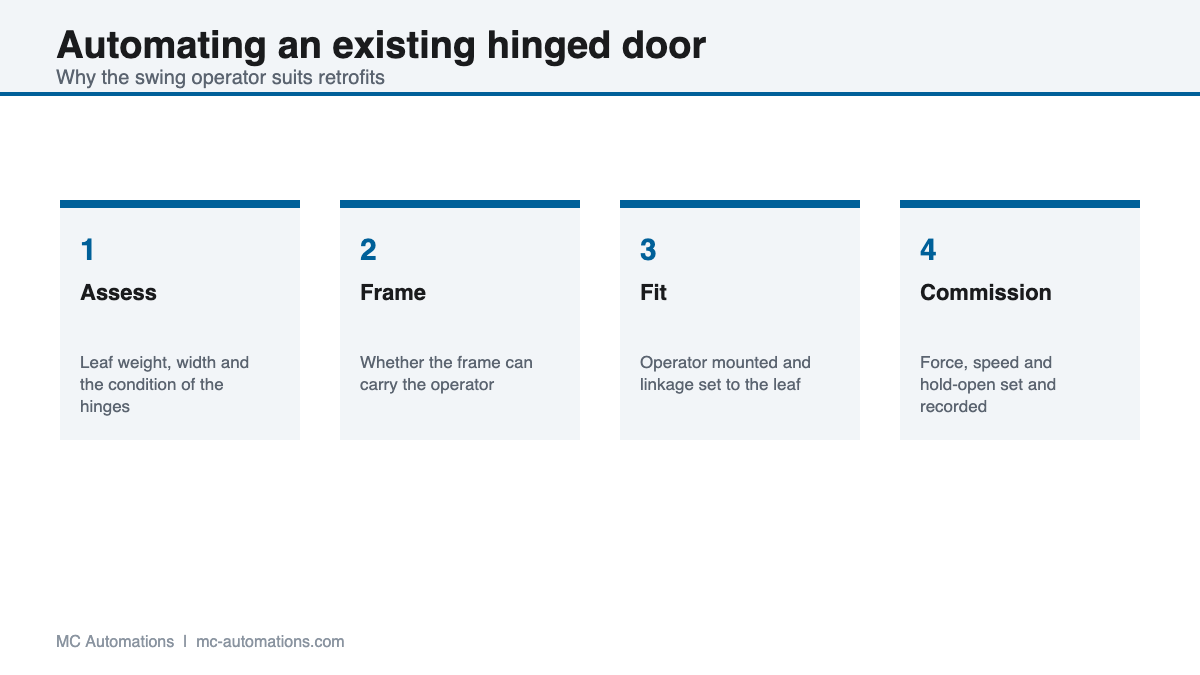
Often, yes — that is the most common reason it is specified. The operator mounts above the existing leaf and drives it through an arm. It depends on the leaf being sound and the hinges and frame being in good order, which we assess before quoting.
How heavy and how wide a door can this swing door operator drive?
Up to 150 kg and up to 1200 mm. Those are not simultaneous maxima — width and weight are interdependent, and the limits were tested without wind pressure.
Does it work on double doors?
Yes. The MCW-100 is configured for single or double doors, with either a pull-arm or a push-arm depending on which face the operator mounts to.
What is push-and-go?
A light manual push on the leaf starts the motor and the operator completes the opening, so the door works without a button or wave sensor.
Can the door still be opened by hand?
Yes. Losing power does not lock the door; the leaf still swings, which is why the MCW-100 suits doors that must stay usable during an outage.
Is the MCW-100 manufactured in South Africa?
No. It is imported and assembled locally at our Laser Park premises. Local assembly is why spares are held in Johannesburg rather than ordered in.
Can it be used on an exposed outside door?
Protection class is IP21, so it is an internal or sheltered-external device. An unsheltered doorway on a weather face is not a suitable location.
Specifying from this MCW-100 brochure?
Send us the door size and weight, which way it opens and what the entrance is for, and we will confirm the configuration in writing before anything is ordered.
Reading the MCW-100 brochure before you quote
A brochure is only useful if it answers the questions that come up on site. This MCW-100 brochure is written for the person specifying the entrance, not for a shelf, so the notes below explain how to use it when a hinged door has to be automated.
Start with the leaf, not the operator
The leaf decides everything. Its weight, its width and the way it is hung set what the swing operator has to do on every cycle, and they are the first things we measure. A timber leaf in a sound frame and a heavy glass leaf on tired hinges are different jobs even when the opening looks identical. Where the hinges or the frame cannot carry the loads involved, we say so rather than fitting an operator that will fight the door for the rest of its life.
Push side or pull side
Whether the operator sits on the push side or the pull side of the leaf changes the linkage, the mounting and the space the entrance needs when it is open. The MCW-100 brochure describes both arrangements; the survey decides which one the opening actually allows. Fire escape routes, corridor widths and the direction people naturally approach from all narrow the choice.
Sensors are part of the specification
An automated hinged door sweeps through space that people stand in. Activation alone is not enough: presence sensing must cover the sweep and the area behind the leaf, and the operator’s own obstruction detection has to be set on site rather than left at a default. That is why our quotations list sensors individually instead of describing a package.
What the brochure will not tell you
It will not tell you what your entrance costs, because that depends on the leaf, the frame, the sensors and the site. It will not promise a response time, and it does not carry laboratory certification figures we do not hold. What it does carry is what the operator is, what it does, and what we commit to: installation by our own technicians, commissioning with the settings recorded, spares held in Johannesburg and 24 months on the operator.
Before you send an enquiry
Send a photograph of the door, a photograph of the frame and hinges, the leaf width and an idea of daily traffic. With those four things we can tell you whether the MCW-100 brochure describes the right product for the opening, or whether a sliding entrance would serve the building better. Saying so early costs nothing; discovering it after installation costs a great deal.
The MCW-100 brochure at a glance

Questions we are asked about the MCW-100 brochure
Can any hinged door be automated with this operator?
Most can, but not all. The leaf has to be sound, the hinges have to be in good order and the frame has to carry the operator. Where one of those is not true we say so before quoting, because automating a tired door simply accelerates its failure.
Does the door still work in a power failure?
That is a design decision taken before the order. Manual operation, battery backup and the behaviour required on an escape route are settled at survey and written into the quotation rather than assumed.
How is the door stopped from hitting somebody?
Presence sensing covers the sweep and the area behind the leaf, and the operator has its own obstruction detection. Both are set on site during commissioning and tested with an object, not left on a factory default.
What does the warranty cover?
24 months on the operator. Wear parts, glass and ironmongery are quoted and warranted separately, and we will confirm that in writing before you order.
Who installs it?
Our own technicians install and commission the entrance, then hand over with the speeds, hold-open time and force settings recorded so the next service visit starts from a known state.
Download
Download the MCW-100 brochure as a PDF
The MCW-100 brochure on this page is also published as a three-page A4 PDF, sized for printing, saving to a project folder or attaching to a tender pack. It carries the same figures as the page above.
- Page one — what the operator does, the headline figures, and where a swing operator is specified.
- Page two — the full technical specification: door weight and width, opening angle and time, hold-open, motor, power, temperature, protection class, operator size and weight, service-life test and warranty, with a drawing of push-arm and pull-arm geometry.
- Page three — control and integration, why MC Automations, and what to send us for a quotation.
In short
MCW-100 brochure at a glance
- The MCW-100 brochure carries no price list: the MCW-100 is quoted against the opening we measured, not a catalogue price.
- Ask about the MCW-100 and we confirm the opening, the head and the power position first.
- MCW-100 operators are installed and commissioned by our own technicians.
- The MCW-100 carries a 24-month warranty on the operator.
- Spares for every operator in this MCW-100 brochure are held in Johannesburg, so a repair does not wait on an import.
- Send the opening size and a photograph and we can quote against a real entrance rather than an assumption.
- Service intervals in the MCW-100 brochure are set against cycle count rather than the calendar.
- Commissioning ends with the speed, hold-open and force settings written down.
- We also service and repair automatic swing doors supplied by other companies.
- Prices for MCW-100 operators exclude VAT unless the quotation states otherwise.
- Everything in this MCW-100 brochure comes from the operator documentation we hold; nothing is estimated.