
Product brochure
Hermetic door brochure: the MCL-165
This hermetic door brochure sets out what the MCL-165 hermetically sealing automatic sliding door is, how it seals, how it is opened without touching it, and — just as importantly — which figures we do not publish. Written to be printed, saved as a PDF or attached to a tender.
The MCL-165 is the hermetically sealing automatic pedestrian sliding door MC Automations supplies, installs, commissions and services. It is specified per room rather than ordered from a size chart, because leaf construction, seal arrangement, activation, interlocking and any shielding are all decided against what the room has to do. This hermetic door brochure gives you the fixed characteristics and is explicit about the rest.
How to use this hermetic door brochure
Read it as a description of a system rather than a datasheet. There are no pressure-differential numbers in this hermetic door brochure and that is deliberate: we do not hold that documentation, so publishing figures would mean estimating them. If your project requires certified performance data, say so at enquiry stage and we will either obtain it in writing or tell you plainly that we cannot.
Use the print button at the top to produce a clean PDF. The print layout strips navigation, buttons and pop-ups, leaving the specification and the diagrams.
Shut is not the same as sealed
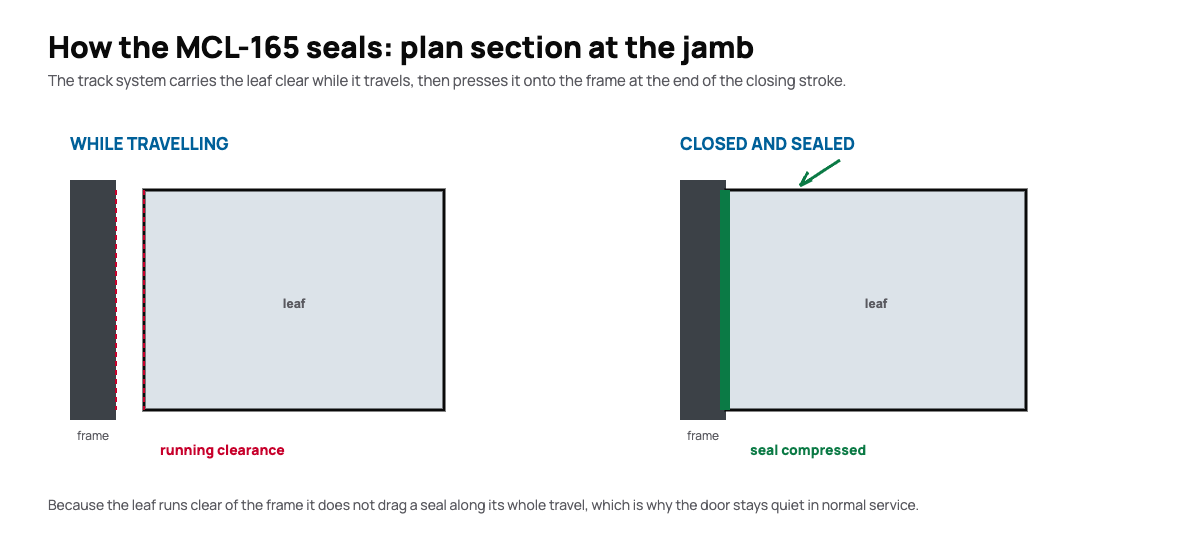
This is the whole point of the product and it is the thing most often misunderstood on a drawing. Every sliding door closes. A closed standard sliding door still has a running clearance at the jambs and at the floor, because it has to be able to move. Air, dust and pressure pass through that clearance quite happily. A hermetic door closes and then does something extra: it seals against the frame.

The MCL-165 does this with a patented track system. While the leaf is travelling it runs clear of the frame, so nothing is dragging along a seal for the length of the opening. At the end of the closing stroke the track brings the leaf onto the frame and compresses the seal. Closed, the door is windproof and dustproof; travelling, it is quiet in normal service. Those two things are usually in tension on a sealing door, and the track system is how they are reconciled.
Hermetic door brochure: MCL-165 specification
Hermetically sealed doors are specified per room. Leaf construction, seal arrangement, activation, interlocking and any shielding are decided against the room’s requirements, so we confirm the specification from a site assessment. We do not publish laboratory certification or pressure-differential figures for this door because we do not hold that documentation. If your project requires certified performance data, tell us at enquiry stage and we will obtain it in writing or tell you we cannot. Note also that the door is designed for sealing in dry rooms.
Hermetic door brochure: opening it without touching it
In a controlled room a door handle is a contamination route. Somebody scrubbed for theatre cannot touch one; somebody carrying a specimen tray or an instrument set has no free hand to touch one with. Every activation option on the MCL-165 exists to remove that contact.
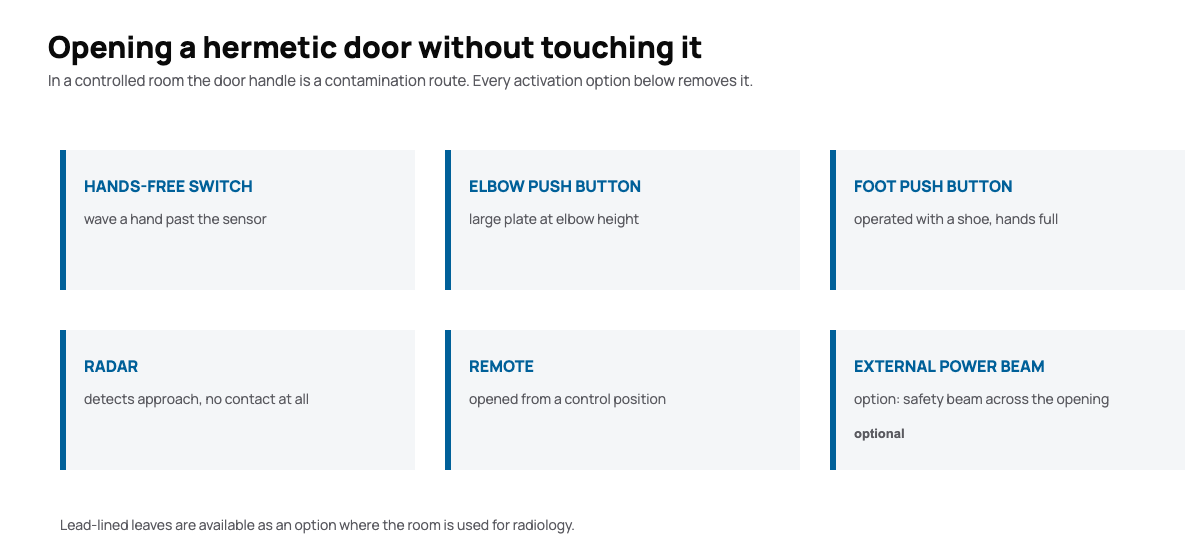
- Hands-free switch — a hand passed near the sensor opens the door with no contact.
- Elbow push button — a large plate at elbow height, for when hands are gloved or occupied.
- Foot push button — operated with a shoe, for when both hands are full.
- Radar — detects approach and opens with no deliberate action at all.
- Remote — opened from a control position rather than at the door.
- External power beam — available as an option across the opening.
Choosing between them is a workflow question rather than a technical one, and it is worth walking the room before deciding. A radar that opens every time somebody passes along a corridor outside is a nuisance in a room that is meant to stay closed; a foot button in a theatre where staff arrive with trolleys may be unreachable. We would rather ask how the room is used than pick a default.
Lead-lined leaves for radiology
Where the room is an X-ray or imaging room, the leaf itself can be specified with lead lining as an option. The door still behaves as a hermetically sealing sliding door; the shielding is built into the leaf construction rather than added to it afterwards.
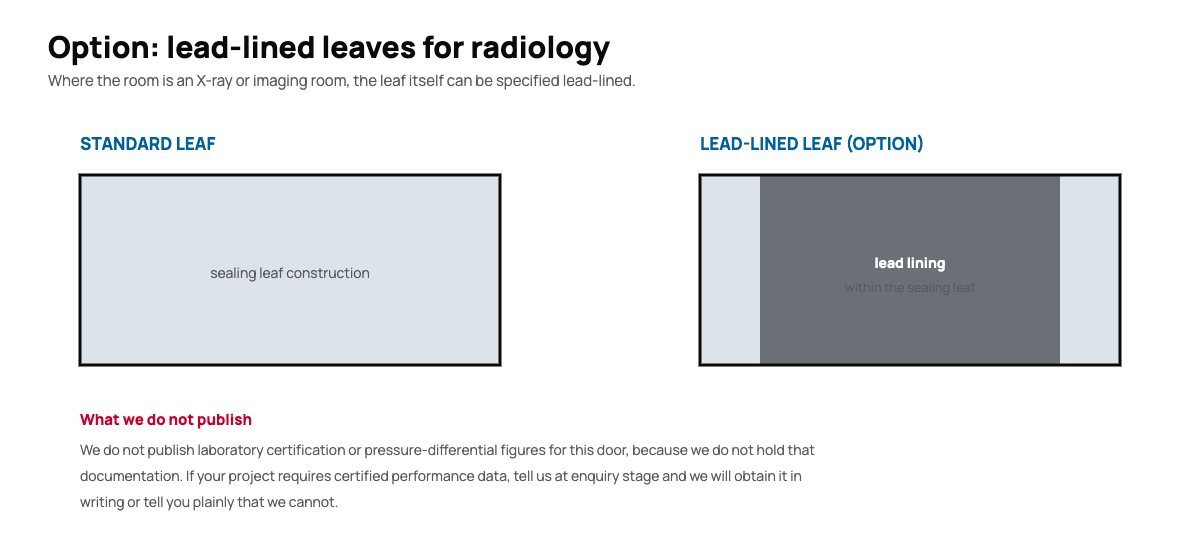
Shielding specification is set by the room and its equipment, not by us, and it is normally determined by a radiation protection assessment for the installation. Tell us what the assessment requires and we will confirm in writing whether we can supply to it. This is an area where we will not estimate: a shielding figure guessed from a brochure is worthless to the person signing off the room.
Where hermetically sealed doors are specified
The MCL-165 is used where a room has to hold a condition rather than simply be closed off. That includes operating theatres and clean areas, imaging and radiology rooms, laboratories, pharmacy and compounding rooms, and controlled production or process rooms. What these have in common is that the door is part of the room’s performance, not just part of its circulation.
The environment qualification matters here. The MCL-165 is designed for sealing in dry rooms. A wash-down area, a wet process room or anywhere subject to hosing is a different requirement, and specifying this door into one would be the wrong answer. If your room is wet, tell us at enquiry stage rather than after the door is on site.
Interlocking and how the door fits the room
Sealed rooms frequently come in pairs with a lobby between them, and the two doors are interlocked so that both cannot stand open at once. That interlock is part of how the room maintains separation, and it is decided against the room’s requirements rather than supplied as standard. Where an interlock is needed, the sequence, the override arrangement for emergencies and the indication at each door all need to be agreed before installation.
The frame and the surrounding construction matter as much as the door. A door that seals against its frame is only as good as the frame’s fixing and alignment, and a sealing door hung in a frame that moves will stop sealing. Floor level across the opening needs the same attention, because the seal at the threshold has to close consistently along its full width.
Why the door is part of the room, not part of the corridor
On an ordinary entrance the door is a piece of circulation: it lets people in and out and its job ends there. In a controlled room the door is part of the room’s performance. If the room is meant to hold a condition — cleanliness, separation, containment, a pressure regime managed by the ventilation plant — then a door that does not seal is a hole in that system, no matter how well the rest of the room is built.
This changes who should be specifying it. A hermetic door chosen from a corridor drawing, on the basis of opening width alone, is likely to be wrong. The people who know what the room has to do are the ones whose requirements should reach us: the facility’s infection control lead, the process engineer, the radiation protection adviser, or whoever is accountable for the room passing its commissioning. We would far rather have that conversation early than supply a door that meets a drawing and fails a room.
Getting the specification right first time
Because there is no size chart, the quality of the specification depends on the quality of the information at enquiry stage. The items that make the most difference are these.
- What the room is and what it has to hold. Theatre, imaging room, laboratory, pharmacy, process room — and what condition it maintains.
- The structural opening, measured, with the finished floor level either established or agreed.
- How people arrive at the door. Scrubbed and unable to touch anything, pushing a trolley, carrying trays, or moving a bed. This decides activation.
- Whether interlocking is required, and if so with which other door, plus what happens in an emergency override.
- Whether shielding is required, and what the radiation protection assessment specifies.
- What the room is cleaned with. Cleaning agents attack seals, and seal life is set by them more than by cycle count.
- Whether the room is dry. The MCL-165 is designed for dry rooms; this is a qualifying question, not a detail.
Supplying that list up front usually removes a round of queries and, more importantly, removes the risk of a door being supplied against an assumption nobody wrote down.
Hermetic door brochure: terms used above
- Hermetically sealing — the leaf seals against the frame when closed, rather than merely closing to a running clearance.
- Running clearance — the gap a normal sliding leaf needs in order to move. It is the gap a hermetic door closes at the end of its stroke.
- Track system — the mechanism that carries the leaf clear while travelling and presses it onto the frame at the end of closing. Patented on the MCL-165.
- Interlock — a control arrangement preventing two doors of a lobby standing open at the same time.
- Lead-lined leaf — an option where the leaf construction incorporates shielding for radiology rooms.
- External power beam — an optional beam across the opening.
- Dry room — a room not subject to wash-down or hosing. The environment this door is designed to seal in.
Cleaning, maintenance and what wears
Seals are the wear item. They are compressed on every closing stroke and they harden and take a set over time, and a hermetic door that has quietly stopped sealing looks exactly like one that is working. That is the reason a sealing door needs a maintenance regime rather than a repair callout: the failure mode is invisible from the corridor.
Cleaning regimes in controlled rooms are aggressive, and the door surfaces and seals have to tolerate the agents actually used in the room. Tell us what those are. A cleaning product that attacks a seal will shorten its life dramatically, and it is a far easier conversation before specification than afterwards.
Automatic doors in South African buildings are designed against the SANS 10400 series supporting the National Building Regulations; copies are published by the South African Bureau of Standards. Healthcare rooms will normally have additional requirements set by the facility, and those govern.
Hermetic doors and the rest of the range
It is worth being clear about where the MCL-165 sits relative to the other automatic doors we supply, because the words overlap confusingly. Every one of these is an automatic sliding door in the loose sense; only one of them seals.
The MC-125 is a general-purpose sliding door operator for entrances and internal openings. It moves people efficiently and it is the right answer for the overwhelming majority of doorways, but a door driven by it closes to a running clearance and does not seal. Where a corridor door in a hospital simply needs to be automatic and hands-free, that is the correct and considerably cheaper specification, and we will say so.
The MCL-165 is specified when the room boundary has to be maintained. The moment a room is holding a pressure regime, a cleanliness classification or a containment requirement, the running clearance on a standard door stops being acceptable and the sealing door becomes necessary rather than preferable. The distinction is worth making early in a project, because the cost difference is real and applying the sealing door to every opening in a department is as wrong as applying it to none.
Full figures for the general-purpose sliding operator are in the MC-125 brochure. Where a hinged door in a clinical area needs automating rather than a sliding one, the MCW-100 brochure covers the swing operator. All three are supplied, installed, commissioned and serviced by the same team, so a department with a mix of openings does not need a mix of suppliers.
What this hermetic door brochure does not claim
- No pressure-differential figures. We do not hold that documentation and will not estimate it.
- No laboratory certification. None is claimed anywhere in this hermetic door brochure. If a project requires certified data, ask at enquiry stage.
- No shielding rating. Lead lining is available as an option; the required specification comes from the room’s radiation protection assessment.
- Dry rooms only. The door is designed for sealing in dry rooms; wet and wash-down areas are a different requirement.
Hermetic door brochure: frequently asked
What makes a door hermetic rather than just automatic?
It seals. A standard sliding door keeps a running clearance at the jambs and floor so it can move. The MCL-165 uses a patented track system that brings the leaf onto the frame at the end of its stroke and compresses a seal against it.
Is the door windproof and dustproof?
When closed, yes — that is the published characteristic. We do not publish pressure-differential figures because we do not hold that documentation.
Can it be used in a wash-down or wet room?
No. The MCL-165 is designed for sealing in dry rooms. Tell us if your room is wet and we will tell you what is appropriate instead.
How is it opened in a sterile area?
Without touching it. Options are a hands-free switch, an elbow or foot push button, radar, or a remote from a control position.
Can it be used on an X-ray room?
Yes — lead-lined leaves are available as an option. The shielding specification comes from the room’s radiation protection assessment, and we confirm in writing whether we can supply to it.
Is it noisy?
It is quiet in normal service. Because the leaf runs clear of the frame while travelling and only seals at the end of the stroke, it is not dragging a seal along the whole opening.
Can you give me a price from this brochure?
No. Hermetically sealed doors are specified and quoted per room, from a site assessment.
Specifying from this hermetic door brochure?
Tell us what the room is, what it has to hold, how staff arrive at the door and whether shielding or interlocking is required, and we will confirm the specification in writing after a site assessment.
In short
Hermetic door brochure at a glance
- The hermetic door brochure carries no price list: a hermetically sealed door is quoted against the opening we measured, not a catalogue price.
- Ask about a hermetically sealed door and we confirm the opening, the head and the power position first.
- Hermetically sealed doors are installed and commissioned by our own technicians.
- A hermetically sealed door carries a 24-month warranty on the operator.
- Spares for every operator in this hermetic door brochure are held in Johannesburg, so a repair does not wait on an import.
- Send the opening size and a photograph and we can quote against a real entrance rather than an assumption.
- Service intervals in the hermetic door brochure are set against cycle count rather than the calendar.
- Commissioning ends with the speed, hold-open and force settings written down.
- We also service and repair hermetically sealed doors supplied by other companies.
- Prices for hermetically sealed doors exclude VAT unless the quotation states otherwise.
- Everything in this hermetic door brochure comes from the operator documentation we hold; nothing is estimated.