
Office park automatic doors for landlords and managing agents: who owns which entrance, the access states a working week needs, the morning peak that sizes the lobby, standardising across an estate, and why maintenance recovery changes the contract.
How Automatic Sliding Doors Work: Components, Sequence and Safety
Automatic sliding doors are everywhere in South African commercial buildings, and almost nobody thinks about them until one stops. This is a plain explanation of how automatic sliding doors work, what the parts actually do, and what that means when you are specifying an entrance or trying to work out why yours is misbehaving.
It is written from what we install and service ourselves rather than from a catalogue.
How automatic sliding doors work, in one sequence
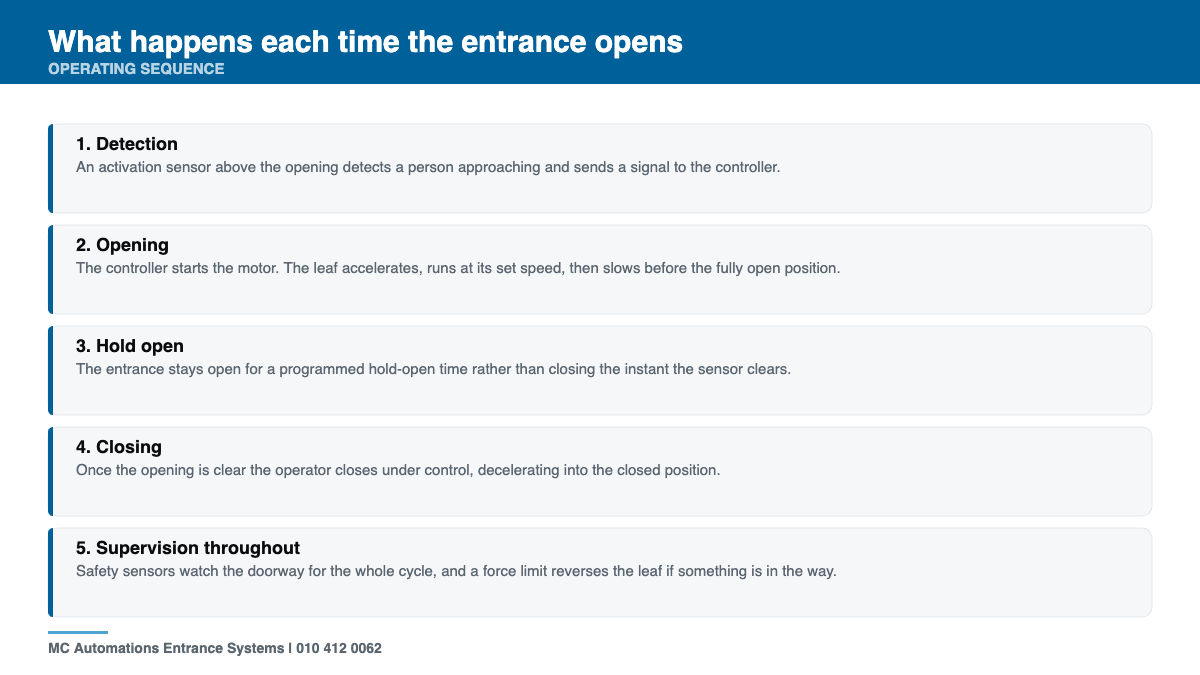
Understanding how automatic sliding doors work starts with the fact that nothing about the cycle is improvised. Every opening follows the same programmed sequence.
A sensor above the opening detects someone approaching and sends an activation signal to the controller. The controller starts the motor, and the leaf accelerates, runs at its set speed, then slows deliberately before it reaches the fully open position. The entrance then holds open for a programmed period rather than closing the moment the sensor clears. When the opening is clear, the operator closes the door under the same kind of control, decelerating into the closed position instead of arriving at it.
Throughout all of that, safety sensors watch the doorway and a force limit reverses the leaf if something is in the way. That supervision is not a bonus feature; it is the part that makes a powered entrance acceptable in a building full of people.
The parts that do the work
From outside, an automatic entrance looks like a sheet of glass that moves, which is why how automatic sliding doors work surprises people. The honest answer to how automatic sliding doors work is that several ordinary components have to agree with each other, every single cycle.
Operator, motor and controller
In how automatic sliding doors work, the operator is the drive assembly that sits above the opening. It contains the motor and the controller, and the controller is where opening speed, closing speed, hold-open time, force and the operating mode are set. When somebody says a door has been “adjusted”, this is almost always what they adjusted.
Activation and safety sensors
In how automatic sliding doors work, activation sensors tell the door to open. Safety sensors guard the doorway while it moves. They are different jobs and, in practice, sensor positioning matters far more than sensor brand. A correctly specified sensor aimed badly will produce a door that opens at passing traffic and misses the person standing in front of it.
Belt, hangers, rollers and track
Most sliding operators in how automatic sliding doors work drive a toothed belt. The belt moves the hangers, the hangers carry the leaves on rollers, and the rollers run in a track. Belt tension and roller condition are what decide whether an entrance runs quietly or announces itself across a retail floor.
The floor guide
In how automatic sliding doors work, a guide at floor level keeps the leaf square while letting it travel. It is the least glamorous part of the assembly and one of the most common causes of trouble, because a floor that has settled, worn or been re-tiled at a different level will fight the door for the rest of its life. No amount of adjustment at the operator end fixes a floor problem.

Single slide or bi-parting
There are two common configurations in how automatic sliding doors work, and the choice is made by the opening rather than by preference.
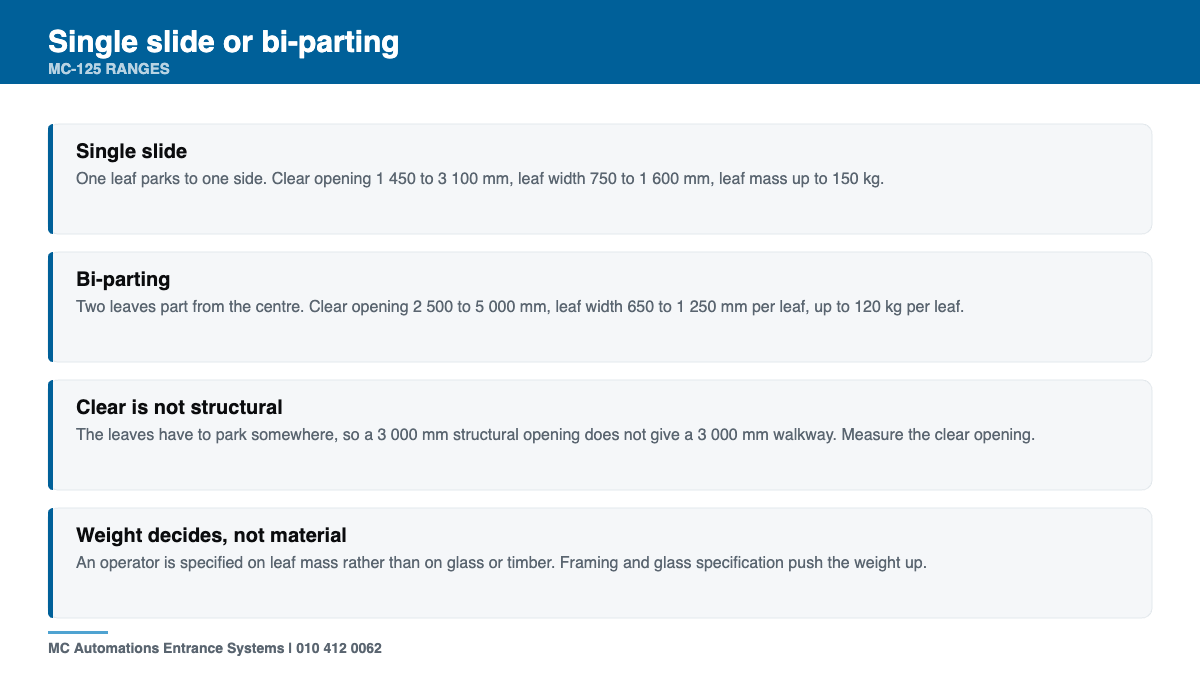
A single slide has one leaf that parks to one side. A bi-parting pair has two leaves that part from the centre. Bi-parting suits wider openings and tends to feel better on high, two-way pedestrian traffic because each leaf only has to travel half as far.
Our own MC-125 sliding door operator covers both, and the published ranges give a useful sense of where the boundary sits in practice. A single leaf suits a clear opening of 1 450 to 3 100 mm, with leaf widths of 750 to 1 600 mm and a leaf mass up to 150 kg. A bi-parting pair covers 2 500 to 5 000 mm, with leaves of 650 to 1 250 mm each and up to 120 kg per leaf.
Two things trip people up when how automatic sliding doors work meets a real opening. The first is that clear opening is not structural opening — the leaves have to park somewhere, so a 3 000 mm structural opening does not hand you a 3 000 mm walkway. The second is that an operator is specified on leaf mass, not on whether the leaf is glass or timber. Glass specification and framing push the weight up, so the leaf build has to be confirmed before anything is ordered.
Sensors, safety and what a force limit is for
The part of how automatic sliding doors work that matters most to a building owner is the part nobody sees: what the entrance does when something goes wrong.
In how automatic sliding doors work, safety sensors monitor the area around the doorway and tell the controller to hold or reverse. The force limit is the backstop — if the leaf meets resistance it does not keep pushing. Both need to be verified across the whole doorway rather than by waving a hand through the middle, which is the single most common shortcut in automatic door servicing and the reason some entrances pass a casual check and still catch someone.
Where an entrance sits on an escape route, the requirements change again, and that is a conversation with the fire professional on the project rather than something settled from a product sheet.
Access control and automatic doors
In how automatic sliding doors work, the entrance does not have to be opened by a motion sensor. It can take its activation signal from access control instead: card readers, keypads, biometric readers, intercoms, reception release buttons or push buttons.
That is how a controlled reception works — the entrance stays shut until an authorised credential is presented, and the access control system then sends the open signal to the operator. It also lets one entrance behave differently at different times of day, running on the sensor during business hours and on credentials outside them.
Where these entrances end up
Knowing how automatic sliding doors work explains where they fit: sliding entrances suit buildings where people arrive continuously and often with their hands full: shopping centres and retail, hospitals and clinics, hotels, offices and corporate receptions, banks, universities, and airport landside areas. We also work on airports.
A sliding leaf needs no swing arc, which is why it wins wherever entrance space is tight. The trade-off is that it needs somewhere to park, and that parking space has to be free of columns, services and signage.
Why service intervals follow cycles, not the calendar
An entrance built on how automatic sliding doors work is a mechanical and electronic assembly that moves thousands of times a week. A mall entrance can do more work in a month than an office door does in a year, so an annual visit means something completely different in each building.
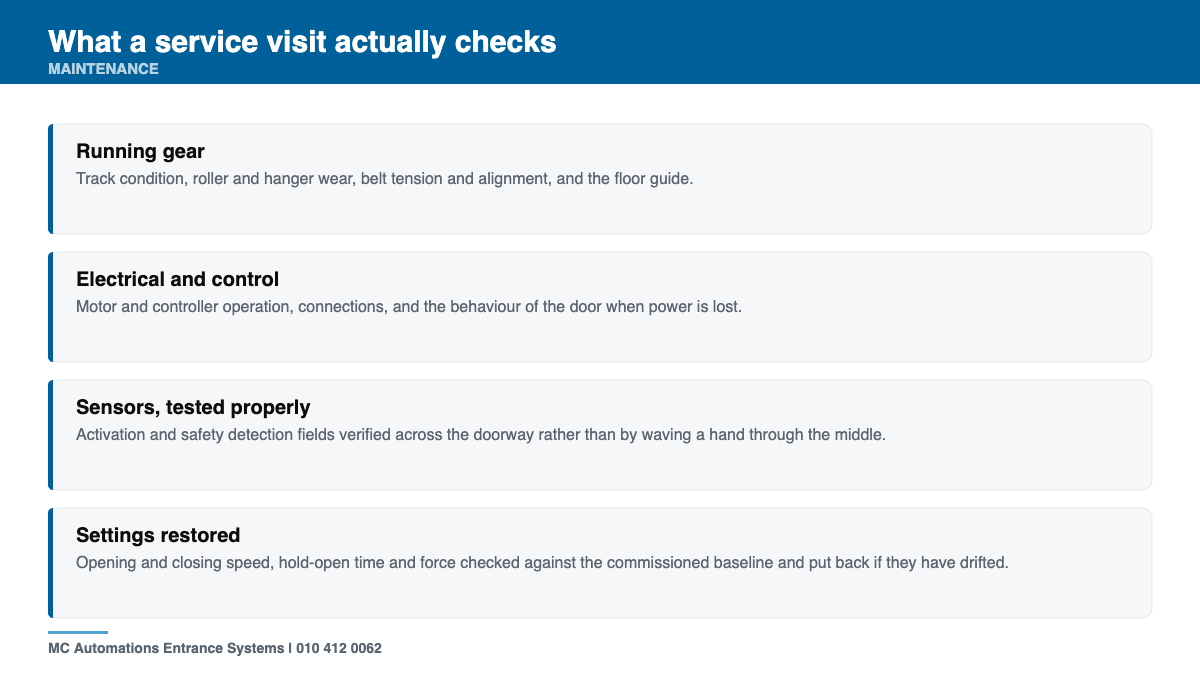
Knowing how automatic sliding doors work makes the maintenance list obvious rather than mysterious: track condition, roller and hanger wear, belt tension, the floor guide, motor and controller operation, the electrical connections, the sensor detection fields, and the commissioned settings.
That last one is the one people forget. An entrance that has drifted from its commissioned speed, hold-open time and force is not obviously broken. It is simply worse, and without a written baseline nobody can tell how far it has moved. We record the settings at commissioning for exactly that reason.
Common symptoms and what they usually mean
The door will not open. Activation sensor, power, controller settings, an access control signal that is not arriving, or something mechanical.
It opens slowly or feels heavy. Usually rollers, track contamination or the floor guide. Occasionally the controller. Often the floor.
It will not close. Frequently a safety sensor seeing something it should not — a reflection, a display stand, a plant that has grown into the detection field.
It has become noisy. Rollers, belt tension or alignment. Noise is a wear signal worth acting on early, because it is cheap then.
It opens and closes repeatedly on its own. Sensor positioning, reflective floors or passing traffic being detected.
Anyone who understands how automatic sliding doors work knows that resetting an entrance repeatedly without finding out why is how a cheap repair becomes an expensive one.
Repairs and spare parts
Entrances built on how automatic sliding doors work eventually need parts: sensors, rollers, hangers, belts, controllers, motors, pulleys, floor guides, batteries, switches and activation devices. We hold spares for our own range in Johannesburg, and consumable items such as belts, rollers, floor guides and seals are replaced as part of servicing rather than under warranty.
The MC-125 carries a 24-month warranty on the operator and is tested to one million operating cycles. It is supplied from R27 590 excluding VAT, which is the operator — what a finished entrance costs depends on the leaf, the glass, the framing and the building around it.
Both our operators are imported and assembled at our Laser Park facility. We are not a manufacturer and do not claim to be one.
The same door behaves differently in different buildings
Once you know how automatic sliding doors work mechanically, the next question is what the building does to them.
A shopping centre entrance sees overlapping arrivals all day, often with trolleys and children, and the entrance must never become the queue. That drives hold-open time and opening speed more than anything on the spec sheet. A hospital corridor sees trolleys, wheelchairs and staff moving quickly, and the priority shifts to reliable detection of a person who is not walking normally. A hotel entrance is mostly about the arrival impression and luggage. A controlled office reception is barely about traffic at all — it is about who is allowed through.
This is why we ask for honest daily traffic rather than an optimistic figure. Understanding how automatic sliding doors work in your building is what turns a correct product into a correct entrance.
Specifying a new entrance: what we actually need
Most delay on an entrance project is not manufacturing. It is the back-and-forth caused by a thin enquiry. To size how automatic sliding doors work against a real opening we need:
- The measured clear structural opening, width and height — not a figure taken off a drawing.
- The leaf build: glass, aluminium framed, timber or steel, and its approximate mass.
- Whether there is parking space either side, free of columns, services and signage.
- The head detail, because the header has to carry the operator and the leaf.
- The floor condition at the threshold, including any re-tiling or settlement.
- Expected daily traffic, honestly.
- Whether access control is involved, and what equipment.
- Whether the entrance sits on an escape route.
Send those eight things and a quotation comes back properly the first time.
Servicing doors we did not install
Because how automatic sliding doors work is the same across makes, we service automatic doors from any major brand, including equipment installed long before we arrived. That is a service relationship only — we are independent and are not an agent or distributor for any manufacturer, and we say so on every quotation.
For sites with several entrances, a service level agreement gives scheduled preventative maintenance rather than a sequence of emergencies. An agreement runs alongside the product warranty; it neither replaces nor extends it.
Automating an existing sliding door
Sometimes. Whether an existing door can be retrofitted to how automatic sliding doors work depends on the leaf mass, the opening dimensions, the condition of the track and frame, and above all the header — it has to carry both the operator and the leaf, and in older buildings the header is frequently the thing that decides the project. The floor matters too, for the reasons above.
It is a site assessment question, not a catalogue question.
What we do not do
Worth saying plainly, because it saves everyone a call. We work on pedestrian entrances only. We do not supply, fit, retrofit or service roller shutter doors, and we do not supply, fit, retrofit or service door closers. A door closer is a mechanical arm that shuts a manual door; it is not an operator and it has nothing to do with how automatic sliding doors work.
We also do not automate garage doors or gates. If that is what you are after, you want a different trade, and we would rather point you there than take the enquiry.
What we do do is supply, install, commission and service automatic sliding and swing pedestrian entrances, with our own technicians on site and the commissioned settings written down at handover.
Johannesburg, Gauteng and the rest of South Africa
We apply how automatic sliding doors work on sites across Johannesburg, Sandton, Midrand, Randburg, Roodepoort, Fourways, Pretoria, Centurion and the East and West Rand, and we install nationwide. Same-day call-outs are a Gauteng service — elsewhere in the country the work is planned, and we would rather say so than imply a response we cannot deliver.
How automatic sliding doors work: the short version
That is how automatic sliding doors work: a sensor asks, a controller decides, a motor moves the leaf on a belt and rollers, a floor guide keeps it square, and safety sensors plus a force limit supervise the whole cycle. Everything that goes wrong later is one of those parts drifting out of the state it was commissioned in.
Frequently asked
How does an automatic sliding door actually open?
An activation sensor detects someone approaching and signals the controller, which drives the motor. The leaf accelerates, runs at its set speed and decelerates into the open position, holds for a programmed time, then closes under the same control once the doorway is clear.
What is the difference between single slide and bi-parting?
A single slide moves one leaf to one side; bi-parting moves two leaves apart from the centre. On the MC-125 a single leaf suits a 1 450 to 3 100 mm clear opening up to 150 kg, and a bi-parting pair covers 2 500 to 5 000 mm at up to 120 kg per leaf.
Why does my automatic door keep opening on its own?
Almost always sensor positioning. Reflective floors, passing pedestrian or vehicle traffic, and moving displays inside the detection field all trigger it. It is an aiming and settings problem rather than a faulty door.
How often should an automatic sliding door be serviced?
Follow cycles rather than the calendar. A shopping centre entrance can do more work in a month than an office door does in a year, so the interval should be set against actual traffic, environment and the manufacturer’s requirements.
Can an existing sliding door be automated?
Sometimes. The leaf mass, opening dimensions, track and frame condition, the floor and especially the header all have to be assessed first. In older buildings the header is usually the constraint that decides it.
Do automatic sliding doors have safety sensors?
Yes. Safety sensors monitor the doorway and a force limit reverses the leaf on obstruction. Both should be verified across the full doorway at every service, not by waving a hand through the middle.
Talk to us about an entrance
If you are specifying a new entrance and want how automatic sliding doors work applied to it properly, send the measured clear opening, the leaf build and mass, a photograph of the opening as it stands, and the honest daily traffic. Start with our automatic sliding doors page, or read how we work as an automatic door service provider on equipment we did not install.
You can reach us on 010 412 0062 or through our contact page. For South African standards background, the South African Bureau of Standards publishes the national standards our own work is measured against.
