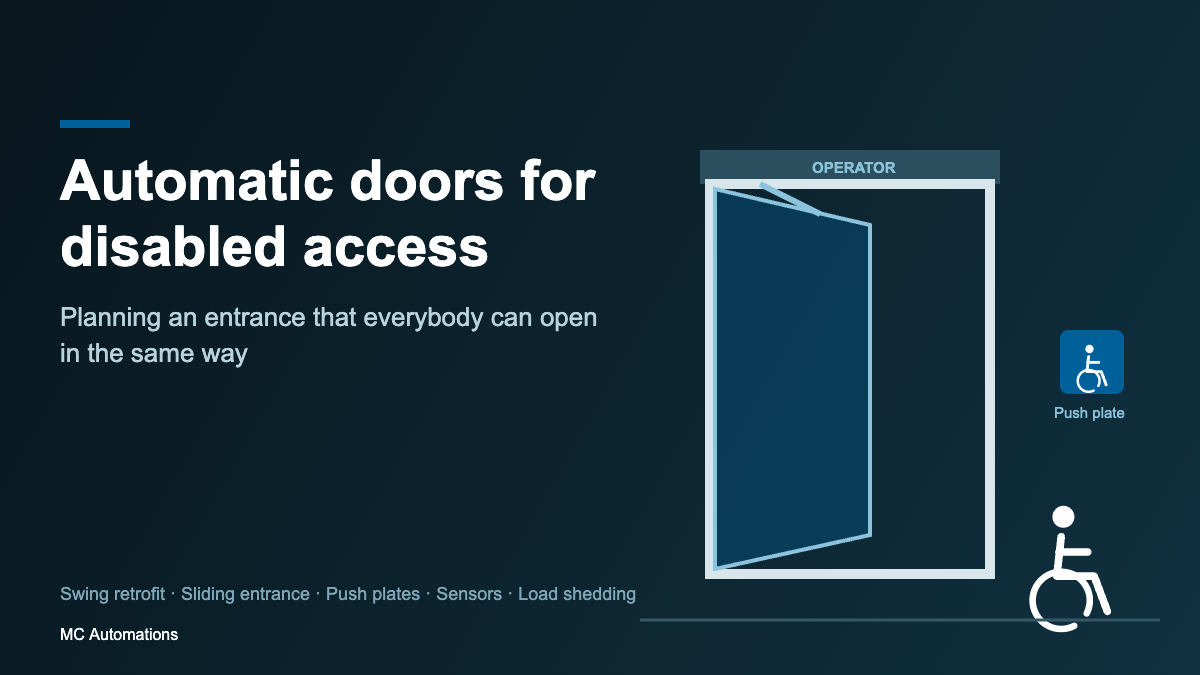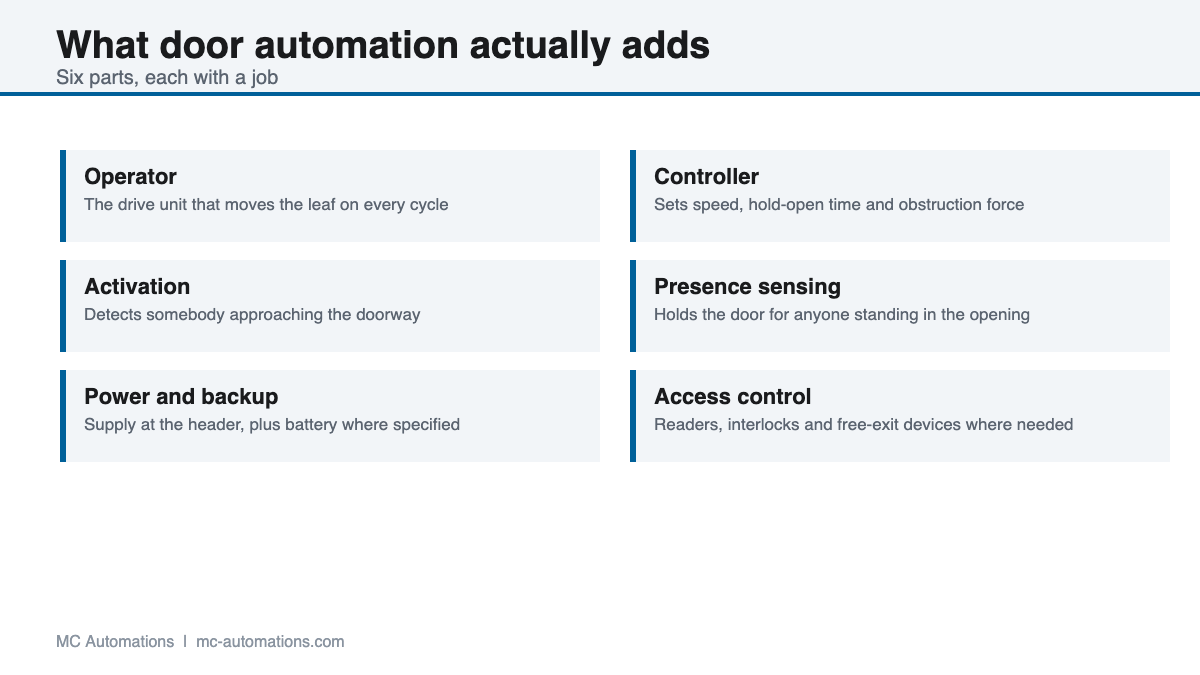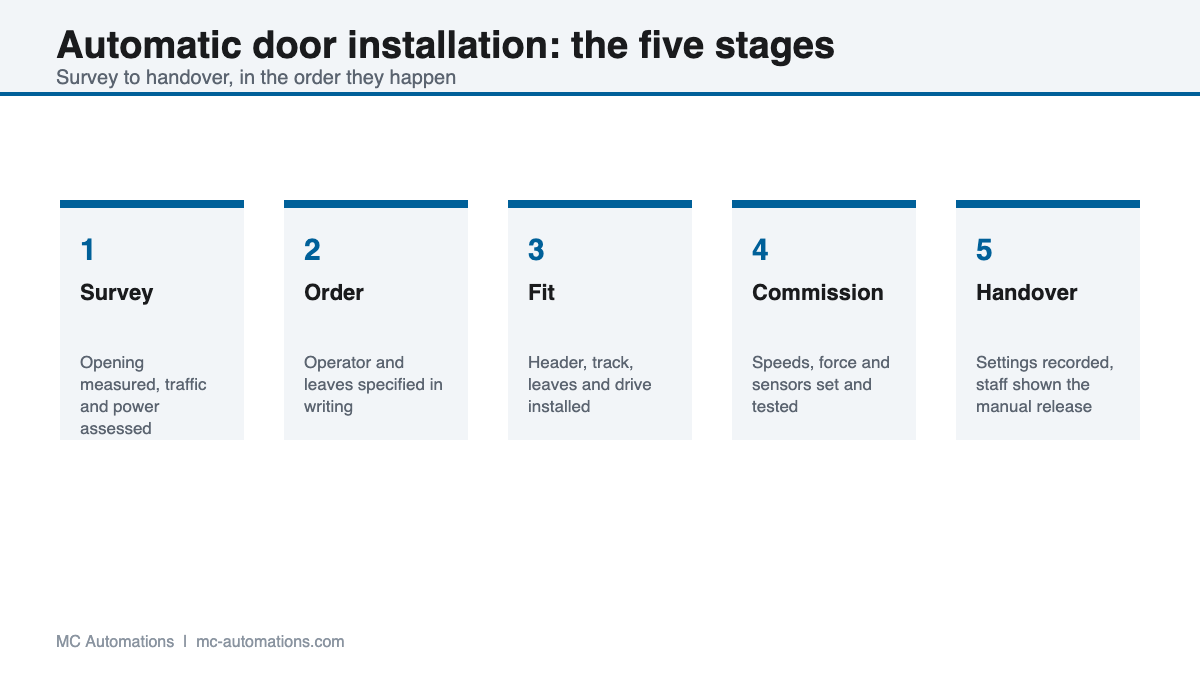
How automatic doors for disabled access are planned in South Africa: swing or sliding, push plates and sensors, low-energy operation, load shedding and SANS 10400 Part S.
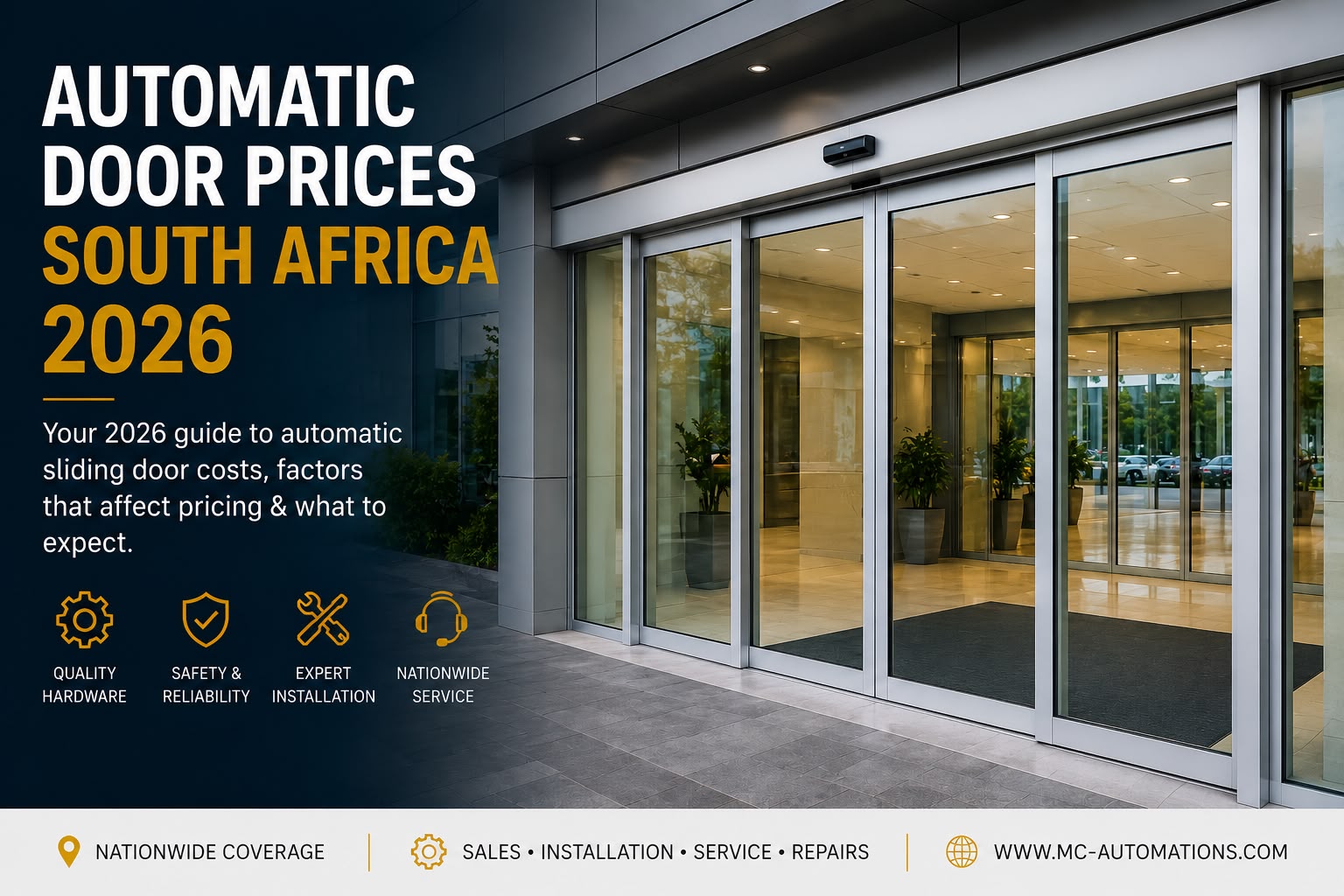
Automatic Door Prices in South Africa (2026): Complete Cost Guide
If you are planning an automatic entrance for a commercial building, the first question is almost always the same: what do automatic door prices in South Africa actually look like? The honest answer is that the figures below are starting points, and the difference between a starting point and your quotation is decided by the opening, the glass, the framing and the operator.
MC Automations designs, supplies, installs, services and repairs automatic entrance doors for commercial, retail, healthcare, hospitality and industrial buildings across South Africa. This guide explains what moves the number, so you can read a quotation properly rather than comparing three prices that are describing three different jobs.
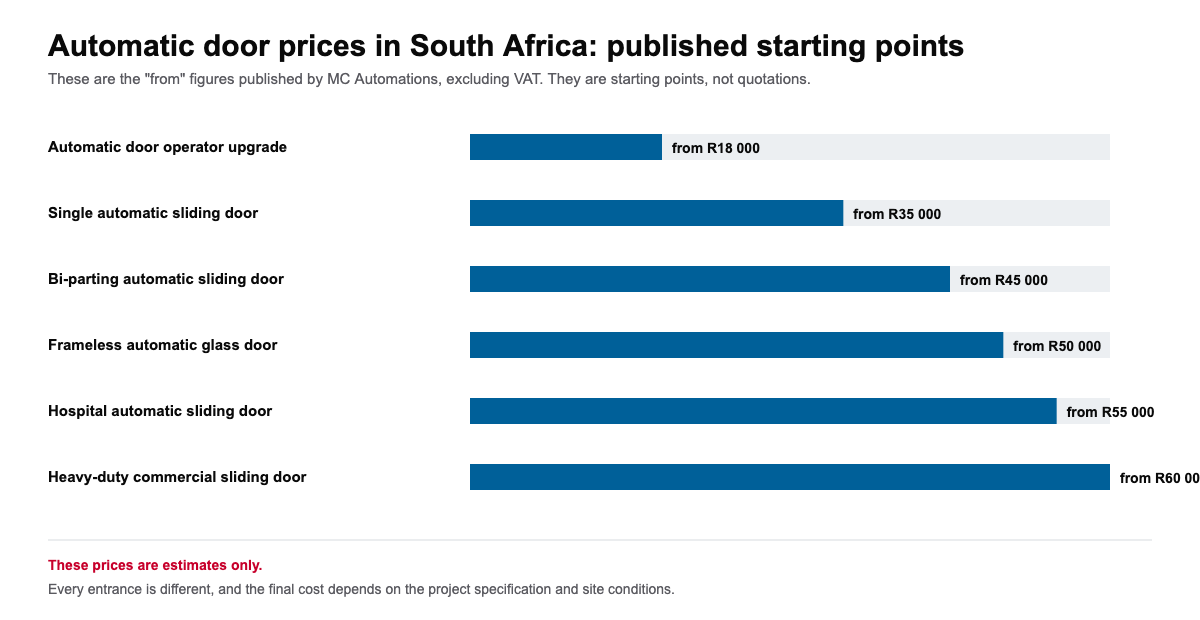
Automatic door prices in South Africa: published starting points
Single automatic sliding doorFrom R35,000
Bi-parting automatic sliding doorFrom R45,000
Heavy-duty commercial sliding doorFrom R60,000
Hospital automatic sliding doorFrom R55,000
Frameless automatic glass doorFrom R50,000
Automatic door operator upgradeFrom R18,000
Please note: these prices are estimates only. They exclude VAT. Every entrance is different, and the final cost depends on the project specification and site conditions. We do not quote an automatic door price without seeing the opening.
What determines automatic door prices
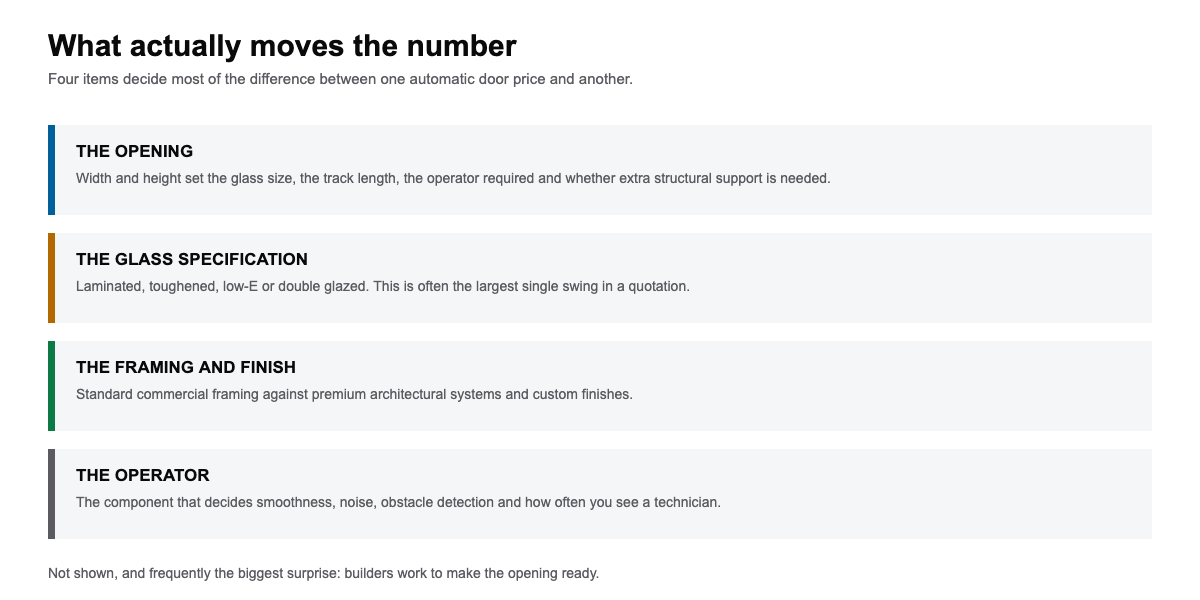
1. The size of the opening
The wider and taller the entrance, the larger the glass panels and the more capable the operator has to be. Larger entrances generally need bigger laminated safety glass, longer tracks, stronger drive motors and additional structural support. Each of those adds cost, and they compound: a wider opening does not simply cost proportionally more, because past a point it changes the configuration entirely from a single sliding leaf to a bi-parting or telescopic arrangement.
2. The glass specification
This is frequently the largest single swing in automatic door prices, and it is the item most often specified late. Common options include 6.38 mm laminated safety glass, 8.38 mm laminated safety glass, toughened safety glass, low-E energy efficient glass and double glazing. Moving from a standard laminated pane to double glazed low-E on a large entrance changes the number materially.
3. The aluminium framing and finish
Finish affects price as well as appearance. Popular options include natural anodised, black, charcoal, white and bronze. Premium architectural systems and custom finishes typically cost more than standard commercial framing, and on a facade where the entrance has to match existing glazing the finish is usually decided for you.
4. The operator
The operator is the most important component in the system and the one most worth protecting in a budget. A quality operator gives smooth, quiet opening and closing, reliable obstacle detection, adjustable speeds, a long service life and lower maintenance cost. Saving money here is the classic false economy in automatic door prices — the saving appears once, on the invoice, and the cost reappears every time a technician attends. Full published figures for our own operators are in the MC-125 brochure and the MCW-100 brochure.
The cost nobody quotes: builders work
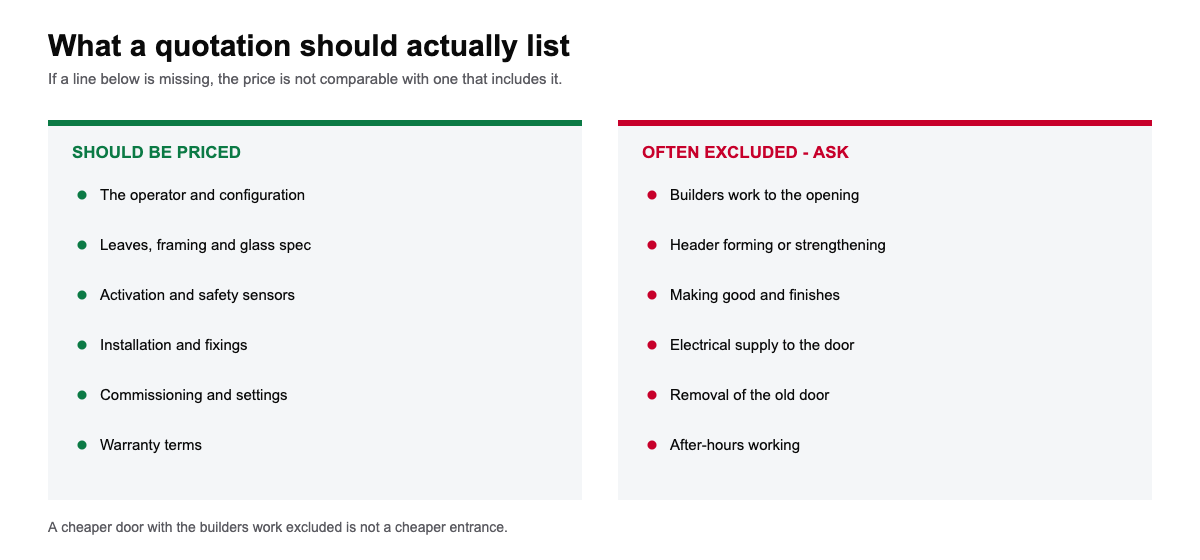
When three quotations for the same doorway arrive hundreds of percent apart, builders work is usually the explanation. Where an existing header is sound, level and fixed to something structural, installation is straightforward. Where the header has to be formed, strengthened or replaced, that work can approach the cost of the door itself — and it is the line most often left out of the cheapest price.
This is why comparing automatic door prices on the headline figure alone is unreliable. Ask each supplier the same question: is making the opening ready included, or excluded?
When an upgrade beats a replacement
The lowest figure in the table is the operator upgrade, and it is the option most buildings overlook. Where the leaves, track and header are sound and only the drive has reached the end of its life, replacing the operator and sensors while keeping the rest is considerably cheaper than a new entrance. Our automatic door modernisation page sets out what can usually be retained and what cannot.
The signal that an upgrade is due is rarely dramatic. It is a slow rise in small failures: the same entrance on the callout log every few weeks, parts replaced that were replaced eighteen months ago, settings drifting faster after each adjustment. Seen one at a time each repair looks cheap; seen across three years the building has often spent more than an upgrade would have cost.
Why buildings invest in automatic entrances
Automatic doors offer more than convenience, and the case is usually easier to make once the running costs are included rather than the purchase price alone.
- Accessibility. Easy access for wheelchair users, elderly visitors, parents with prams and customers carrying goods — without anyone having to ask for help.
- Energy and comfort. A door that closes reliably behind every person keeps conditioned air in the building. On a busy entrance that shows up on the HVAC running cost rather than on the door invoice.
- Hygiene. Hands-free entry matters in healthcare, food and clean environments, which is why touch-free activation is standard on those openings.
- Throughput. A wide entrance that clears quickly stops queues forming at the door in retail peaks.
- Appearance. The entrance is the first thing anybody touches. It sets expectations for the building behind it.
Getting an accurate automatic door price
The fastest way to turn an estimate into a real number is to send the opening. Measure the structural opening as built rather than taking it from a drawing, note the clear opening you actually need, say what the header is built of, and add photographs — one from a few metres back, one of the header, and one along the wall showing the space beside the doorway. Three pictures usually shorten a quotation more than three paragraphs of description.
Automatic entrances in South African buildings are designed against the SANS 10400 series supporting the National Building Regulations; copies are published by the South African Bureau of Standards. We will tell you which requirements apply to your opening, and we do not publish a certification claim we cannot evidence.
You can send those details through our quotation page, and if you are pricing more than one entrance say so at the outset — an estate is priced differently to a single door.
Automatic door prices by building type
The published table is arranged by door type, but in practice automatic door prices are driven as much by the building as by the doorway. The same nominal opening in two different buildings is genuinely two different jobs.
Retail and shopping centres
These carry the highest cycle counts of any sector, which pushes automatic door prices upward in two ways. The operator has to be specified for sustained duty rather than occasional use, and the work almost always happens outside trading hours, which carries its own cost. The offset is that a retail entrance failing during trading costs the tenant far more per hour than the door did, so under-specifying here is the most expensive saving available.
Healthcare
Clinical openings add requirements that general commercial entrances do not have: hands-free activation so nobody has to touch the door, and in controlled rooms a hermetically sealing door that closes against its frame rather than to a running clearance. Those requirements sit outside the standard sliding-door bands, which is why hermetic entrances are quoted per room rather than from a table. Our hermetic door brochure explains what is specified and what we do not publish.
Offices and reception
Usually the most straightforward, and often the closest to the published starting points. The variables that move automatic door prices here are access control integration, whether the entrance sits on an escape route, and the finish specification where the door has to match an existing facade.
Industrial and logistics
Wider openings, heavier traffic and a harsher environment. Wide openings frequently need a bi-parting or telescopic arrangement rather than a single leaf, and where wall space is short a telescopic door is the only way to achieve the clear opening — see the telescopic sliding door brochure for how that works.
What automatic door prices do not tell you
The purchase price is the visible number, and it is the smaller half of what an entrance costs a building over its life. Three running costs sit behind it.
Maintenance. Wear on an automatic door tracks cycles, not the calendar. A shopping centre entrance completing several thousand cycles a day and an office side door managing a few dozen are years apart in real wear after twelve months, and they need different service intervals. A maintenance arrangement priced against measured traffic almost always costs less over three years than reactive callouts, which is the case our service level agreement page sets out in detail.
Downtime. This never appears on the quotation and is usually carried by somebody other than whoever holds the maintenance budget. An entrance out of service costs a retail tenant in lost footfall, a hospital in disrupted movement, an office in complaints. Doing that arithmetic once for your own building tends to reframe the comparison: the gap between two automatic door prices is frequently smaller than the cost of a single day with the main entrance out of use.
Energy. A door that closes reliably behind every person keeps conditioned air inside. On a busy entrance that shows up on the HVAC running cost rather than the door invoice, which is precisely why it goes unnoticed.
How to budget for an entrance properly
If you are putting a number into a budget before you have a quotation, build it in four parts rather than taking a single figure from a table.
- The door itself. Start from the published band that matches the configuration you expect. This is the part automatic door prices tables actually cover.
- Making the opening ready. The great unknown. On a new build designed for the door it is minimal; on a retrofit into a facade that never carried one it can rival the door.
- Electrical supply. A dedicated supply terminated where the operator will sit, pulled before the head is closed up rather than chased in afterwards.
- Maintenance from year one. Not an afterthought. Budgeting it at the outset is what stops an entrance sliding into reactive callouts.
Treating those as four lines rather than one is the single most useful thing a facilities team can do with automatic door prices at budget stage, because it makes the uncertain item visible instead of hiding it inside a single figure.
Why we do not publish a full price list
We publish starting points and we are explicit that they are estimates. We do not publish a complete price list, and it is worth saying why rather than leaving it looking evasive.
A full list would have to assume a header condition, a floor level, a glass specification, a finish and a traffic profile. Change any one of those and the number moves. A published figure that appears precise and then does not survive the site visit is worse for a building than an honest range, because it has already been written into a budget by the time it changes. Where we can give real automatic door prices from documentation, we do — the operator specifications in our brochures are published in full for exactly that reason.
The same principle governs everything else on this site. Where we hold a figure in writing we publish it; where we do not, we say so rather than estimating. Automatic door prices are the area where that discipline matters most, because it is the number people plan around.
Comparing quotations without getting caught
When you have three numbers in front of you, four checks separate a real comparison from a false one. Is the clear opening the same in all three, or has one supplier quietly narrowed it so a standard leaf fits? Are the safety devices equivalent, or is one quotation cheaper because it has less presence detection? Is builders work included or excluded in each? And is commissioning priced, or is the door being installed and left on factory settings?
That last one is worth pressing on. Speeds, hold-open time and sensor coverage are set on site against how the entrance is actually used, and an installation rushed at that stage produces a door that technically works and irritates everybody who walks through it. It is invisible in a comparison of automatic door prices and extremely visible once the building is open.
Automatic door prices: a checklist before you compare
Run every quotation through this. It is the fastest way to tell whether two automatic door prices are describing the same entrance.
- Same clear opening? The most common hidden difference in automatic door prices, because narrowing the opening lets a cheaper configuration fit.
- Same glass specification? Laminated against toughened, low-E or double glazed. Often the largest single swing.
- Same framing and finish? Standard commercial framing and a premium architectural system are not comparable line items.
- Builders work in or out? Ask explicitly. This is where most of the apparent gap between automatic door prices actually lives.
- Commissioning priced? A door left on factory settings will generate callouts within weeks.
- Safety devices equivalent? Less presence detection makes a quotation cheaper and the entrance worse.
- Electrical supply included? A dedicated supply terminated at the operator, not chased in afterwards.
- Warranty on what? The operator, the installation, or both.
- Maintenance from year one? Automatic door prices look very different once three years of servicing is included.
If a supplier will not answer those in writing, that tells you something useful before you have spent anything. Reliable automatic door prices come from a specification both parties can see, not from a number quoted over the phone.
Getting a real number for your entrance
The starting points on this page exist so you can budget. They are not a quotation and they are not meant to be treated as one. To turn published automatic door prices into a figure you can commit to, we need the opening measured as built, the clear opening you require, what the header is built of, the traffic the entrance will carry, and photographs.
Send that through the quotation page and we will come back with a configuration and a price against your actual opening — and we will tell you plainly which parts of the number are firm and which depend on what is found when the opening is exposed.
Automatic door prices: frequently asked
How much does an automatic door cost in South Africa?
Published starting points run from R18,000 for an operator upgrade and from R35,000 for a single automatic sliding door, excluding VAT. These are estimates only — the final automatic door price depends on the opening, the glass, the framing and site conditions.
Why do quotations for the same door differ so much?
Usually because they describe different jobs. Builders work to make the opening ready is the most common exclusion, followed by commissioning and the extent of the safety sensors. Check those three before comparing on price.
What is the cheapest way to get an automatic entrance?
If a door already exists and only the drive has failed, an operator upgrade from R18,000 is normally the cheapest route, because the leaves, track and header are retained.
Do these automatic door prices include VAT?
No. The published figures exclude VAT.
Do you charge for a site visit to quote?
Sometimes, depending on what the visit involves, and we tell you before we attend rather than afterwards. We do not price revolving or hermetic entrances without seeing them.
Can you give me an automatic door price over the phone?
We would rather not. A figure given without the opening is a guess, and it anchors expectations unhelpfully. Send dimensions and photographs and you will get a real number instead.
In short
Automatic door prices at a glance
- Automatic door prices are quoted against the opening we measured, not a catalogue price.
- Ask about automatic door prices and we confirm the opening, the head and the power position first.
- Automatic door prices are installed and commissioned by our own technicians.
- Automatic door prices carry a 24-month warranty on the operator.
- Spares for automatic door prices are held in Johannesburg, so a repair does not wait on an import.
- Send the opening size and a photograph and a quotation for automatic door prices usually follows within two working days.
- Service intervals for automatic door prices are set against cycle count rather than the calendar.
- Commissioning of automatic door prices ends with the speed, hold-open and force settings written down.
- We also service and repair automatic door prices supplied by other companies.

Related Posts