
Automatic door compliance and downloads
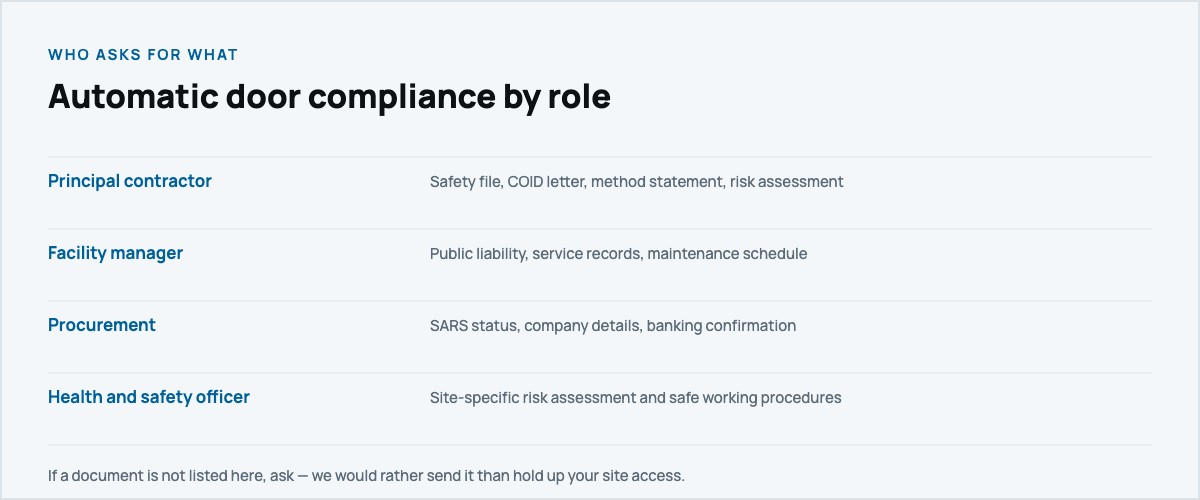
Automatic door compliance is what gets our technicians through the gate and your entrance signed off. This page holds the automatic door compliance documents principal contractors, facility managers and procurement teams ask us for, plus downloadable templates you can use on your own projects.
We work to the applicable South African labour and occupational health and safety requirements, and we issue automatic door compliance documentation per project rather than once a year, so what you receive matches the site you are working on. Standards for automatic pedestrian doors in South Africa are published through SABS.
Safety & Compliance
Compliant. Insured. Site-Ready.
Safety, compliance and accountability built into every commercial entrance project.
MC Automations operates with a strong commitment to workplace safety, regulatory compliance and responsible project execution. Our operations are conducted in accordance with applicable South African labour and occupational health and safety requirements, supported by the documentation and controls expected on professional commercial sites.
We maintain COID compliance, Public Liability Insurance and SARS compliance, helping clients, principal contractors and facility managers appoint a contractor that meets key commercial and statutory requirements.
For site-based installations and projects, comprehensive safety files are maintained and available as required, supporting contractor onboarding, site access and project-specific health and safety requirements.
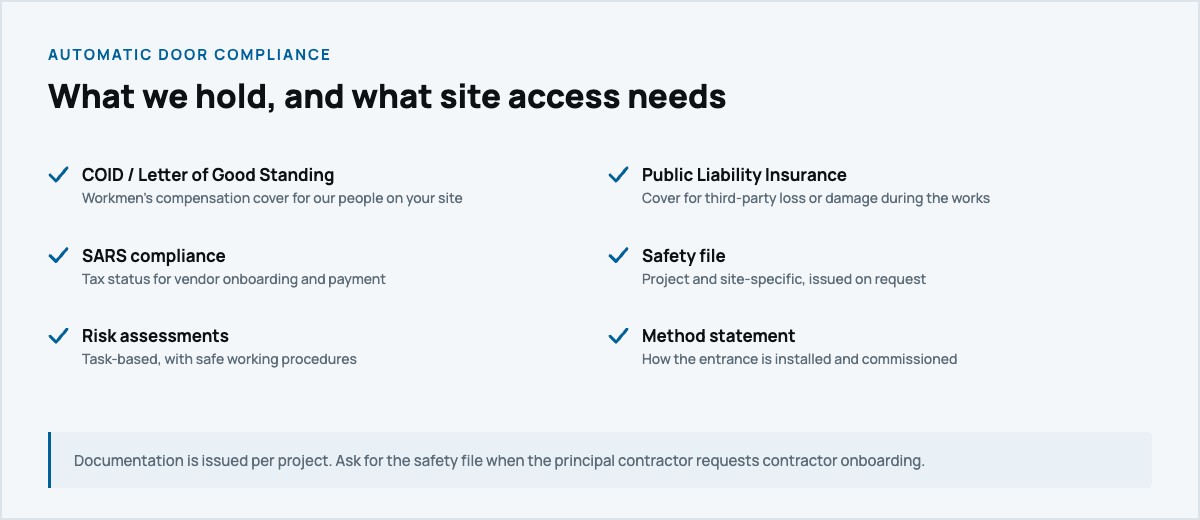
Our compliance framework includes
- South African labour and workplace requirements
- COID compliance and Letter of Good Standing
- Public Liability Insurance
- SARS compliance
- Comprehensive safety documentation
- Project and site-specific safety files
- Risk assessments and safe working procedures as applicable
From documentation to installation, safety and compliance form part of how we deliver every commercial entrance project.
Automatic door compliance resources
MC Automations provides automatic door compliance resources for South African projects. Use these downloadable templates to standardise inspections, reduce snags and support handover documentation for automatic sliding, swing, telescopic, revolving and hermetically sealing entrances, including the MC-125 automatic sliding door. For aluminium windows, doors, shopfront glazing and curtain walling, those are supplied by our sister company Coetz Glazing.
Service areas: Nationwide across all nine provinces, from our base at Laser Park, Johannesburg.
Downloads
- Pre-installation checklist (structural opening as built, header condition and load path, finished floor level, power supply)
- Installation checklist (header fixings and load path, track alignment, power supply readiness, sensor positions, commissioning settings)
- Safety device checklist (activation and presence detection coverage, hold-open time, manual opening force, escape-route behaviour)
- QA / snag list template for automatic entrances (alignment, travel, noise, sensor coverage, finish)
- Handover pack template (as-built configuration, settings left on site, care and maintenance, warranty, supplier details)
- Equipment submittal register (operator model, configuration, sensors, controls, spares held)
- MC-125 automatic sliding door installation checklist (fixing, alignment, power supply readiness, safety sensors, signage, functional testing)
- MC-125 automatic sliding door service record template (routine inspections, adjustments, parts replaced, call-outs, sign-off)
- MC-125 automatic sliding door handover checklist (user training, emergency release, manuals, warranty details, compliance evidence)
Download the MC Automations Compliance Pack
Download the MC Automations pack to standardise site inspections, reduce snags and support handover documentation on automatic doors (including the MC-125 automatic sliding door) in South Africa. All templates are branded with the MC Automations logo. We supply, install and service automatic doors nationwide across all nine provinces, from our base at Laser Park, Johannesburg.
Automatic door compliance FAQ
MC-125 automatic sliding doors, site readiness and handover
What is the MC-125 automatic sliding door used for?
The MC-125 automatic sliding door is suited to high-traffic entrances such as retail, offices, medical facilities and estates, where smooth access control and reliable day-to-day operation are required.
What should be ready before installing an MC-125 automatic sliding door?
Confirm the opening is square and level, fixing points are sound, the correct door configuration is on site, and the power supply and cable routing are ready. If the door is part of an aluminium shopfront, confirm glazing, thresholds and sealing details match the drawings.
What safety checks should be recorded for the MC-125?
Record sensor activation tests, safe opening/closing behaviour, signage, emergency/manual release operation (if applicable), and final commissioning settings. Keep dated sign-off for handover and future audits.
Do I need a service log for the MC-125 automatic sliding door?
Yes - most sites and facilities expect a documented service history for safety, warranty and maintenance planning. Capture inspection dates, checks performed, adjustments, call-outs and any parts replaced.
What should be included at handover for an MC-125 installation?
Include operating instructions, warranty details, commissioning/setting notes (where applicable), completed installation and safety checklists, and signed handover documentation. Keeping this evidence helps with facilities management and future troubleshooting.
What causes the most call-outs on automatic sliding doors like the MC-125?
Common causes include misalignment, dust/debris in the track area, power interruptions, sensor obstructions and impact damage. Regular checks and a consistent service record help reduce downtime.
Do you cover glass, aluminium or shopfront glazing?
Not directly — MC Automations supplies, installs and services automatic doors. Aluminium windows and doors, shopfront glazing and curtain walling are handled by our sister company, Coetz Glazing, and glazing compliance questions are best directed there.
Downloadable automatic door compliance templates
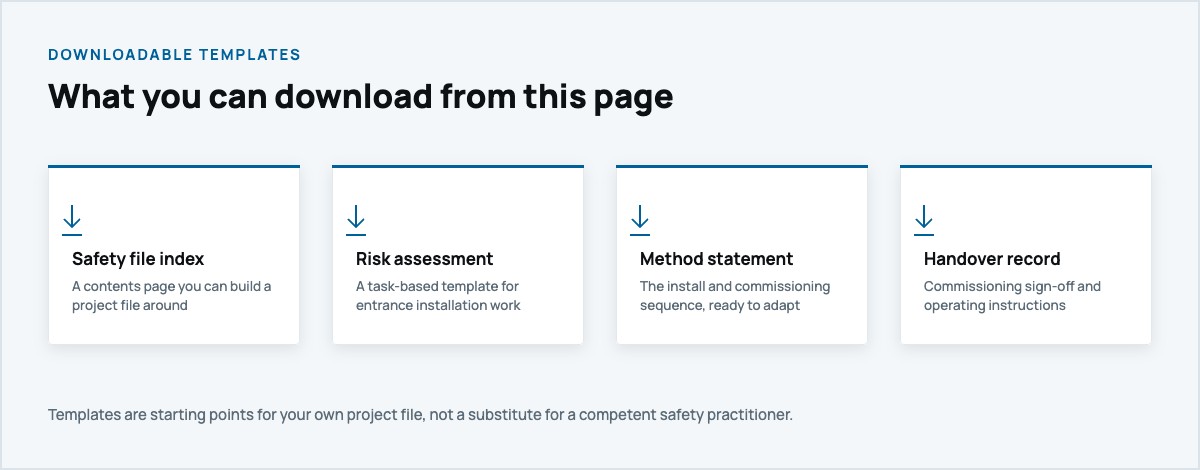
The templates on this page exist because the same four documents are requested on almost every commercial entrance project. They are written around automatic door installation work specifically, rather than generic construction, so the hazards and controls already reflect glass handling, overhead operator mounting, live electrical connection and working in a trading environment.
Use them as a starting point for your own automatic door compliance file. They are not a substitute for a competent health and safety practitioner, and where your principal contractor issues its own format, we will complete theirs instead — just send it with the order.
If you need the project-specific pack rather than the templates — our COID letter of good standing, public liability schedule, SARS status and a site-specific safety file — ask us and we will issue it against your project reference.
Why buildings ask for a compliance pack
Before a contractor is allowed on site, the building has to satisfy itself that bringing that contractor in does not transfer risk onto the occupier. That is the whole purpose of an automatic door compliance pack. It is not paperwork for its own sake — each document answers a specific question the facilities manager, the landlord or the principal contractor is obliged to ask.
The questions are consistent across South African sites: is this contractor registered and in good standing for workplace injury cover, are they insured if they damage something or injure somebody, are their tax affairs in order, and have they thought through how the work will be done safely in this particular building. A complete pack answers all four before anybody has to chase it.
What each document in the pack is for
- Letter of Good Standing (COID). Confirms registration with the Compensation Fund and that contributions are current. It is what protects the building from liability if a contractor’s employee is injured on site. Most sites will not issue a permit to work without a valid one, and it expires — an out-of-date letter is treated as no letter.
- Public liability insurance. Covers damage to property or injury to third parties arising from the work. Buildings usually specify a minimum cover level, and on larger sites they will ask to be noted as an interested party.
- Tax clearance / SARS status. Confirms the contractor is tax compliant. This is a procurement requirement far more often than a safety one, and it is the item that most frequently delays vendor onboarding.
- Company registration and banking details. Verifies the entity you are contracting with is the entity being paid. Requesting these through a formal onboarding process rather than by email is now standard practice, and sensibly so.
- Safety file. The site-specific document set: risk assessment, method statement, appointments, competency records and emergency arrangements for the actual work being carried out.
The safety file is the one that is usually wrong
Insurance and tax documents are either current or they are not. The safety file is where automatic door compliance most often breaks down, because a generic file is not a safety file. A risk assessment that does not mention working at height above a public entrance, or a method statement that does not address how pedestrians are kept away from a partially dismantled doorway, is not describing the job that is about to happen.
Automatic door work has a specific risk profile. The work happens above head height, usually in a doorway the public is still trying to use, frequently involving glass leaves weighing over a hundred kilograms, and often on a live electrical supply. A file that addresses those things is short and useful. A file that runs to eighty generic pages and mentions none of them is worse than useless, because it creates the impression that the risks have been considered when they have not.
Who asks for what, and when
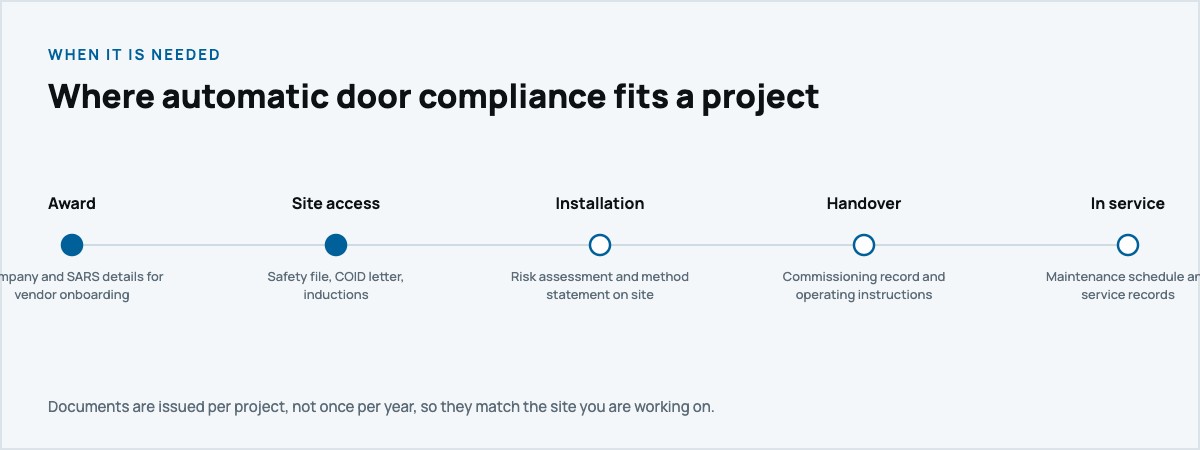
The sequence matters, because requesting everything at once slows a job that could have started. In practice, procurement wants company registration, tax status and banking details at vendor onboarding, before any work is discussed. Facilities or the principal contractor wants the letter of good standing and public liability cover before a permit is issued. The safety file is site-specific and produced against the actual scope, which means it cannot sensibly be issued before the scope is agreed.
On a multi-site estate this is worth systematising once. Vendor onboarding documents can be lodged centrally and refreshed on expiry, leaving only the safety file to be produced per job. Buildings that do this get contractors on site in days rather than weeks.
Expiry, and the most common delay
Almost every automatic door compliance document has an expiry date, and the single most common cause of a delayed start is a document that was valid when it was filed and is not valid now. Letters of good standing and tax clearance certificates both lapse. Insurance renews annually. If a building holds a contractor’s pack from eight months ago, roughly half of it may already be out of date.
The practical answer is to ask for current copies at the point of instruction rather than relying on what is on file. It takes one email and removes the most predictable reason for a job not starting on the day it was booked.
What we will and will not claim
We will provide current compliance documentation on request, and the templates on this page are free to download and use for contractor onboarding generally — they are not specific to us.
What we will not do is publish a certification or testing claim we cannot evidence. If a project requires proof of compliance against a particular standard, tell us at enquiry stage and we will either obtain it in writing or tell you plainly that we cannot. Automatic entrances in South African buildings are designed against the SANS 10400 series supporting the National Building Regulations; copies are published by the South African Bureau of Standards. We will tell you which requirements apply to your opening, and we will not assert an approval we do not hold.
Automatic door compliance: frequently asked
What is a letter of good standing?
Confirmation from the Compensation Fund that a contractor is registered for workplace injury cover and that contributions are current. It protects the building if a contractor’s employee is injured on site, and most sites will not issue a permit to work without a valid one.
Is a generic safety file acceptable?
Rarely, and it should not be. A safety file has to describe the actual work: working above a live public entrance, handling heavy glass leaves, and isolating an electrical supply. A file that does not mention those is not describing an automatic door job.
How long does automatic door compliance onboarding take?
That depends almost entirely on whether documents are current. Where everything is in date it is usually a formality; where a letter of good standing or tax clearance has lapsed, it becomes the critical path.
Can we use your templates for other contractors?
Yes. The downloadable templates on this page are general contractor onboarding documents, not MC-specific, and you are welcome to use them across your supply chain.
Do you carry public liability insurance?
Yes, and we will provide current confirmation on request along with the rest of the pack. We would rather send documentation than make a claim about it on a web page.
Who should we send compliance queries to?
Send them with your enquiry and we will route them. If you are onboarding us as a vendor, say which portal or process you use, because most delays come from documents going to the wrong place rather than not existing.
Automatic door compliance on a live building
Almost all of our work happens in buildings that stay open. That changes what compliance means in practice, because the people at risk are not only the technicians — they are the shoppers, patients, staff and visitors who keep walking toward a doorway that is temporarily not a doorway.
A permit to work on an entrance should therefore address segregation before it addresses anything else: how the public is physically prevented from entering the work area, what the alternative route is, and who is responsible for maintaining that barrier while the work is under way. A cone and a sign is not segregation on a mall concourse at midday. Where an entrance cannot be adequately segregated during trading, the correct answer is to do the work outside trading hours, and a contractor who does not raise that is not thinking about it.
The second live-building issue is the escape route. Many automatic entrances form part of a means of escape, and taking one out of service changes the building’s evacuation capacity for the duration. That is a conversation to have with whoever is responsible for fire safety before the job is booked, not a discovery to be made on the morning.
Records after the work, not just before it
Automatic door compliance is usually discussed as something that happens before a contractor arrives. The half that gets neglected is what the building holds afterwards. A completed job should leave behind a record of what was done, which parts were replaced, what settings the door was left on, and confirmation that the safety devices were tested and function correctly.
That record matters for two reasons. It is what lets the next visit — possibly by a different technician, possibly years later — start from knowledge rather than from guesswork. And it is the evidence that the entrance was being maintained properly, which is precisely the thing nobody can reconstruct after an incident. Ask for it as part of the scope rather than as a favour afterwards.
A note on sub-contracting
Where a contractor sub-contracts part of the work, the compliance chain has to extend to the sub-contractor too. A principal contractor holding a perfect pack for a company that then sends somebody else’s technicians to site has not achieved anything. It is a fair question to ask directly: will the people attending be your employees, and if not, whose documentation are we holding for them?
We would rather answer that question at enquiry stage than have a building discover the answer at the gate. Automatic door compliance only works if it describes who actually turns up.
Automatic door compliance: a checklist before you instruct
Run through this before booking work. Every item is an automatic door compliance question a well-run building asks, and every one of them is quicker to settle now than on the morning of the job.
- Is the letter of good standing current? Automatic door compliance fails here more than anywhere else, because the document lapses quietly.
- Is public liability cover in force, at the level your site requires? Ask for the certificate rather than an assurance.
- Is tax status current? Usually a procurement gate rather than a safety one, but it stops jobs just as effectively.
- Does the safety file describe this job? Working above a live public entrance, handling heavy glass, isolating a supply. Generic files do not meet automatic door compliance requirements in any meaningful sense.
- Who is actually attending? If any part is sub-contracted, the automatic door compliance chain has to cover them too.
- Is the entrance on an escape route? Taking it out of service changes the building’s evacuation capacity for the duration.
- How will the public be kept clear? Segregation is the first automatic door compliance question on a trading site, not the last.
- What record will you hold afterwards? Automatic door compliance is not finished when the contractor arrives; it is finished when the building holds evidence of what was done and that the safety devices were tested.
Our automatic door compliance pack is available on request and the templates above are free to use across your supply chain. Where a project needs evidence against a specific standard, ask at enquiry stage and we will obtain it in writing or tell you plainly that we cannot.
Automatic door compliance: a checklist before you instruct
Run through this before booking work. Every item is an automatic door compliance question a well-run building asks, and every one is quicker to settle now than on the morning of the job.
- Is the letter of good standing current? Automatic door compliance fails here more than anywhere else, because the document lapses quietly.
- Is public liability cover in force at the level your site requires? Ask for the certificate rather than an assurance.
- Is tax status current? Usually a procurement gate rather than a safety one, but it stops jobs just as effectively.
- Does the safety file describe this job? Working above a live public entrance, handling heavy glass, isolating a supply. Generic files do not meet automatic door compliance requirements in any meaningful sense.
- Who is actually attending? If any part is sub-contracted, the automatic door compliance chain has to cover them too.
- Is the entrance on an escape route? Taking it out of service changes the building’s evacuation capacity for the duration.
- How will the public be kept clear? Segregation is the first automatic door compliance question on a trading site, not the last.
- What record will you hold afterwards? Automatic door compliance is not finished when the contractor arrives; it is finished when the building holds evidence of what was done and that the safety devices were tested.
Our automatic door compliance pack is available on request, and the templates above are free to use across your supply chain. Where a project needs evidence against a specific standard, ask at enquiry stage and we will obtain it in writing or tell you plainly that we cannot.