
Automatic door careers at MC Automations are site-based roles installing, servicing and repairing automatic entrances across South Africa. We supply, install, commission and service the doors ourselves, so the people doing that work are our own — not sub-contracted. Most technicians arrive without automatic door experience and are trained on our equipment.
Careers
Empowering People
We are all about people, and we believe in doing the right thing and doing it well. At MC Automations, our people are the most important. They come from all walks of life and bring with them a multitude of talents and perspectives. We aim for diverse representation throughout the company, and we stay committed to equal pay, safe working conditions, gender balance and an inclusive work environment
Current job opportunities:
Technical Sales Representative – Entrance Equipment
Location: Gauteng
- Salary: R11,500 per Month
- Commission 8% on target
- Provident fund
DUTIES AND RESPONSIBILITIES
- Quarterly contribution towards the board report
- Establish new accounts by planning & organising daily work schedule to call on existing or potential clients
- To liaise with other departments internally regarding managing product supply, sales support and technical aspects, with a view of customer delight
- To identify and secure new customers within the region
- Keeps management informed by submitting activity and results reports, such as daily call reports, weekly work plans, and monthly and annual territory analysis.
- Develop/implement a growth strategy focusing on specific market segments
- Sell and achieve annual target
- Source, negotiate and sign new business
- Deal with clients professionally at all times
- Provide feedback to Sales Manager on weekly basis
- Liaise with Sales Manager where necessary
- Promote /sell / secure orders existing & prospective customers via a relationship-based approach
- Market products/ services to existing / potential customers & assist them in selecting those best suited to their needs
- Develop clear and effective written proposals / quotations for current and prospective customers
- Expedite the resolution of customer problems and complaints
- Identify advantages and compare organisation products/services
- Supply management with oral and written reports on customer needs, problems, interests, competitive activities, and potential for new products and services
- Keep abreast of product applications, technical services, market conditions, competitive activities, advertising and promotional trends through the reading of pertinent literature and consulting with marketing and technical service areas.
- Cold calling
- Quoting
- Weekly call report
KNOWLEDGE/SKILLS/EXPERIENCE
- A Minimum of a Matric
- A Minimum of 3 years sales experience
- Proven track record and ability in building and maintaining strong customer relationships(Reference checks will be done)
- Good communication skills
- Knowledge of construction industry preferred
- Own reliable vehicle
- Drivers licence
Submit your CV
Automatic door careers: what the job actually is
Most people applying for automatic door careers have not worked on an automatic entrance before, and that is fine — almost nobody arrives knowing the MC-125 or the MCW-100, because we train on our own equipment. What matters is whether the work suits you, and it is worth being clear about what it involves before you apply.
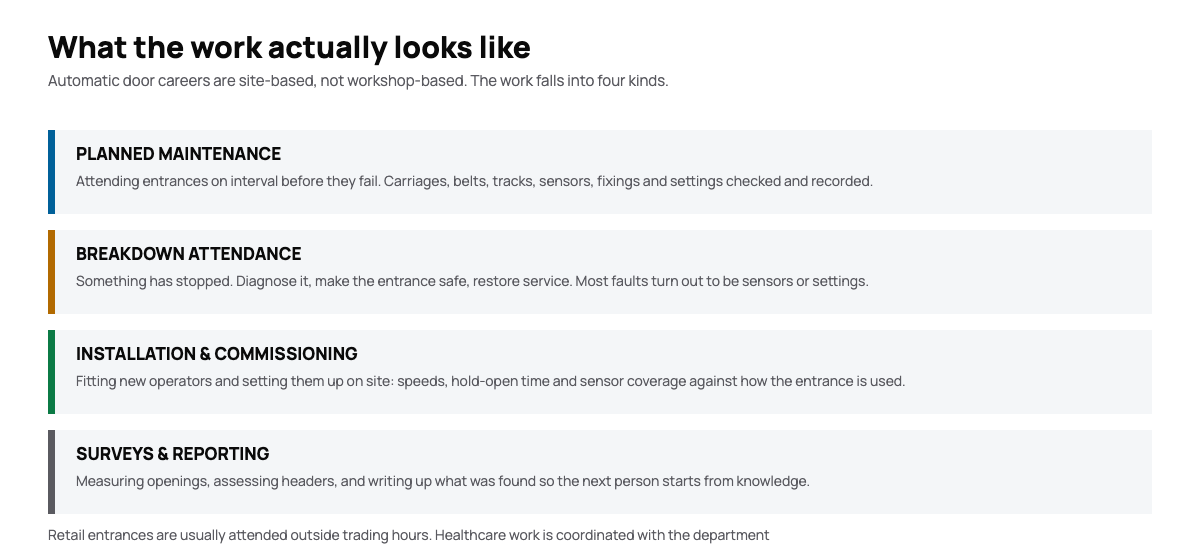
This is site work. You travel, you work in buildings that stay open while you are in them, and you spend a lot of the day above head height in a doorway that the public is still trying to use. It is not a workshop job and it is not a desk job.
Seven things we look for
Formal qualifications matter less in automatic door careers than most people expect. These are the attributes that actually predict whether somebody will do well.
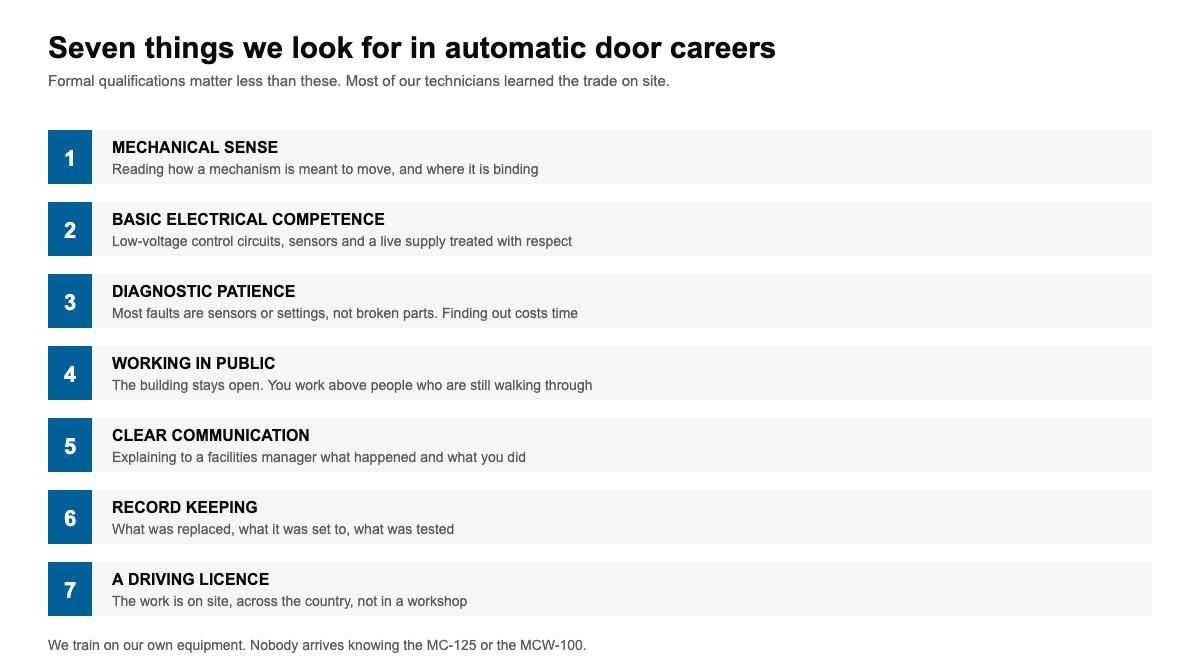
The one worth expanding on is diagnostic patience. A large share of the faults we attend are not broken parts at all — they are sensors that have drifted out of alignment, settings that were knocked, or a supply voltage sagging at the bottom of its range and producing intermittent behaviour that looks exactly like an operator fault. Finding that out takes time and a methodical head. People who want to replace something immediately tend to struggle; people who want to know why tend to do well.
Working in a building that cannot close
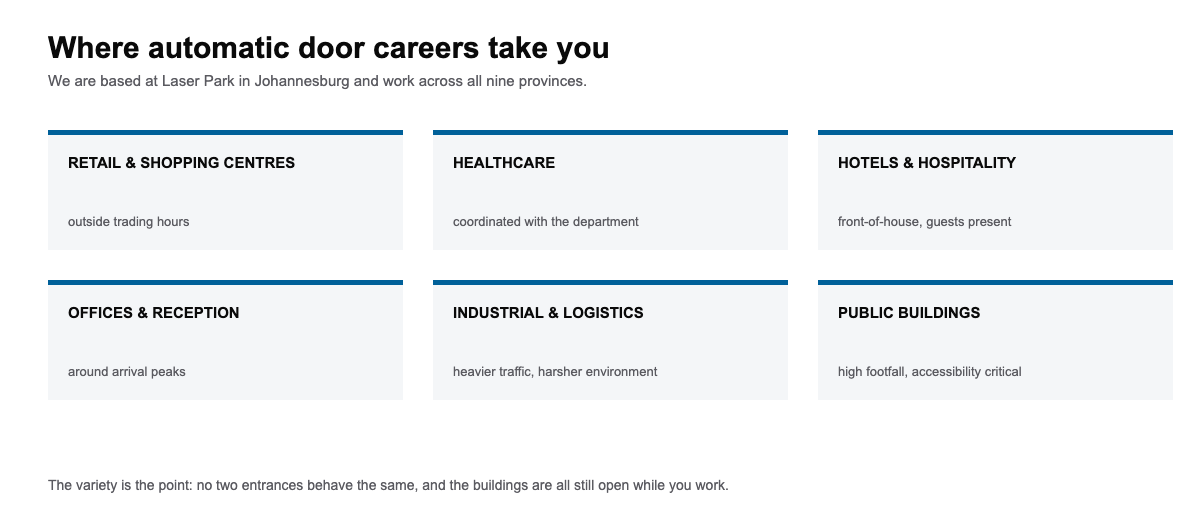
This is the part that separates automatic door careers from most other trades. An entrance cannot simply be shut while you work on it. On a retail site that usually means working outside trading hours. In healthcare it means coordinating with the department rather than the facilities office, because closing a door can affect clinical movement in ways a maintenance schedule does not capture.
It also means the public is a constant consideration. Segregating the work area properly, keeping a route open, and being able to explain to somebody why they cannot walk through this doorway right now are all part of the job. Technicians who are good with people, not just with mechanisms, are disproportionately valuable.
Training and progression
We train on our own equipment because we supply, install and service it. New technicians work alongside experienced ones before attending alone, and the progression is generally from assisting on planned maintenance, to attending routine service alone, to breakdown work, to installation and commissioning. Commissioning comes last deliberately — setting an entrance up correctly for how it is actually used is a judgement skill, and it is learned by seeing a lot of entrances.
Because we service and repair automatic doors from other manufacturers alongside our own, the exposure is broader than working for a single-brand operation. That is genuinely useful experience to hold.
How to apply
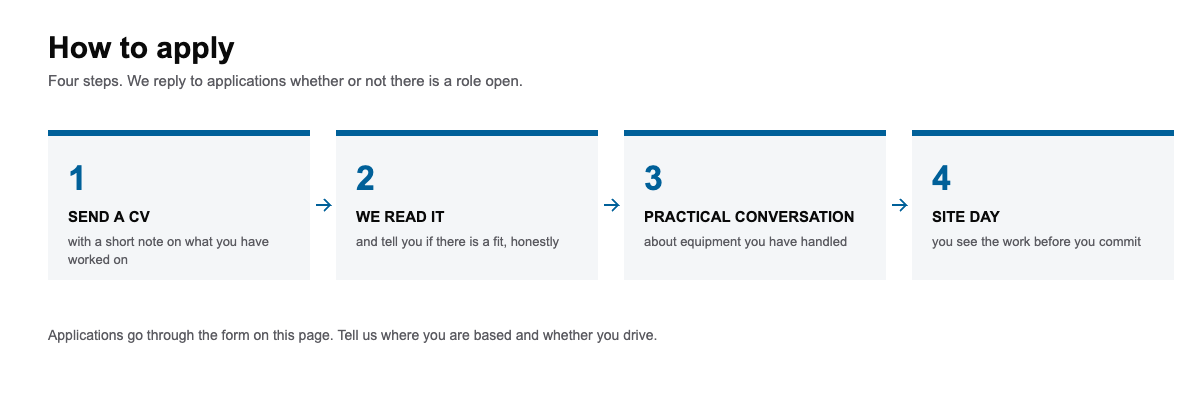
Send a CV through the form on this page with a short note about what you have actually worked on — not a job description, but the equipment you have handled and the kind of faults you have chased. Tell us where you are based and whether you drive, because the work is on site across the country.
If there is no suitable role open we will say so rather than leaving you waiting. Automatic door careers here tend to open with little notice, and we keep applications on file.
Automatic door careers: frequently asked
Do I need experience with automatic doors?
No. Almost nobody arrives knowing our equipment, and we train on it. What helps is mechanical sense, basic electrical competence and the patience to diagnose rather than replace.
Do I need a formal qualification?
It is not a barrier. Most of our technicians learned the trade on site. Demonstrable competence matters more than a certificate.
Do I need a driving licence?
Effectively yes. The work is site-based across the country, not workshop-based.
Is the work only in Johannesburg?
We are based at Laser Park in Johannesburg and work nationwide, so travel is part of the role.
What are the hours?
Variable, because entrances are frequently attended outside trading hours. Retail work in particular tends to happen when the shop is closed.
Do you keep applications on file?
Yes. Roles open with little notice, so it is worth applying even when nothing is advertised.
The equipment you would be working on
It helps to know what the work is actually against. The two operators we supply and assemble locally are the MC-125 sliding door operator and the MCW-100 swing door operator, and their full specifications are published so you can see the sort of numbers a technician works to. Beyond those we install and service revolving entrances, telescopic sliding doors and hermetically sealing doors for clinical and controlled rooms.
Because we also service and repair automatic doors from other manufacturers, anyone in automatic door careers here sees a far wider range of equipment than a single-brand operation would offer. That breadth is the part most technicians say they value.
Safety, compliance and why it is not paperwork
Automatic door careers involve working above head height, in public, on live electrical supplies, around glass leaves that can weigh over a hundred kilograms. The compliance side of that is not administrative box-ticking — it is the reason everybody goes home. Our automatic door compliance page sets out the documentation buildings require before a contractor comes on site, and you would work within that on every job.
Entrances in South African buildings are designed against the SANS 10400 series supporting the National Building Regulations, published by the South African Bureau of Standards. You do not need to know that on day one, but you will learn which requirements apply to the openings you work on.
What we will not promise you
We would rather be straight than sell the role. Automatic door careers here involve travel, and hours that move around the buildings we serve rather than a fixed nine-to-five. Retail work frequently happens when the shop is shut. Breakdown attendance is unpredictable by definition. If you want a fixed workshop routine, this is the wrong job and we would rather you knew that before applying than after.
What we do offer is training on the equipment, a broad range of work rather than one repetitive task, and a company where the people doing the installing and servicing are employees rather than a rotating sub-contractor pool. Our maintenance agreements and repair work give a sense of the volume and type of jobs involved.
Is this the right move for you?
People come into automatic door careers from a few recognisable directions, and each brings something different.
- From general maintenance work. You already understand buildings and how to behave in an occupied one. Automatic door careers will stretch the electrical and diagnostic side, which is where the training focuses.
- From an electrical trade. The control side will feel familiar. The mechanical judgement — reading how a leaf is running, feeling where it binds — takes longer.
- From gate or garage door automation. The closest adjacent trade. The difference is that pedestrian entrances carry public safety obligations gates do not, so sensing and force are treated far more seriously.
- From no trade at all. This happens more than people expect. Automatic door careers reward method and attitude more than any specific prior qualification.
The first six months
Nobody attends alone at the start. New technicians work alongside experienced ones, initially on planned maintenance, because that is where you see the largest number of entrances in the shortest time. Seeing many doors is how pattern recognition builds — after enough visits you start hearing a carriage that is about to need attention rather than reading it off a checklist.
Breakdown attendance comes next, and it is where automatic door careers become genuinely interesting. A door that has stopped is a diagnostic problem with a building waiting on the answer, and the discipline is to work through it methodically under pressure to simply replace something. Installation and commissioning come last, because setting an entrance up correctly for how it is actually used is judgement rather than procedure.
What people find hardest
Two things, consistently. The first is working in front of an audience. In a workshop nobody watches you; in automatic door careers you are in a doorway with the public walking past, sometimes impatient. Being able to keep working calmly and explain politely why the entrance is closed is a real skill.
The second is resisting the urge to replace parts. It is always faster to swap a component than to find out why a door is behaving badly, and it is almost always wrong. The technicians who progress fastest in automatic door careers are the ones who slow down at exactly the moment everybody wants them to hurry.
Honest answers to what we get asked most
People considering automatic door careers usually want to know three things job adverts never answer. How much travel is there really? Enough that you need a licence and should expect to be away from base most days; we work nationwide from Johannesburg. Are the hours unsociable? Sometimes, particularly retail, because entrances are attended when buildings are closed. Is it physical? Moderately — working at height, handling components, occasionally manoeuvring heavy leaves, but not heavy labour.
What keeps people in automatic door careers, on their own account, is that the work varies. No two entrances behave identically and the problems are genuinely problems rather than repetitions. If that appeals more than predictability, this is likely a good fit.
Applying without a current vacancy
Roles open with little notice, so applications sent when nothing is advertised are genuinely worth sending. We keep them on file and reply either way. If you are early in considering automatic door careers and want to understand the work before applying, say so — we would rather have a short honest conversation than process an application from somebody who has not seen what the job involves.
Automatic door careers: a checklist before you apply
Run through this honestly. Automatic door careers suit a particular kind of person, and it is better to establish that now than three months in.
- Do you drive, and will you travel? Automatic door careers here are nationwide from Johannesburg. This one is close to non-negotiable.
- Are you comfortable working at height? Most of the work happens above head height in a doorway.
- Can you work with the public watching? The building stays open. This is the part that surprises people about automatic door careers.
- Do you prefer finding out why to swapping parts? The single best predictor of success in automatic door careers.
- Can you write up what you did? Records are part of the job, not an afterthought.
- Are variable hours workable? Retail entrances are attended when shops are shut.
- Do you want variety over routine? If routine appeals more, automatic door careers will frustrate you.
If most of those are yes, send a CV through the form on this page. Tell us what equipment you have actually handled, where you are based, and whether you drive. Automatic door careers here are learned on the job, so we are reading for aptitude rather than for a list of certificates.
Why we employ rather than sub-contract
A lot of automatic door work in South Africa is delivered by sub-contracted labour, and that shapes what automatic door careers look like at most companies: short engagements, no training investment, and no real progression because nobody expects you to still be there next year.
We supply, install, commission and service the equipment ourselves, and the people doing that are employees. That is a commercial decision as much as a cultural one — a building on a maintenance agreement is entitled to expect the same technicians to know its entrances, and that only happens if those technicians stay. It also means training is worth doing properly, because the benefit comes back to us.
For someone weighing up automatic door careers, the practical difference is continuity. You learn a set of buildings, you see the consequences of your own work over years rather than weeks, and the diagnostic instinct that takes time to build actually gets the time.
What good looks like after a few years
An experienced technician in automatic door careers can walk into a lobby, watch an entrance cycle twice, and tell you roughly what is wrong before opening anything. That is not intuition — it is having seen several thousand doors and learned what a slightly late close, a faint knock at one end of travel or an inconsistent hold-open actually indicate.
The same person can also tell a facilities manager the truth when the honest answer is unwelcome: that an entrance is at the end of its economic life, that a recurring fault is a header problem rather than an operator problem, or that the door is fine and the real issue is a floor that has moved. Being trusted to say that is the part of automatic door careers people tend not to anticipate and end up valuing most.
A note on safety culture
We would rather a job took longer than have somebody work around a risk because the building was impatient. Entrances are worked on in public, above head height, on live supplies, around heavy glass. Everyone in automatic door careers here has the standing to stop a job that cannot be done safely, and nobody is expected to justify that afterwards.
That includes pushing back on a building. If an entrance cannot be adequately segregated from the public during trading, the correct answer is to attend outside trading hours, and saying so is part of the role rather than an inconvenience to be managed around.
Send us something specific
The applications that stand out are not the polished ones — they are the specific ones. Tell us about a fault you chased and how you worked it out. Tell us what equipment you have had your hands on. If you have never worked on automatic doors, tell us what you have worked on instead and why automatic door careers appeal now. A short honest note beats a long generic CV every time.